300 mm Flat-to-Flat Format
The main tile has approximately 0.07794 m² of ceramic face. Its larger six-sided pattern uses the same 9 mm section as the two smaller formats.
Unglazed Large Hexagon Porcelain Floor Tiles
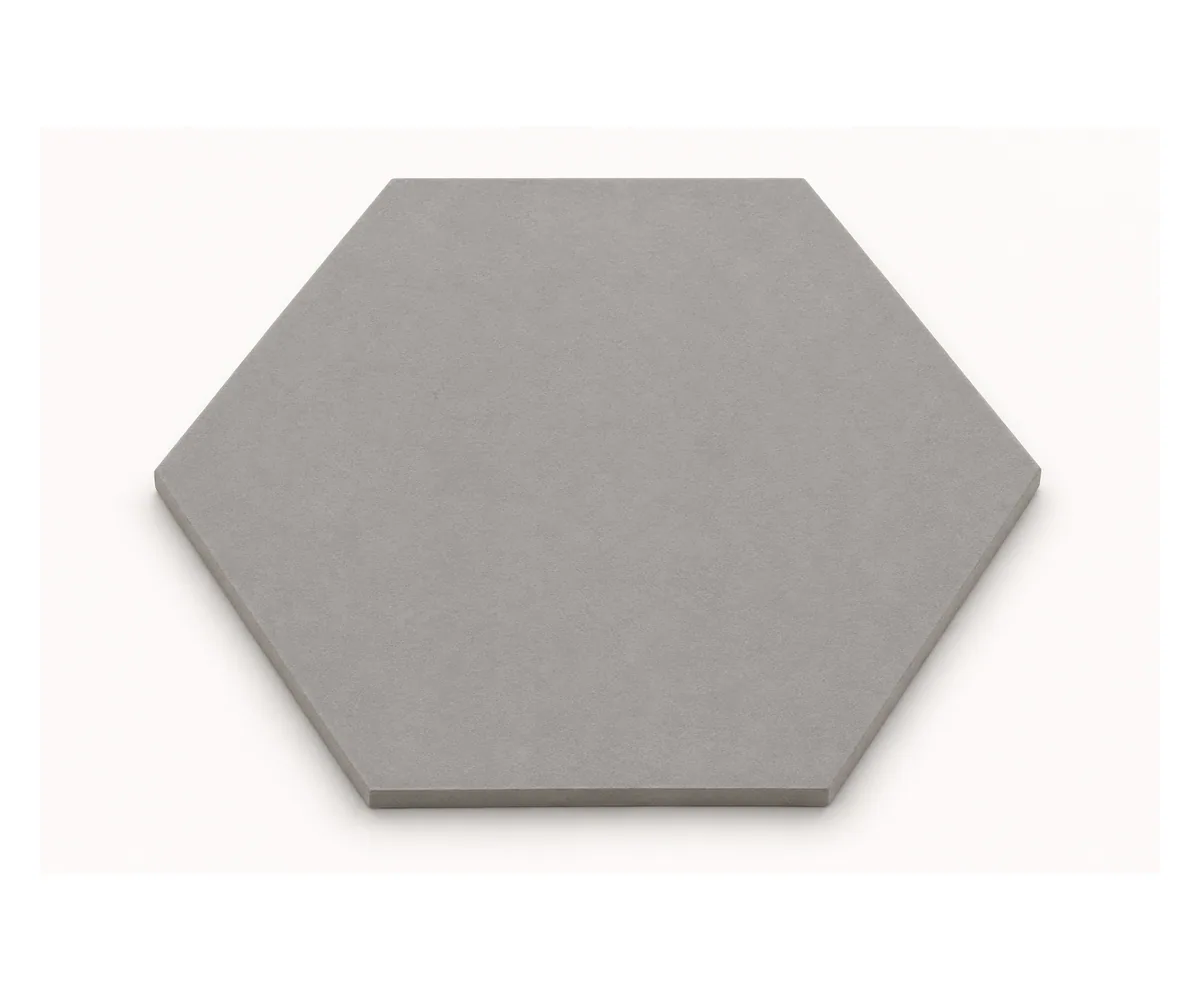
The tile uses an unglazed through-body porcelain requirement at 9 mm nominal thickness. A neutral gray, fine-textured matte face continues to the exposed ceramic edge.
The main regular hexagon measures 300 mm between opposite parallel faces. Its corner-to-corner span is approximately 346.4 mm, and each side is approximately 173.2 mm long.
Each hexagon is supplied as an individual tile. The layout sets the chosen tile orientation, clear joints, cut borders and transitions as a complete floor finish.
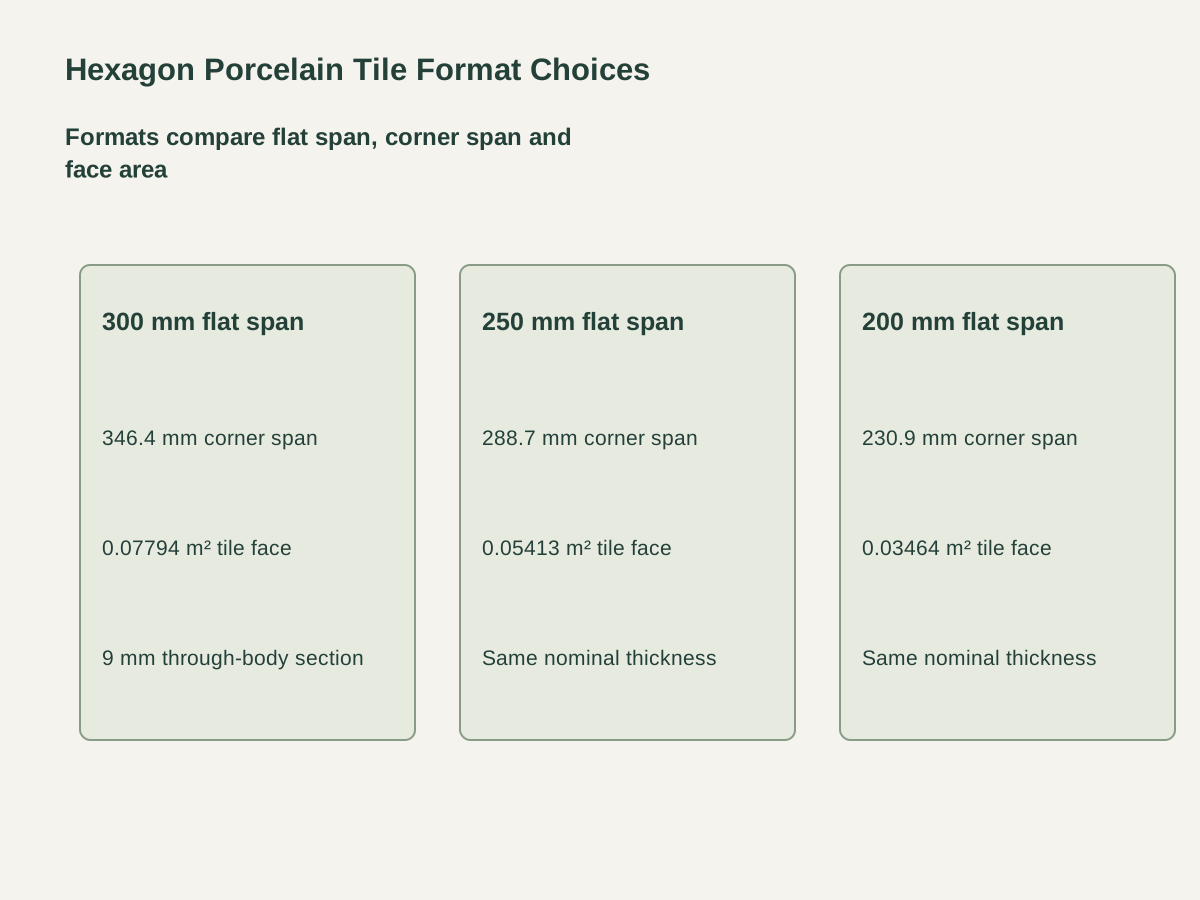
The main tile has approximately 0.07794 m² of ceramic face. Its larger six-sided pattern uses the same 9 mm section as the two smaller formats.
The middle tile has approximately 0.05413 m² of face and a 288.7 mm corner span. It retains equal sides and the same unglazed material reference.
The smaller tile has approximately 0.03464 m² of face and a 230.9 mm corner span. Its finer floor pattern receives a separate row and border takeoff.
| Tile body and face | Unglazed through-body porcelain; gray fine-textured matte face |
|---|---|
| Flat-to-flat tile format | 300 mm flat-to-flat ·346.4 mm corner span ·9 mm thick |
| Nominal thickness | 9 mm |
| Main corner-to-corner span | Approximately 346.4 mm on 300 mm flat-to-flat tile |
| Main equal-side length | Approximately 173.2 mm |
| Approximate tile-face areas | 300 format:0.07794 m²; 250:0.05413 m²; 200:0.03464 m² |
| Joint-layout requirement | 3 mm clear joints; installed coverage follows the room grid |
| Supply unit | One loose regular-hexagon tile; floor-setting components itemized on their own |
 Open product drawing ↗
Use the flat-to-flat dimension to identify the selected format. The room drawing also shows hexagon orientation, center lines, doorway cuts and perimeter borders.
The floor-layout requirement uses 3 mm clear joints between tiles. Tile-face area remains separate from installed coverage, which also depends on joint geometry, cut rows and room boundaries.
The floor detail carries substrate preparation, setting bed, movement joints and transitions together. Required surface documentation and accepted face/edge samples follow the intended room use.
List 200, 250 or 300 mm flat-to-flat tiles by room. The takeoff separates net floor area, cut tiles, borders and retained spare pieces.
Quote the 9 mm unglazed through-body porcelain, fine-textured gray face and regular six-sided geometry, with variation and edge quality recorded on the sample.
Schedule the setting system, 3 mm clear-joint layout, movement details and transitions against the actual floor assembly. Installation materials and special cut pieces have their own quantities.
Protect tile faces and hexagon corners during packing. Format/room labels, piece counts, spare allocations and destination remain with each delivery reference.
The 200, 250 and 300 mm values are measured between opposite parallel faces. The 300 mm tile spans approximately 346.4 mm between opposite corners.
Each of the six equal sides is approximately 173.2 mm long on the 300 mm flat-to-flat format. The regular-hexagon face geometry is shown on the technical drawing.
The approximate ceramic-face areas are 0.03464 m² for 200 mm, 0.05413 m² for 250 mm and 0.07794 m² for 300 mm formats. These values describe the tile face.
The layout uses 3 mm clear joints. Installed coverage is taken from the room grid, including joint geometry, cut borders, transitions and the actual room outline.
The requirement is 9 mm unglazed through-body porcelain with a neutral gray, fine-textured matte face. The order retains the accepted surface and exposed-edge reference.
Count the chosen format from the floor layout, then add cuts, borders and spare pieces as separate quantities. Setting materials, movement details, grout and transitions follow the coordinated floor assembly.
 Chevron Wood-Look Porcelain Floor Tiles
 600 × 1200 mm Matte Terrazzo-Look Floor Tiles
 800 × 800 mm Polished Porcelain Floor Tiles
 Unglazed Red Quarry Floor Tile