On this page
Contract furniture is worth paying for when the specific product’s evidence and service terms meet a use that the residential alternative has not been shown to support. The value may be a documented public-use configuration, an executable cleaning routine or a repair arrangement the operator needs. The word “contract” alone does not establish any of those benefits. For ordinary private household use, a suitable residential product can remain the better choice.
Compare the same type of furniture and the same task. This article uses indoor side chairs, not a comparison between a domestic dining chair and an unrelated office task chair. It gives an evidence-fit matrix and two completed decisions: one for a public shared room and one for a private family dining room. Neither is a test of actual branded products.
Define the use before deciding what is worth buying
A chair used by changing visitors throughout the day faces a different operating brief from a chair used by one household. Describe users, setting, expected handling, cleaning, floor surface and service needs. Avoid labels such as “heavy duty” unless the supplier translates them into a relevant product and evidence scope.
For seating, identify whether the task includes repeated rearrangement, stacking, long sitting periods or use by people requiring a particular accommodation. Do not assume that one test declaration covers every user or every application. A task chair, a side chair and a lounge chair should not be treated as the same product category simply because all provide a seat.
Set the requirements that matter to the actual room, including any local project or regulatory requirements. Contract furniture is not a single universal certification and does not replace that work. Indoor public-use evidence also does not establish outdoor suitability, which needs its own exposure review.
Read the product evidence, not the sales channel
Real retail product pages can distinguish uses. IKEA Iceland’s page for YNGVAR chair 804.176.36 identifies public environments and public-use testing. Its PINNTORP chair 005.904.80 page identifies home-use testing and indoor use. These are two specific manufacturer declarations. They do not show which chair lasts longer, establish a global warranty or prove that one construction is stronger in every situation.
The useful lesson is that a residential retail channel can contain a product with stated public-use evidence, while a home-use declaration does not automatically answer a public-room brief. Conversely, a commercial sales presentation may still omit the actual configuration covered by its evidence.
If a supplier cites a program, read what the program actually does. BIFMA’s January 2025 Compliant program agreement describes a registry of self-declared conforming products and states that BIFMA does not test or certify those products. That program should not be renamed a blanket “contract furniture certificate.” Check the identified product and applicable evidence rather than treating a logo as approval of an entire catalog.
Request a traceable connection between the offered model and its evidence. The record should identify the tested or assessed configuration, relevant method and version, report source, limitations and any covered variants. A report for a different base, seat or attachment needs a valid applicability explanation. A generic company test photograph is insufficient.
Use an evidence-fit matrix for the same chair task
The following comparison is a purchasing method.
| Requirement | Contract-marketed offer | Residential-marketed offer |
|---|---|---|
| Intended use | Confirm the exact public/commercial setting and any limits; the label is insufficient. | Confirm whether the stated domestic use matches the task, or obtain evidence for any proposed wider use. |
| Product configuration | Match model, base, seat, joints and offered variants to the evidence. | Apply the same identity check. Retail availability is neither a pass nor a failure. |
| Strength / stability evidence | Review applicable reports and limitations for the actual seating category; do not assume extra strength. | Review the evidence relevant to its declared use. Do not stretch a home-use declaration into public-use approval. |
| Cleaning / handling | Confirm the exact finish’s routine, permitted movement/stacking and inspection instructions. | Check the same tasks against its care sheet; change the routine or product if incompatible. |
| Maintenance / spares | Confirm available feet, fasteners or service parts, fitting responsibility and commercial conditions. | Confirm actual replacement/service options. Do not presume they are absent or equivalent. |
| Warranty / service | Check purchaser, use, territory, exclusions and parts/labor/transport scope. | Check the same conditions, including any domestic-use limitation; the purchase receipt alone does not settle coverage. |
| Purchase value | Pay for the required, evidenced benefits and executable service, with a defined complete offer. | Retain it when the actual use, evidence, care and service requirements are met without an unnecessary upgrade. |

A warranty needs a route to service
A stated warranty period is only one field. Identify who receives a claim, how the product is identified, what evidence is required and who handles service locally. Separate manufacturing-defect cover from wear, accidental damage, cleaning damage or an unsupported use. Read the actual terms rather than assuming identical exclusions across brands.
Herman Miller’s current service guidance, for example, directs buyers to the selling dealer or retailer to establish eligibility and requests identifying product information. MillerKnoll’s warranty page also says coverage varies by brand and product. Those are reasons to retain records and verify the applicable route, not a promise that every commercial chair carries the same service.
Discuss replacement components and transport before buying. An available foot pad can be useful, but the supplier must identify the right part and how it is fitted. A local repair contact can matter more to an operator than a vague promise of “lifetime support.” Do not turn a repair possibility into a guaranteed replacement time.
Shared-room use brings chair movement, floor care and maintenance into the buying decision. Appearance alone does not establish contract suitability.
C-49: the contract option earns its place in a shared room
All products, evidence-review outcomes, supplier replies and buyer decisions in the following cases are assumed. No actual laboratory report, registry listing, brand test or real hotel acceptance is being claimed.
A small hotel needs 24 indoor armless side chairs for a shared reading and informal-meeting room. Visitors change throughout the day; staff move chairs for floor cleaning. The brief requires an applicable public-use evidence package, an accepted care routine and a service route for the ordered configuration. Stacking is not required.
Offer C is marketed as contract furniture. Assume its dossier identifies model C49, the exact seat/base construction, relevant report and covered configuration. The buyer’s competent technical reviewer accepts the evidence for the stated use and its limitations. The supplier confirms the named finish’s compatibility with the operator’s proposed cleaning method, provides an inspection routine and identifies replacement feet. The seller also confirms the applicable commercial-use service terms, local claim contact and allocation of parts, labor and transport costs.
Offer R is marketed for residential use. Its assumed documents support private household use; the seller does not provide evidence or a service authorization for the hotel’s shared room. Offer X is also advertised as “contract,” but supplies only a corporate brochure and a logo without a traceable connection to the offered chair.
The buyer selects C for all 24 shared-room positions. R is not accepted for that task, and X is rejected as insufficiently documented. The selection pays for requirements C has actually satisfied in the assumed review. It does not prove that C is physically superior to every residential chair.
If C’s offered finish, base or supplier later changes, the buyer requires a renewed applicability decision before release. The completed choice is tied to the accepted configuration and service arrangement, not a permanent approval of the word “contract.”

R-49: a residential alternative is accepted for a household task
A separate private family dining room needs four indoor side chairs for household meals. It is not a hotel guest room, rental, staff room or public meeting space. This different task does not inherit the hotel’s public-use requirement.
Assume R’s declared home-use evidence matches the exact ordered chair and the household’s intended use. The family accepts its comfort and dimensions at the dining table, can follow its cleaning and assembly/inspection instructions, and accepts the seller’s domestic service terms. The seller confirms the applicable product and finish references and the claim route for that household purchase.
The household chooses four R chairs and declines the proposed contract upgrade because the extra commercial service arrangement is not a requirement of this task. This is a usable residential choice under stated conditions, not permission to transfer R into the hotel’s shared room. If the room becomes a paid venue or business space, reassess the actual use and terms.
When is the premium justified—and when is it not?
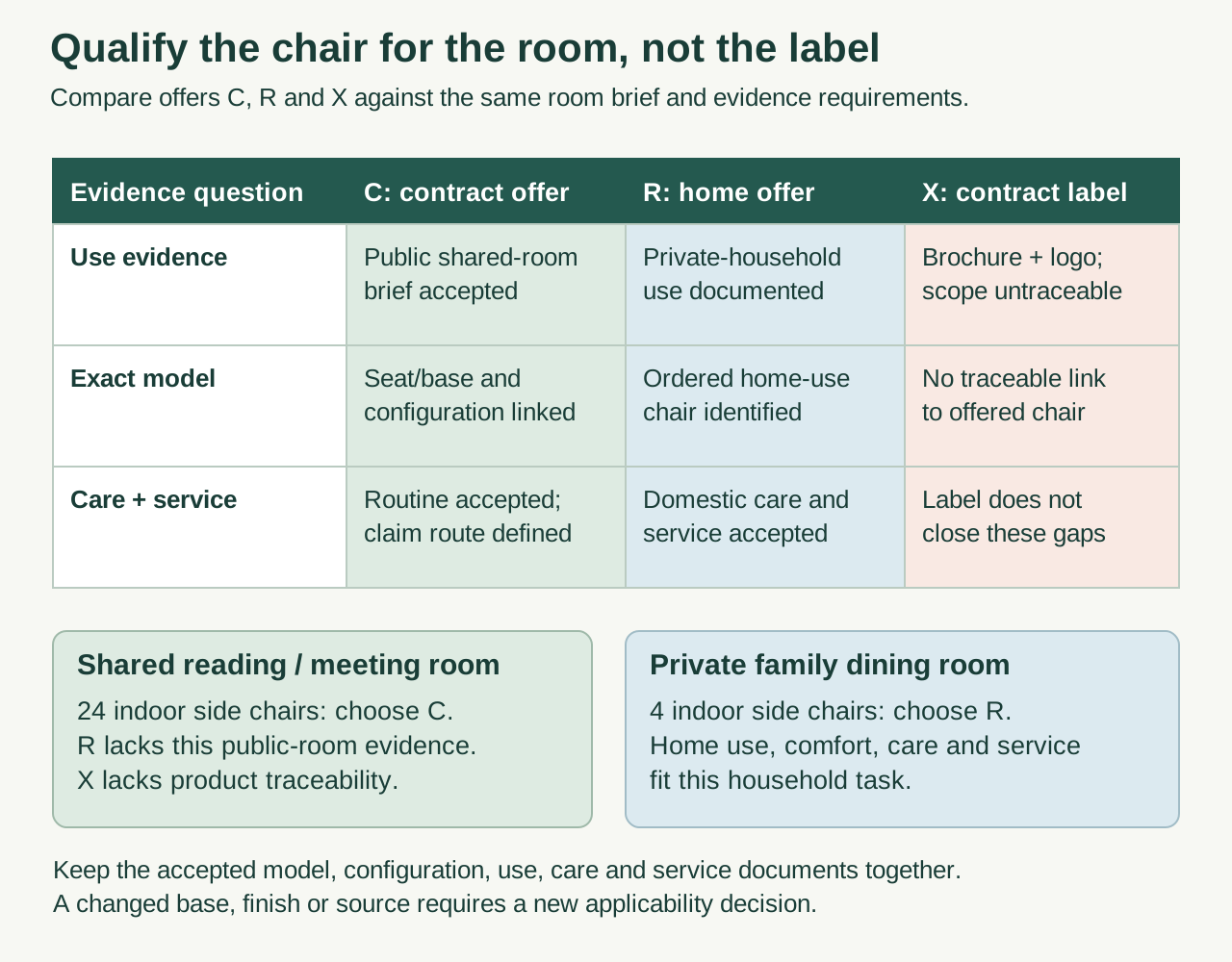
A contract premium can be justified when it buys required evidence, documented configuration control, acceptable maintenance or service the operator can use. Compare the whole offer, including required assembly, delivery and any selected spares. Do not assume a higher price automatically includes these items.
The premium is unproven when the only difference is the label or a generic brand statement. It may also be unnecessary when a residential offer meets a genuinely domestic task, or when a retail-channel product independently satisfies the actual public-use requirements. There is no useful universal percentage premium because the accepted scopes differ.
- Record each use as a separate task before applying an approval across rooms.
- Keep the exact model, configuration, evidence and accepted care/service documents attached to the order.
- Separate technically unconfirmed offers from qualified alternatives before comparing their prices.
Send NOVARMIA the room use, chair configuration, evidence requirements and maintenance/service needs to discuss comparable furniture offers. Ask for the product-specific basis behind each claim rather than a category-wide assurance.
FAQ
Does changing the upholstery leave the chair evidence unchanged?
Not automatically. Ask whether the new cover, filling and attachment are within the relevant evidence and service scope. Requirements specific to upholstery or the destination must be reviewed separately; a matching frame name is insufficient.
Can an approved chair be copied by another factory?
A similar appearance does not transfer the original product’s evidence or service responsibilities. Treat the new source and configuration as a new applicability review, including traceability of the offered construction.
Are secondhand contract chairs automatically suitable?
No. Verify identity, condition, modifications, intended use and available service records. Original evidence does not establish the current condition of a used chair, and the original warranty may have purchaser or channel conditions.
How should a product discontinued after approval be replaced?
Keep the required use and evidence criteria, then assess the proposed replacement against them. A successor name or similar finish is not automatic equivalence. Record the accepted new model and any changed care or service terms.