2000 mm Single Panel
The main package is one 2000 mm-wide panel at 2400 mm finished height. Width describes the laid-flat textile from side edge to side edge.
Mesh-Header Room-Divider Curtains
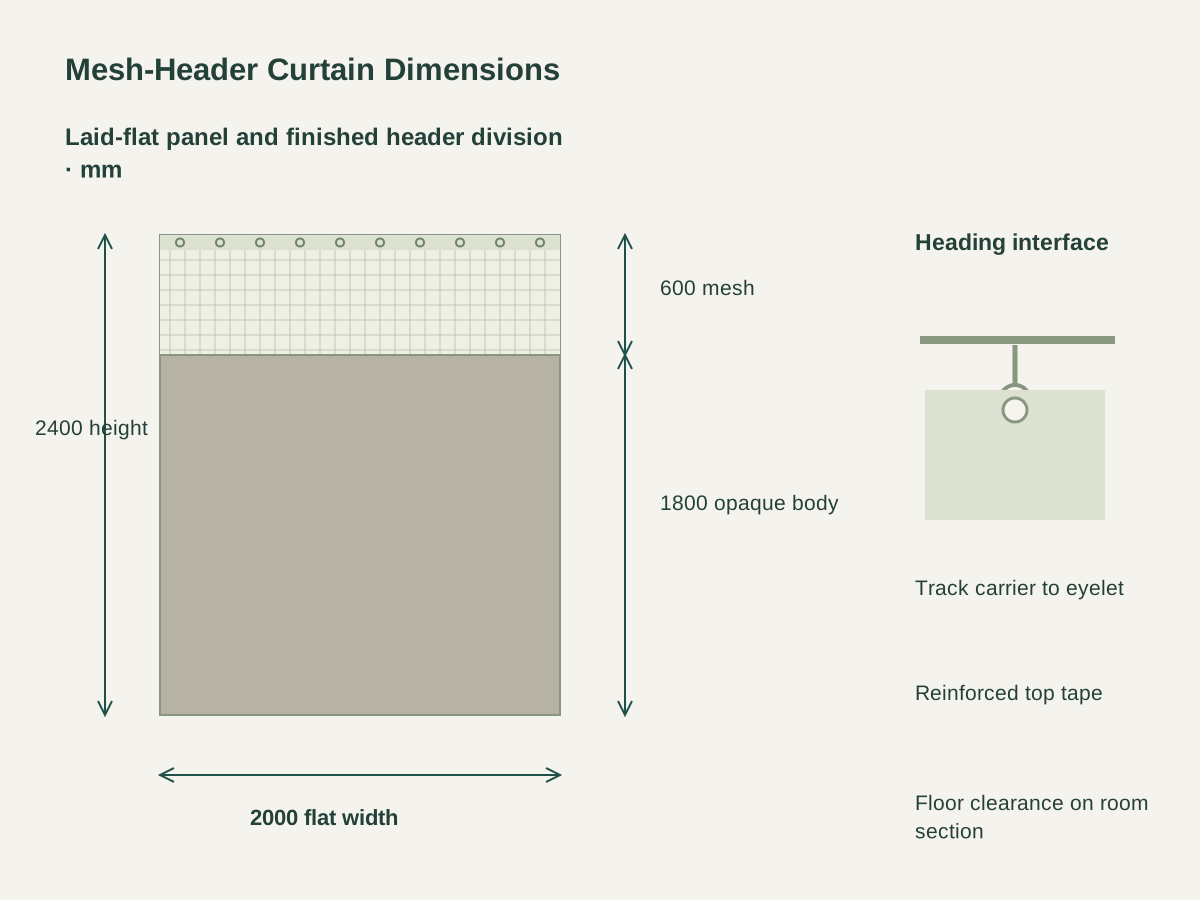
The upper 600 mm of the finished panel uses open polyester mesh, including the reinforced top heading. Its square openings keep the upper band visually open above the opaque curtain body.
A warm-gray woven polyester body extends 1800 mm below the header seam. The two textile sections form a 2400 mm finished panel height, with sewn side edges and lower hem.
Stainless eyelets are set into reinforced top tape. Compatible individual carriers connect the curtain to its track, with eyelet spacing, carrier count and end details retained on the hanging schedule.

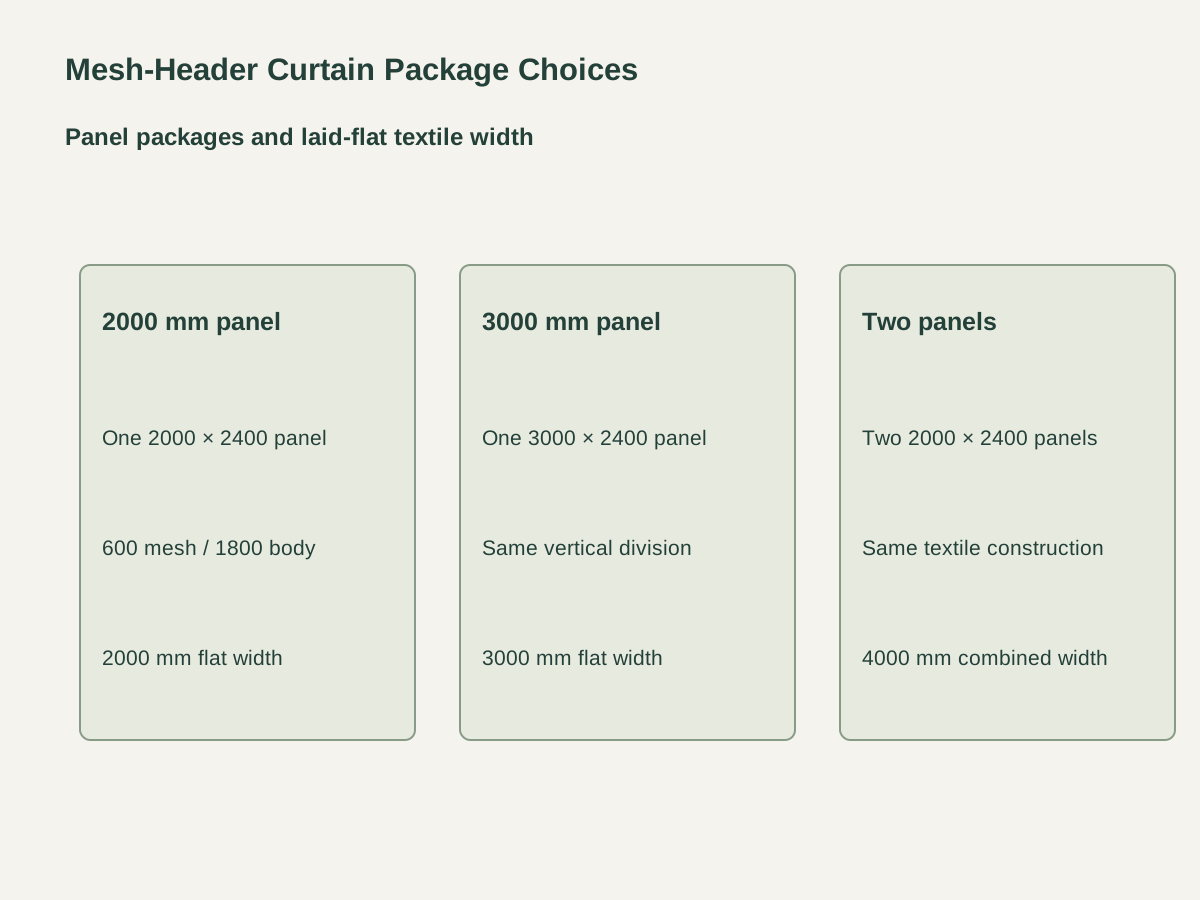
The main package is one 2000 mm-wide panel at 2400 mm finished height. Width describes the laid-flat textile from side edge to side edge.
The wider single panel increases the laid-flat width to 3000 mm while keeping the same 600 mm mesh header and 1800 mm lower body.
The paired package supplies two independently referenced 2000 × 2400 mm panels. Their 4000 mm combined flat width is allocated to the track route, overlaps and desired gathering.
| Textile construction | White polyester mesh header with opaque gray woven-polyester body |
|---|---|
| Curtain panel package | 1 × 2000 W × 2400 H mm panel · 2000 mm flat textile width |
| Header/body heights | 600 mm mesh heading + 1800 mm opaque body = 2400 mm |
| Heading connection | Reinforced top tape with stainless eyelets |
| Track interface | Individual compatible carriers; count/spacing matched to eyelets |
| Panel alternatives | 3000 mm single width or two 2000 mm-wide panels |
| Hanging layout | Rail elevation, carrier drop, floor clearance, gathering and overlaps on room drawing |
| Supply unit | Chosen curtain panel package with eyelets; track/carrier components itemized by route |
 Open product drawing ↗
The panel height runs from the finished heading top to the lower hem. Track/carrier drop and the chosen floor clearance establish the actual rail elevation on the room section.
Laid-flat textile width is distributed along the straight or turning track route. The curtain schedule shows gathering, closing overlaps, draw direction and the parked fabric position.
The hanging detail pairs eyelets with compatible carriers and end stops. Mounting supports, track joints and any removal/service position follow the room layout and installation plan.
Quote one 2000 mm panel, one 3000 mm panel or two 2000 mm panels. Keep room identifiers, divider routes and panel counts with the chosen package.
List the white polyester mesh, gray woven body, 600/1800 mm division and stitched hems. Fabric samples, top reinforcement and required textile documents stay with the complete panel.
Schedule the stainless eyelets and their spacing with compatible carriers. Track lengths, turns, joints, stops, supports and installation are identified on separate component lines.
Pack the curtains cleanly with room, panel and hanging references. The shipment schedule distinguishes initial panels, rotation/spare panels, hardware packs and destination.
The 2400 mm finished panel uses a 600 mm mesh header, including its reinforced heading, above an 1800 mm opaque body. A horizontal seam joins the two textile sections.
Choose one 2000 × 2400 mm panel, one 3000 × 2400 mm panel or two 2000 × 2400 mm panels. Width is measured with the textile laid flat.
Stainless eyelets in reinforced top tape connect to compatible individual track carriers. The hanging schedule pairs their spacing, quantities and end-stop details.
The room section combines the finished panel height with the carrier drop and chosen floor clearance. Those dimensions establish the actual track elevation.
The track layout distributes flat textile width into gathering, closing overlaps and the parked curtain position. The two-panel package provides 4000 mm combined flat width for that allocation.
Include the track route, panel packages, installed height, textile samples and room count. Add eyelet/carrier references, overlaps, mounting support, installation, spare panels, packing and destination.
 Custom Blackout Curtains for Sliding Glass Doors
 Motorized Split-Draw Curtain Track
 Custom Sheer Curtains for Sliding Glass Doors
 Recessed Manual Double Curtain Tracks