On this page
Choose drawer slides by combining mounting position, running mechanism, extension and the load conditions of the actual model. Side-mount and undermount describe where a runner sits; ball bearings and rollers describe how it moves. They are not three mutually exclusive types. Soft-close and push-to-open add another function choice. A useful specification identifies the complete combination, length and compatible drawer construction.
Start with the drawer’s task and available space, then select a documented runner assembly. The examples below use real product families to distinguish combinations and one wooden drawer to show a dimension, load and compatibility review. They do not establish a universal safe contents weight or interchangeability between brands.
Separate the selection into five independent questions
- Mounting: side-mounted runners sit beside the drawer; concealed undermount systems are arranged beneath it. Other specialist arrangements exist. A side-mount slide laid flat is not automatically an approved undermount system.
- Running mechanism: ball-bearing and roller systems describe bearing contact. Their detailed construction matters more than the generic word. A concealed runner can use rollers.
- Extension: partial extension leaves part of the drawer behind the cabinet front; full extension provides greater access; over-travel moves beyond the normal full-extension position. Use the model’s actual travel dimension.
- Load conditions: identify the rated pair or assembly, length, drawer width, mounting orientation and test/application conditions. Separate dynamic operation from a static resting load.
- Function and service: specify conventional closing, self-closing, damped closing or a compatible touch-opening system, plus disconnect and adjustment requirements.
A purchase description such as “full-extension soft-close slides” answers only part of that list. It does not state the drawer-side clearance, bottom construction, length, fixing method or approved opening mechanism. A name such as “roller” alone gives even less basis for selecting the finished assembly.
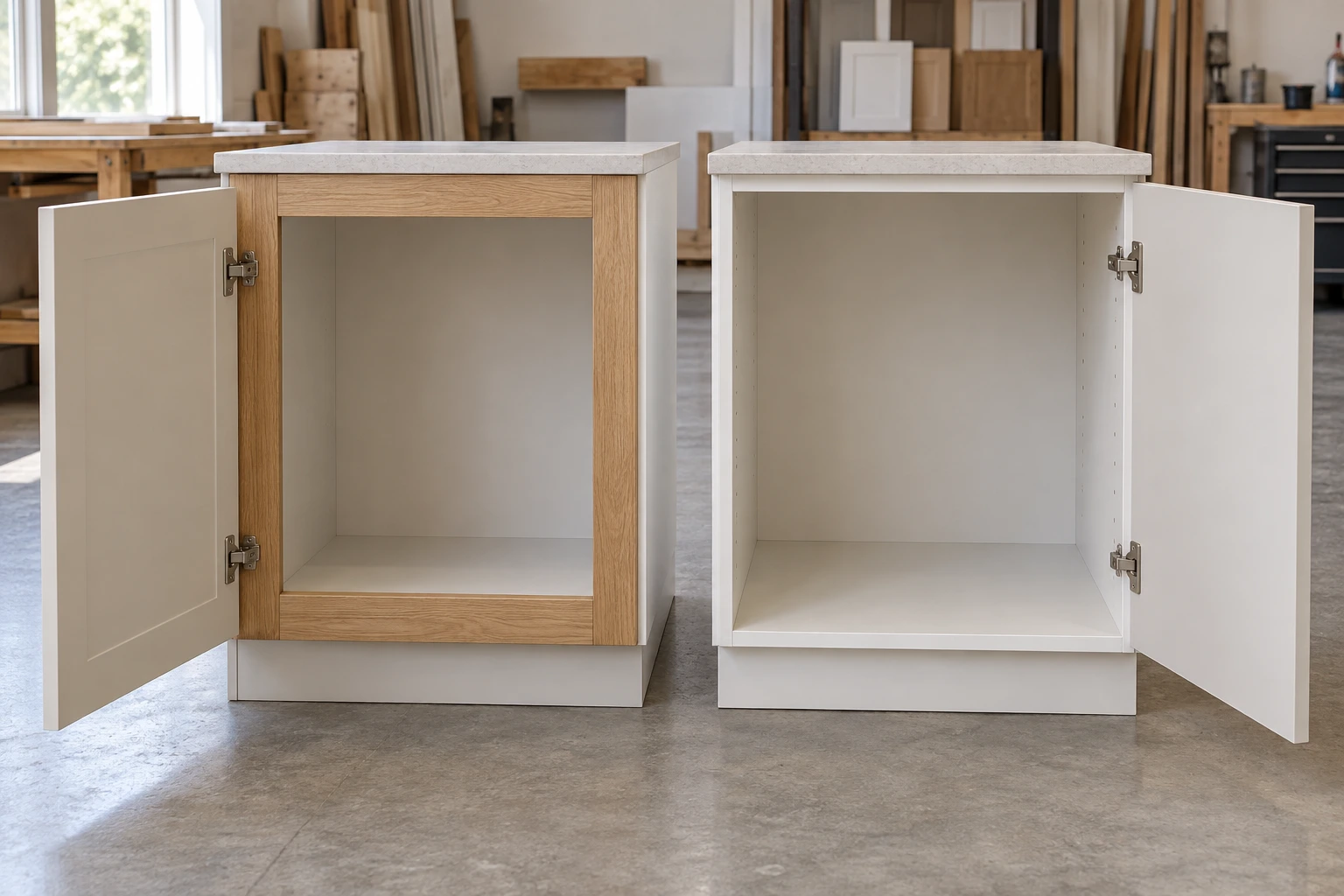
An installed side runner beside separate undermount samples.
Compare access using travel, not a premium label
Consider what the user must reach. A shallow stationery drawer may not need the same rear access as a deep drawer holding cooking equipment. Over-travel can help where an overhanging work surface or cabinet detail would otherwise obstruct access, but its extra movement must also clear people, doors and adjacent elements.
Do not infer an exact travel from the ordered nominal length. Accuride’s official 3832E/3834E technical sheet distinguishes the slide-length dimension from travel. Its 3832-E22 row, for example, lists a 550 mm slide length and 559 mm travel. Those are manufacturer dimensions for that named reference, not a formula for every slide sold as 22 inches or full extension.
The same source also covers a separate over-travel model. That does not make its load, length options or accessories identical to the full-extension version. Confirm the exact variant and current specification before accepting a substitution.

Match the application to a real combination
The following is a shortlist for investigation, not a brand ranking. Product availability and final ordering references need confirmation for the destination market. Each option remains subject to its own dimensional and load review.
| Drawer task | Candidate combination | What makes it a candidate or rejects it |
|---|---|---|
| General wooden drawer; visible side hardware acceptable | Accuride 3832E Classic: side-mount, ball-bearing, full-extension, with hold-in detent and lever disconnect. | Develop where side clearance and conventional operation suit the design. Do not describe the Classic as a soft-close or touch-release variant. |
| Rear access obstructed by an overhang | Accuride 3834E: side-mount ball-bearing over-travel option in the same wider product family. | Check the actual added travel and its operating envelope. Use its own rating and ordering data, not the 3832E value by association. |
| Wooden drawer with concealed hardware and damped closing | Blum MOVENTO: concealed full-extension runner; the current UK overview identifies cylindrical nylon rollers and BLUMOTION closing. | Develop with the matching drawer geometry, locking devices and selected runner. Concealed mounting does not mean it uses the side-mount box-width rule. |
| Handleless drawer | A specifically configured touch-opening variant or system, such as the relevant Accuride touch-release product or a compatible MOVENTO motion package. | Require the exact components, front travel and operating clearances. Do not combine an arbitrary push latch with an unrelated soft-close runner and assume compatibility. |
Partial-extension products remain valid candidates where the required access permits them. Check the chosen model’s measured travel and rear access with the actual contents. A lower-access option is a poor substitute if retrieving the back item is the main task, even if its length and advertised load appear similar.
Read the load number with its conditions attached
A load rating needs a defined assembly. Is it for a pair, one runner or a complete drawer system? What length and drawer width were tested? Does it apply to repeated movement, a static load or a particular mounting direction? How is the mass of the moving drawer itself treated? Resolve these questions before assigning an allowable contents load.
Accuride’s 2025 wood-cabinetry catalog discusses dynamic-load testing, geometry and mounting as selection factors. The official R10-0616 3832E/3834E sheet gives a specific rating reference using a nominal 22-inch slide, a 24-inch-wide drawer and 50,000 cycles. The publication’s “up to 100 lb” headline is not a transferable approval for any drawer length, width, fixing or use.
Use the latest applicable technical release for the actual part and finish. A family brochure can summarize several variants; a model sheet may have an older revision date. Where documents differ, obtain clarification rather than selecting the largest number. Do not copy a static-load margin into a dynamic use claim, or apply a flat-mount reduction rule to a model whose flat mounting is not permitted.
Blum’s current UK MOVENTO range likewise associates different load classes with different nominal-length ranges. The range name alone does not select a length/class combination. Final selection needs the applicable planning data and hardware configuration, not an unqualified comparison of one brand’s maximum with another brand’s lower class.
D-14: a filled dimension and load review
Assume a conventional wooden storage drawer with a handle. It has a 400 mm clear cabinet opening between mounting surfaces and 600 mm available internal depth. A proposed 3832-E22 pair will be mounted vertically at the sides. The drawer body and attached moving components are assumed to weigh 8 kg; the intended contents add 22 kg. These are inputs, not measurements, test results or an approved application.
The currently hosted Accuride 3800-family brochure calls for a drawer box 1-1/16 inch narrower than the cabinet opening. At 25.4 mm per inch, that is 26.9875 mm total difference. For the 400 mm opening, the unrounded screening width is 400 − 26.9875 = 373.0125 mm, approximately 373.0 mm. This is a screening calculation, not an approved machining dimension or tolerance.
| Field | Filled review input | Decision or remaining check |
|---|---|---|
| Task and function | Handled wooden drawer; full rear access requested; conventional closing accepted. | 3832E Classic retained for development; no soft-close or touch-opening claim. |
| Opening and box width | 400 clear opening; approximately 373.0 outer box screening width from the family brochure rule. | Confirm current part-specific side-space requirement, tolerances and parallel mounting surfaces before machining. |
| Length and depth | R10 sheet lists 3832-E22 at 550 slide length. Available cabinet depth is 600; arithmetic difference is 50. | The 50 is remaining envelope, not a prescribed rear clearance. Check setback, fixings, front and rear interference. |
| Travel | R10 sheet lists 559 travel for this reference. | Plot full movement and handle/front projection in the room; recheck latest ordering data. |
| Moving mass | 8 drawer/attached components + 22 contents = 30 kg. | Submit the complete mass, width, length and duty to the applicable rating/application review. Do not approve it merely because 30 is below a headline maximum. |
| Compatibility | Vertical side mounting; specified drawer and cabinet materials; screws/brackets still to be selected. | Approve the actual fixing, member positions and disconnect access. No permission to rotate the slides flat. |
| Release status | Candidate selected; geometry and mass recorded. | Production HOLD for current technical confirmation and a representative assembled application check. |
The width example shows why a runner change can require a different drawer box. A concealed system may use another width relationship, bottom position, rear preparation and locking-device detail. Replacing the D-14 side runners with undermount hardware while retaining the calculated box is a redesign, not a purchasing equivalent.


Check the assembled drawer before releasing the order
- Document identity: record the exact runner pair, length, finish, accessories and technical revision. Keep handed parts and locking devices identifiable.
- Verify geometry: compare finished cabinet and drawer dimensions with the approved planning sheet, including bottom/rear preparation and relevant front position.
- Review the intended use: include the moving box, attached front/components and contents in the mass record; confirm the applicable duty and rating basis.
- Check operation: use the agreed representative application procedure to inspect travel, clearances, fixing behavior, closing/opening function and removal access.
- Close substitutions: any changed runner, drawer material or motion package returns to the affected checks before production release.
A smooth empty demonstration does not establish loaded performance. Equally, improvised overloads or hanging a person from a drawer are not an acceptance test. Follow the manufacturer’s applicable procedure and project review responsibility. Record observed defects and corrections rather than turning one sample movement into a lifetime claim.
Carry the accepted runner combination into the cabinet RFQ component schedule. Send NOVARMIA the drawer section, clear cabinet dimensions, intended contents/moving mass, access requirement and proposed hardware reference to discuss a compatible drawer-and-runner specification.
FAQ
Can the old screw holes be reused when slides are replaced?
Compare the new fixing pattern, screw requirements and existing substrate condition. Matching nominal length does not establish that the old holes provide the required support. Obtain an approved repair or refixing detail where the original holes or panel are damaged.
Does a wide drawer always need two pairs of slides?
No general rule follows from width alone. Check the actual model’s permitted drawer geometry and support arrangement. Extra runners can introduce alignment constraints and are not a substitute for an approved wider-drawer system.
Can a full-extension runner be used behind a hinged cabinet door?
Check the drawer’s route past the door, hinge body and frame at the actual opening angle. The runner can provide its stated travel yet still encounter the enclosing door. Include any approved stand-off or door-clearance detail in the assembly.
Should lubricant be added if a new drawer feels stiff?
Check alignment, mounting space, fixing interference and the intended opening mechanism first. Follow the particular manufacturer’s maintenance instructions before applying any lubricant or cleaner. A different lubricant is not an accepted remedy for a dimension or installation error.