On this page
The best corner kitchen cabinet storage is the option that makes your actual cookware retrievable in a compatible cabinet. Choose a blind-corner pull-out when you need daily access to the rear and can accommodate its travel. Choose a lazy Susan when the cabinet is designed for a rotating tray and the contents fit around its shape. Choose fixed shelves for occasional-use storage when a low parts count matters more than bringing every item to the doorway.
These are recommendations for residential-style base cabinets, based on mechanism geometry and procurement requirements—not results of a hands-on product test. The comparison covers three storage families, not brands. Start with the corner layout: a mechanism that works well in an L-shaped carousel cabinet may not fit a rectangular blind-corner cabinet at all.
Rotating trays require a matching cabinet and door arrangement.
Identify the corner before choosing its storage
A blind corner extends behind the adjacent cabinet run, leaving a portion that is not directly in front of its door. A carousel corner is planned around rotating shelves, often with an L-shaped or diagonal front arrangement. The words “corner cabinet” do not establish which one a supplier has priced.
In a new kitchen, compare each complete cabinet-and-storage arrangement within the same corner zone, including the adjacent cabinets it displaces. In an existing kitchen, treat the carcass, access opening and service obstructions as constraints. Changing the storage family may require a new cabinet and frontage; it is not necessarily a hardware upgrade.
- Record the cabinet shape: a plan view showing both wall runs and the door position is more useful than a front photograph alone.
- Separate external and internal dimensions: a nominal door width does not equal the clear opening after hinges, frame members and door projection.
- Show the moving neighbors: adjacent drawers, dishwasher doors, oven handles and a nearby wall can limit operation.
- List what must fit: include pan handles, lids and the height needed to lift an item off the tray.
Lazy Susan vs. pull-out vs. fixed shelves
Use the same contents and retrieval task for every candidate. This table compares typical configurations; the offered model’s drawings control the final fit and operation.
On a narrow screen, scroll the comparison table horizontally to see every option.
| Decision criterion | Lazy Susan / carousel | Blind-corner pull-out | Fixed shelves |
|---|---|---|---|
| How you reach the rear | Rotate the shelf until the item reaches the opening; the tray usually remains inside. | Bring a tray outside or move rear baskets forward, depending on the mechanism. | Reach through the opening; front items may need to come out first. |
| Contents that suit it | Pots, bowls and containers that fit the tray outline and clear the post, where present. | Frequently used cookware that fits the individual trays or baskets. | Occasional-use items that pass through the door and can be retrieved from their assigned position. |
| Geometry to prove | Rotating envelope, shelf diameter/shape, post position and door arrangement. | Clear opening, internal envelope, mounting side and complete extension path. | Shelf depth, span, support layout and an unobstructed retrieval path. |
| Space while operating | Allow for the specified door movement and the user’s position. | Allow for doors, extended trays and a person lifting the contents. | Allow for the open door and for setting down items removed from the front. |
| Cleaning access | Check access around and beneath the trays, including the rear floor. | Extended trays help expose their surfaces; rails and concealed floor areas still need access. | Simple surfaces, but the deep rear can be difficult to reach. |
| Service items | Post/bearings, stops and any door-coupling components. | Arms or slides, mounts, stops and dampers; some parts are model-specific. | Shelf supports, shelves and ordinary door hinges. |
| Quotation drivers | Cabinet configuration, tray material, post/bearing system and door hardware. | Mechanism set, handing, trays, damping, fitting work and replacement components. | Shelf construction, edge finish, supports and access-door hardware. |
Lazy Susans: best for a corner designed to rotate
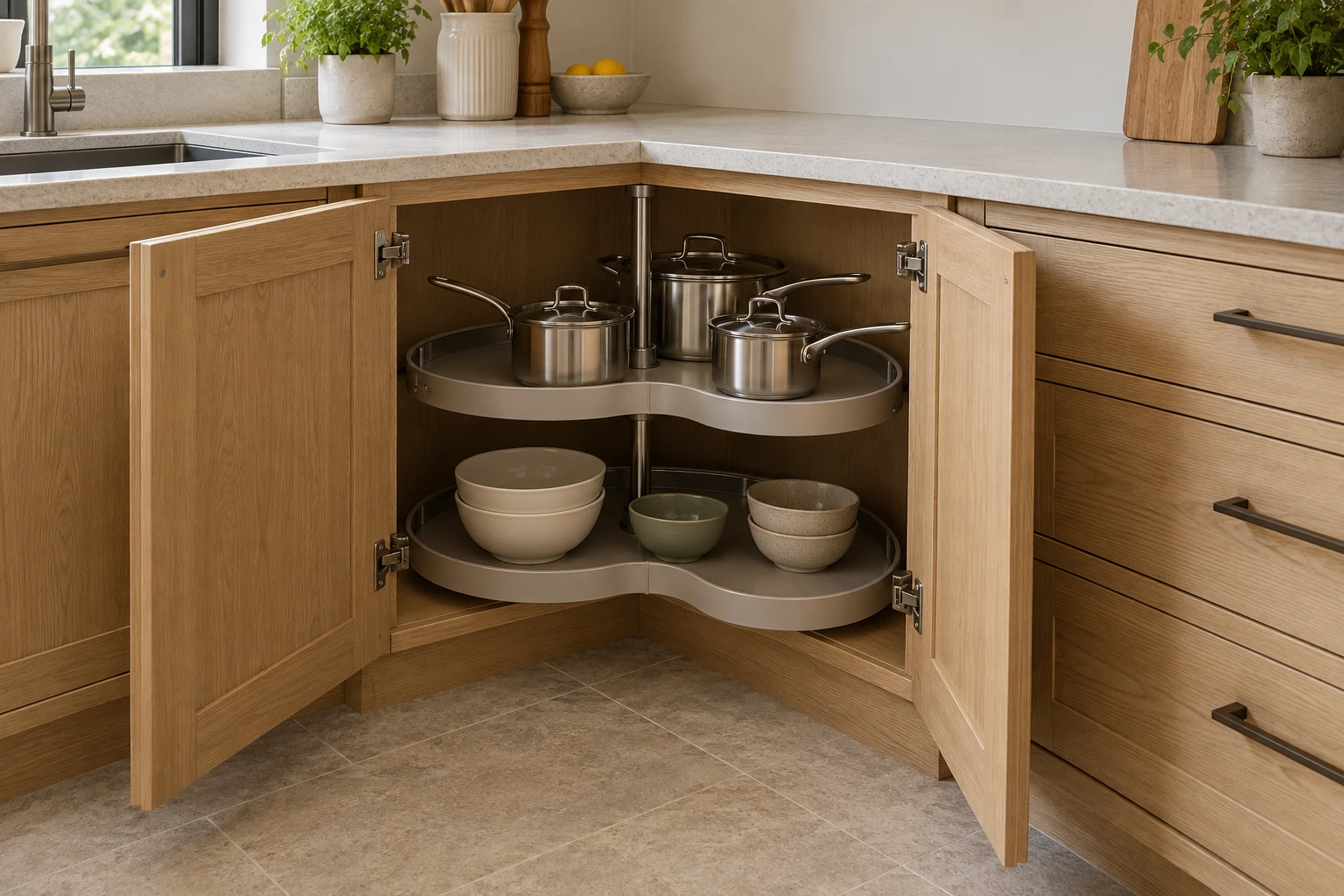
A carousel brings a rear item toward the opening without requiring you to pull out an entire basket assembly. It is a strong candidate for everyday pots and bowls when their footprints fit the tray. Round trays, kidney shapes and cut-out trays are not interchangeable descriptions; ask which shape and door arrangement are included.
The tradeoff is usable shape. A long pan handle, a tall stack or an item extending beyond the rail can obstruct rotation even when the cabinet has plenty of empty volume. Avoid selecting it from shelf diameter alone. Reject a carousel retrofit if the cabinet cannot accommodate its rotation or its door system without unapproved rebuilding.
Pull-outs: best for bringing blind-corner contents forward
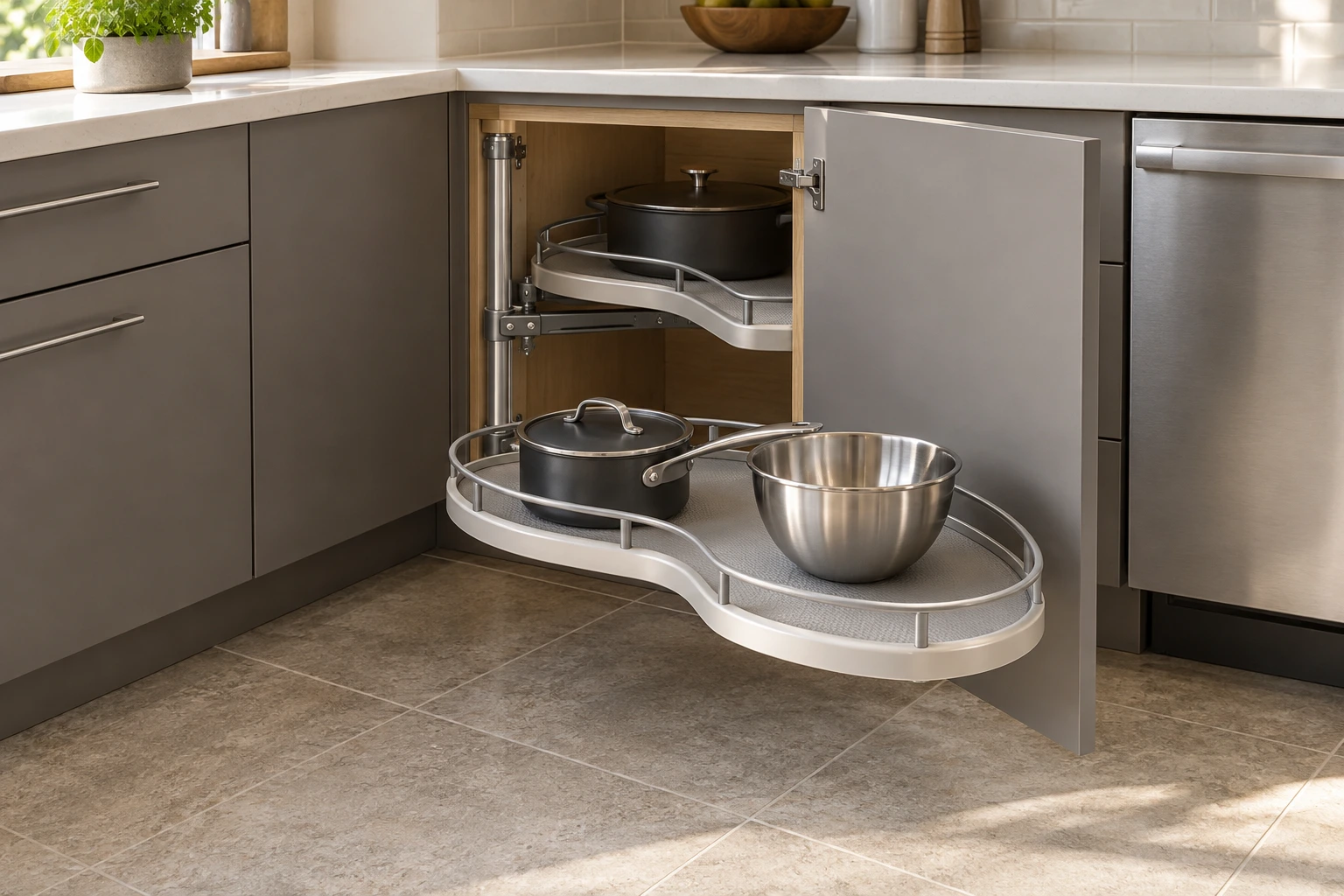
A pull-out is the preferred starting point when daily-use cookware would otherwise sit behind the neighboring run. But “pull-out” covers different motions. Kesseböhmer’s LeMans description shows independently moving swing-out trays; its MagicCorner description uses a sequence that moves the front storage sideways and brings rear storage forward. A photograph of one extended tray does not establish what happens to the rest.
Ask the supplier to demonstrate the whole sequence with the intended contents. A system that presents every required item at the opening is more useful than one that merely shifts the obstruction. Reject it if the extended assembly prevents a person from standing where they need to lift a pan, or if a nearby handle stops the door before the mechanism can operate.
Fixed shelves: best for occasional-use storage and simple servicing
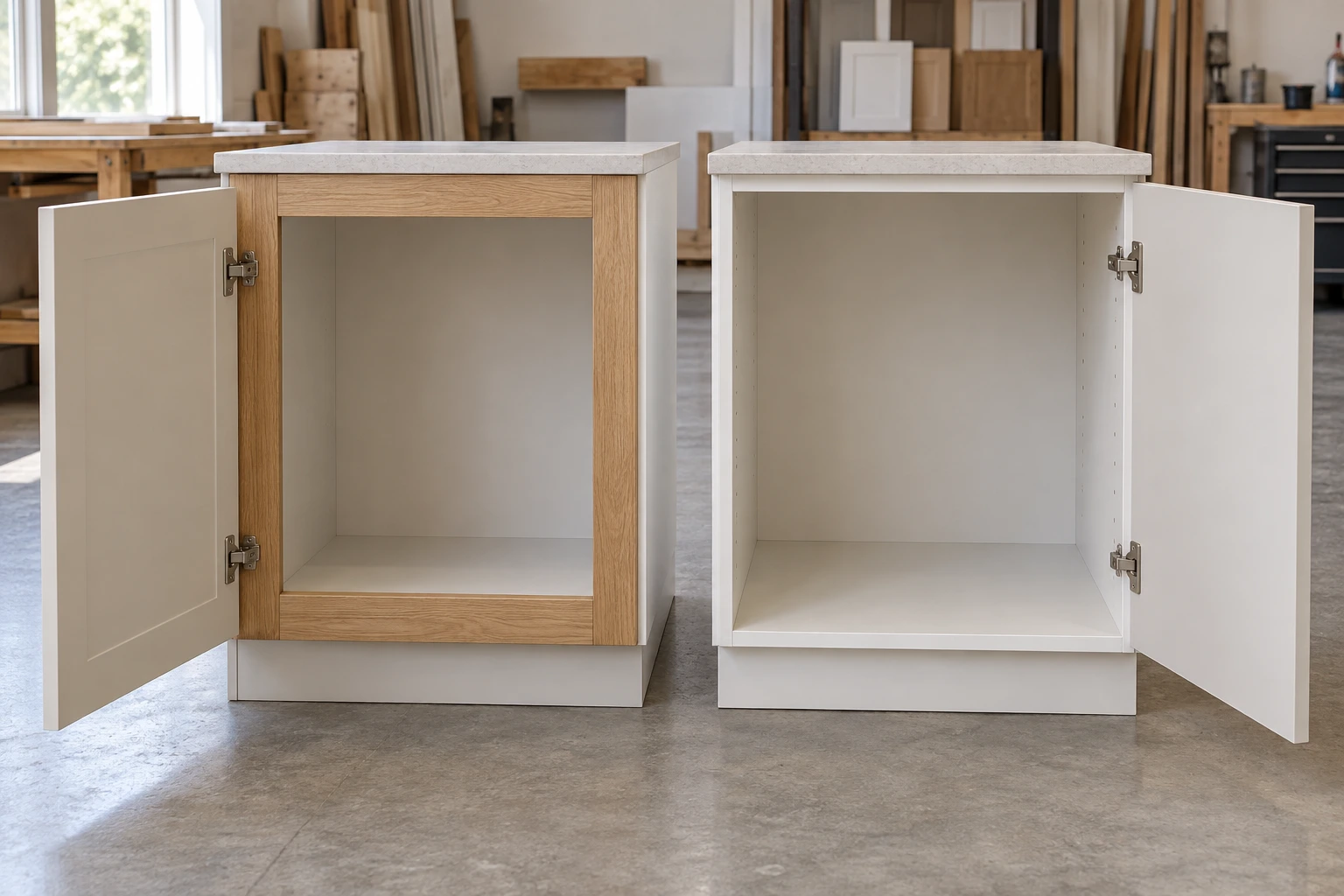
Fixed shelves remove the rotating or sliding mechanism from the specification. That can be attractive in kitchens where the corner holds seasonal serving pieces, spare containers or rarely used cookware. The shelf and support design still need a stated load basis; “no mechanism” does not mean unlimited capacity.
Choose shelves only after testing the route to the rear. An appliance can fit inside a cabinet yet be impossible to lift through the doorway. For items used every day, repeated unloading of the front is a reason to change the layout. In a new plan, also consider leaving the deepest corner unused and placing better-accessed storage beside it if all three options perform poorly.

Check the entire assembly, not just the tray
Request the exact mechanism code, handing diagram, installation revision, minimum clear dimensions, attachment details and operating envelope. Keep that document with the cabinet drawing. Version matters: the official LeMans download index separates instructions for versions before and from Q4 2025. A familiar family name is not a complete installation reference.
- Check empty-cabinet fit. Compare the required opening and internal width, depth and height with the finished cabinet. Include hinges, rails, pipes and drawer housings in the obstruction check.
- Check moving fit. Trace the door and every tray or basket through the full sequence, with neighboring doors and drawers in the agreed operating positions.
- Check loaded fit. Confirm that the contents clear the rim, post, upper tray and door. Obtain the permitted load and distribution for each relevant component, rather than assuming one total applies everywhere.
- Check servicing. Establish how the mechanism can be adjusted, cleaned and replaced after the countertop and adjacent cabinets are installed.
Keep cabinet performance evidence separate from mechanism limits. KCMA A161.1-2022 addresses performance and construction of factory-assembled kitchen and vanity cabinets under defined conditions. It does not select your corner fitting or turn a laboratory shelf test into a universal working load. Request evidence covering the offered assembly and installation.
For cost comparison, hold the visible finish, cabinet construction and surrounding layout constant wherever possible. Then separate the mechanism price, installation work, changes to doors or fillers, and any credit for deleted shelves. A low-priced hardware kit may omit trays, a mounting post or optional damping. Do not compare that kit with a fully fitted cabinet as though the scope were equal. The cabinet quote comparison guide explains how to normalize the wider package.
A filled selection record for cabinet C-07
Its purpose is to show a complete selection for quotation; dimensions are not recommended minimums.
| Field | Example entry |
|---|---|
| Layout and quantity | One new frameless blind-corner base cabinet, with its proposed carcass configuration held constant; storage continues to the left behind the adjacent run; door hinged on the right when viewed from the front. |
| Finished clear dimensions | Opening: 420 mm wide × 600 mm high. Interior: 840 mm wide × 520 mm deep × 650 mm high. Planned available door opening: 100°. These design inputs require verification against the finished assembly and nearby obstructions. |
| Storage task | Daily access to two saucepans, one frying pan and one mixing bowl; keep handles within the tray outline. Buyer supplies actual object dimensions and weights before model approval. |
| Neighbor constraint | Dishwasher on the right run. Corner storage is used with the dishwasher closed; demonstrate the required standing and lifting space. |
| Primary selection | Price a compatible blind-corner pull-out that brings every required item to a reachable position. Exact model and motion remain supplier submissions. |
| Rejected alternative | A conventional carousel requiring an L-shaped corner carcass is excluded from this quote for the unchanged new-cabinet configuration. It would be a separate layout revision. |
| Fallback | Fixed shelves only if the owner reallocates daily cookware to nearby drawers and assigns the corner to occasional-use items. |
| Release condition | No production release until model fit, mounting, loads, loaded motion and replacement access are confirmed for the cabinet revision. |
The result is a defined purchasing direction: retain the proposed blind-corner cabinet configuration and request a complete new cabinet with a pull-out option. A supplier response saying only “fits a 450 mm door” is incomplete because it does not resolve the stated 420 mm clear opening. If no submitted system passes the checks, use the stated fallback or revise the layout; do not silently substitute a different mechanism.
Copyable RFQ note
“C-07: price 1 complete new blind-corner cabinet with a compatible pull-out for the recorded layout and clear dimensions. Identify mechanism code, orientation on plan, tray quantities/materials, damping, fixing components and installation scope. Return the model-specific fitting drawing, loading instructions, maintenance information and replacement-parts arrangement. List exclusions and any change required to the opening, door, filler or adjacent cabinet. Quote fixed shelves separately as a fallback; do not substitute without approval.”
Add this record to the wider kitchen cabinet RFQ specification. The record establishes what is being bought; the supplier’s returned model details establish whether the proposed option fits.
Approve the everyday storage task
At sample review, use the actual intended items or agreed dimensional stand-ins. Follow the manufacturer’s loading instructions; this is a usability check, not a substitute for certified testing.
- Place: load each assigned item without overhanging the tray or occupying the mechanism’s path.
- Retrieve: bring the hardest-to-reach item to its usable position. Record any other items that must first be removed.
- Operate: complete the full opening and closing sequence without contact, snagging or pushing on stored objects.
- Maintain: demonstrate access to spills, adjustment points and removable parts using the specified procedure.
- Record: save the cabinet revision, hardware code, contents list, outcome and corrections. Repeat affected checks after a substitution.

Which option should you specify?
For a compatible blind corner holding daily cookware, start with a pull-out. Its value is the retrieval task it completes. For a new corner designed around rotation, choose a lazy Susan when the contents and door motion work well together. For infrequently used storage, choose shelves when the retrieval path is acceptable and simpler servicing is the priority. If the corner cannot pass the task, relocating the items is a better decision than buying more elaborate hardware.
To discuss a corner cabinet quotation with NOVARMIA, send the corner plan and storage brief: finished opening and internal dimensions, door swing, adjacent appliances, cookware list, quantity and destination. These inputs support a discussion of cabinet configuration, fitting scope and the documents still needed for approval.
Frequently asked questions
Can a corner organizer be fitted below a sink?
Only if the specific mechanism leaves the required space for the sink bowl, waste pipe, valves and service access throughout its motion. A standard corner-cabinet illustration does not establish this. Provide a coordinated sink-and-plumbing section; otherwise keep the organizer outside the sink base.
Does a pull-out make a kitchen accessible?
It may reduce reaching into the cabinet, but that alone does not establish accessibility. The user must still operate the door, apply the required force, approach the tray and lift its contents. Evaluate the intended user’s needs and any applicable project requirements separately.
What should the order say about spare parts?
Record the mechanism and revision, replaceable components, supplier contact and the agreed process for ordering them in the destination market. Do not assume another brand’s damper or slide is interchangeable. For repeated units, agree any spare inventory separately rather than hiding it in the cabinet quantity.
Can the same specification be used for mirrored kitchen layouts?
Use the same performance task, but issue a separate orientation on plan for each mirrored layout. Some mechanisms are handed; others allow different mounting arrangements. Confirm the part codes and door interaction for both before treating them as one identical item.