What does 603 granite look like?
It has a fine gray grain of pale and dark mineral speckles, closely distributed and quite different from a heavily veined slab. Tone and grain vary between pieces, so matching adjoining surfaces are chosen from the actual stone.
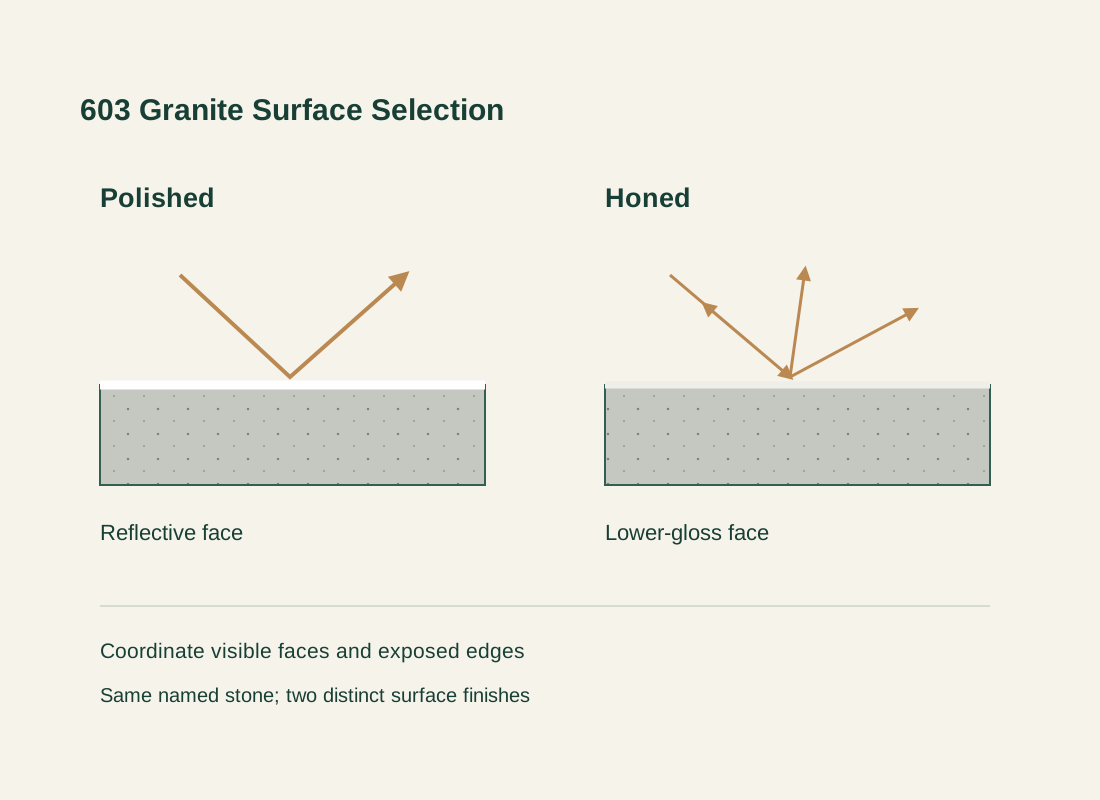
What is the difference between polished and honed 603 granite?
Polished has a reflective surface; honed has a lower-gloss appearance. Choose between a brighter sheen and a quieter surface, then coordinate the exposed edges and adjoining pieces. Neither finish name alone supplies a slip-resistance rating.
Are the slab size and finished-piece size the same?
No. A slab is the material used for cutting; a finished piece is the item sized for the installation. The finished-piece list gives its length, width and thickness. Available slab dimensions and the cutting layout determine whether a particular piece can be made in one section.
Can this granite be cut for a sink or basin?
Yes, countertop pieces can include fixture openings, with the sink or basin template setting the opening and mounting detail. Faucet holes, finished cutout edges and the supporting cabinet or frame are detailed with it.
Can one selection cover the wall, floor and countertop?
Yes, 603 granite can be cut for all three applications. Each application has its own piece sizes, joints, finish and installation requirements. A floor still needs an appropriate finish selection and installation design; the material name is not a floor-performance approval.
Does the granite supply include installation and supporting cabinets?
Stone pieces, surface work and openings can be itemized apart from cabinets, brackets, substrates, sinks, setting materials and site installation.