White Laminated Plywood Case
The white case finish covers the top, sides and exposed edges. The final end-panel and edge schedule keeps the cabinet consistent when placed independently beside a desk or other office furniture.
Office Stationery Cabinet configuration
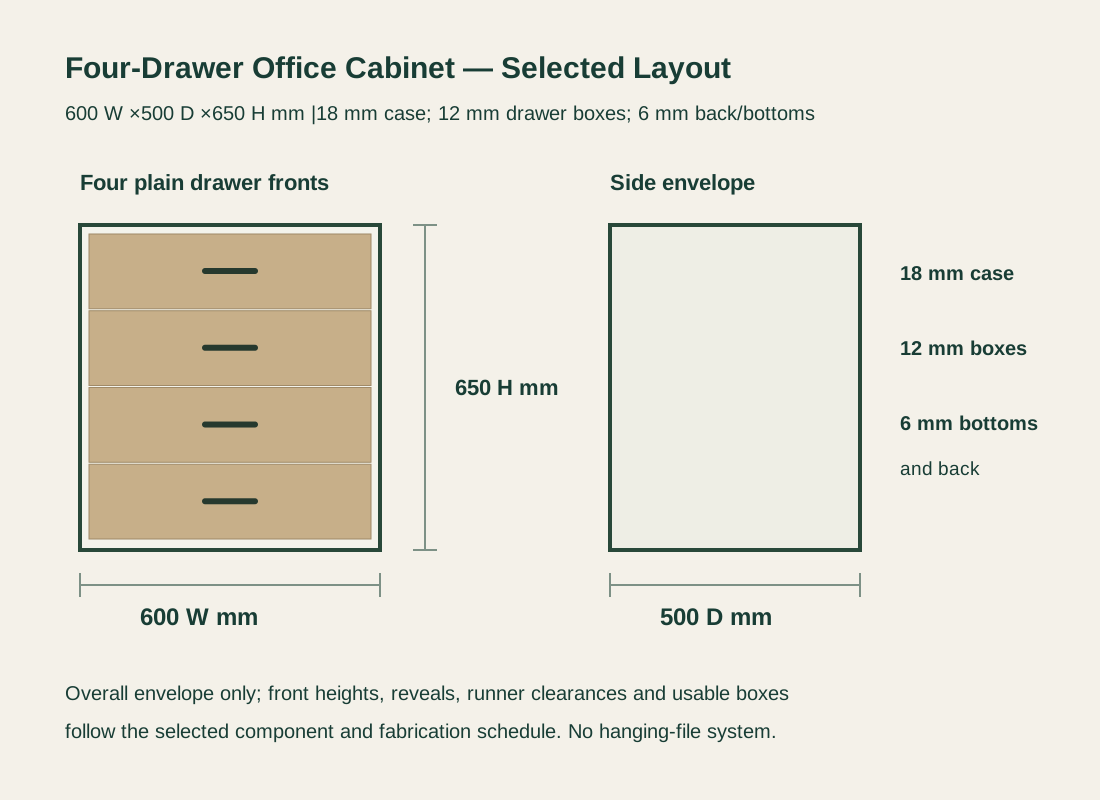
Four plain-front drawers separate paper, stationery and small office supplies within one compact cabinet. Each front has a black bar pull. The cabinet stands on a fixed floor base and does not include casters or a desk worktop.
The selected outer case uses 18 mm plywood. Drawer-box sides and backs use 12 mm plywood, with supported 6 mm plywood bottoms. The cabinet also has a supported 6 mm back. These thicknesses belong to the project construction schedule.
Each drawer uses a selected manual runner assembly. Runner model, side clearance, fixing positions and extension determine the final usable box dimensions.

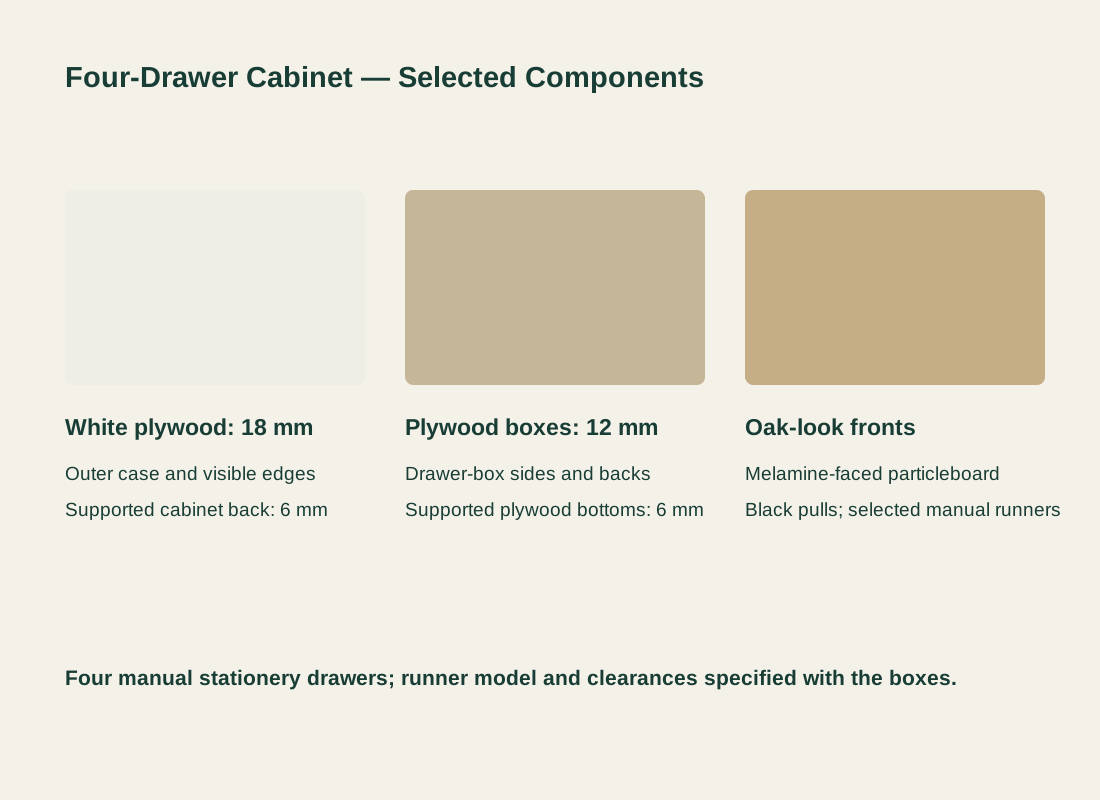
The white case finish covers the top, sides and exposed edges. The final end-panel and edge schedule keeps the cabinet consistent when placed independently beside a desk or other office furniture.
Four light oak-look melamine-faced particleboard fronts form the drawer face. The wood pattern is a printed surface on particleboard, with no solid oak or veneer. Front thickness, grain direction and reveal gaps are coordinated with the drawer layout.
Black bar pulls repeat across the four fronts. Pull position and final front gaps are set together so the drawer stack stays consistent. Hardware color and runner components remain separate specification items.
| Drawer layout | Freestanding stationary office cabinet with four stacked manually operated drawers; fixed floor base |
|---|---|
| Selected configuration | 600 W ×500 D ×650 H mm selected project cabinet; white 18 mm plywood case, four oak-look melamine-faced particleboard fronts, 12 mm plywood drawer boxes and supported 6 mm bottoms/back. Ordinary manual runners are selected for the final assembly. |
| Project overall size | 600 W ×500 D ×650 H mm selected project basis; final front, joint and site allowances in the order drawing |
| Case & back | 18 mm plywood outer case; supported 6 mm plywood back |
| Drawer boxes & fronts | 12 mm plywood box sides/backs with supported 6 mm bottoms; oak-look melamine-faced particleboard fronts and black bar pulls |
| Runner & usable-space interface | Actual manual runner model, side clearances, extension, fixings and final clear box dimensions specified for the assembly; no unselected performance rating |
| Supply boundary | Cabinet, four drawers, scheduled runners/pulls and supported back; organizers, packing, freight and site services itemized |
| Minimum order | Quoted per model at your project quantity. Where a factory model has a production minimum, the quotation states it; small quantities can ship with the rest of your project in one container. |
| Standards & certificates | Matched to the ordered model: tell us the standards or certificates your market or project requires, and we confirm in writing which documents are available for this configuration before you order. |
 Open product drawing ↗
The selected cabinet is 600 mm wide, 500 mm deep and 650 mm high. Use that complete envelope when placing it beside a desk or within a furniture plan. An under-desk position also needs the actual underside clearance and usable knee-space layout.
Overall cabinet width is not usable drawer width. The 18 mm case sides and selected runner clearances reduce the box envelope; the 12 mm drawer sides then reduce its interior width. Match paper packs and organizers to the final clear box dimensions.
Reserve space in front for the actual drawer travel and a user’s standing or seated approach. The floor support and restraint interface are matched to the final assembly and location. Packed size and delivery access are recorded alongside the closed-cabinet dimensions.
Our quote identifies the 18 mm case, 12 mm drawer-box sides/backs and supported 6 mm bottoms/back. Four separate drawer boxes and their connections form part of the cabinet line.
Oak-look melamine fronts, grain alignment, edge treatment and reveal details define the drawer face. Their material specification is distinct from the white plywood case.
The actual runners, pulls and connection hardware are listed by component. A different extension, closing action or rated capacity changes the hardware specification and may change box dimensions.
Cabinet quantity, assembly state, front protection and destination determine packing and transport. Desks, organizers, freight, carry-in and local placement are each itemized where applicable. Tell us the rooms and quantities and we will put this on one quote with everything else you are ordering, and show you what fits in a container.
The project envelope is 600 mm wide, 500 mm deep and 650 mm high. The final order drawing coordinates front thickness, reveals, joints and the chosen runner assembly within that overall size.
The outer case uses 18 mm plywood. Drawer-box sides and backs use 12 mm plywood. Drawer bottoms and the cabinet back use supported 6 mm plywood. These are selected project construction dimensions.
No. The fronts are oak-look melamine-faced particleboard. Their finish sample, thickness, grain direction and edge treatment are recorded alongside the plywood case and drawer boxes.
The selected layout uses ordinary manual runners. Full extension, soft-close action and any load rating depend on the actual component specified in the quotation. The model and required clearances are confirmed with the drawer boxes.
No. This configuration is for stationery, paper and small office supplies. Hanging-file rails and locks are not included. Those functions require a different defined fitting and cabinet specification.
Compare the full 600×500×650 mm cabinet with the desk underside, knee-space layout and the required drawer-opening space. Use the final clear drawer dimensions for organizers and paper packs; the cabinet’s outside width is not its usable drawer width.
 Open Geometric Bookcase with Metal Trim
 Compact Ash-Veneer Display Cabinet with Three Open Recesses
 Marble-Front Sideboard with Curved End Panels
 Wide Flat-File Cabinet for A1 Drawings with Shallow Drawers