On this page
A door-leaf price and a complete-door-set price cover different tasks. Compare them only after the frame, casing, hardware, finish, machining, delivery and fitting are defined. In this case dated October 30, 2026, a USD 180 primed leaf becomes a USD 650 completed door task; the competing route totals USD 770. The buyer selects the confirmed USD 650 route. All figures are before taxes.
The useful purchasing unit is one scheduled doorway with an agreed operating result. A leaf may be exactly what a replacement job needs, but it is not a same-scope alternative to a new frame and fitted hardware when those items are required. Equally, a quote called “complete” needs an actual contents and service definition.
What do leaf, prehung and complete mean on this offer?
The leaf, also called a slab, is the moving door panel. Masonite’s interior-door guidance distinguishes a slab from a prehung unit with the slab already hinged to its frame. That helps identify the basic supply format. It does not establish that every offer includes decorative casing, a lockset, a final painted finish or installation.
Read the seller’s terminology. JELD-WEN Canada’s current molded-door page describes a prehung option with a knocked-down frame and identifies a primed, ready-to-paint finish. The label therefore does not replace the packing arrangement or finish specification. Ask what arrives assembled, what remains loose and which machining is already done.
In this article, “complete door set” means the specifically listed leaf, frame, casing and operating hardware supplied with the agreed finish and preparation. Delivery and site fitting are then stated separately. This is the definition used for the two offers below.
Start with doorway D-12, not a unit price
D-12 is an ordinary dry-room interior doorway in a new opening, with no existing frame being retained. The brief does not request a fire, smoke or acoustic rating. Establish the real project’s required performance before using this example: a doorway that requires an assessed special system cannot be substituted into this ordinary-door comparison.
| Interface | Scheduled requirement | Assumed confirmation |
|---|---|---|
| Leaf | One solid-core composite flush leaf; nominal 800 × 2,040 × 40 mm; agreed product reference L-D12. | Both offers identify the same construction and product reference. The price comparison does not infer sound isolation from “solid core.” |
| Opening / frame | New frame with stops for finished wall depth 125 mm. Refer to measured opening record O-D12 and drawing D12-S1. | Both providers accept the same opening record, finished-floor reference and frame detail. |
| Casing | Matching plain casing/architrave on both room faces, including corner joints. | Both identify the same section and full coverage, not one-sided trim. |
| Handing / operation | Plan D12-P1 shows the swing and hinge side from a labeled corridor viewpoint; passage function without a privacy lock. | Providers accept the marked plan rather than relying on an ambiguous left/right abbreviation. |
| Hardware / preparation | Three specified hinges, passage latch, lever pair, roses, strike and fixings under hardware reference H-D12. | Providers confirm compatibility and machining locations for this assumed leaf/frame combination. Quantity is a model input, not a general hinge rule. |
| Finish / fitting | Accepted warm-white final coating on required leaf, frame and casing surfaces; fitted hardware and final adjustment. | Providers accept finish sample F-D12, required edge treatment after machining, installation touch-up and operation checks. |
Clearances, trimming limits, frame allowances and fixing methods must come from the actual accepted system and site conditions. A photograph of a similarly sized door cannot establish those details.
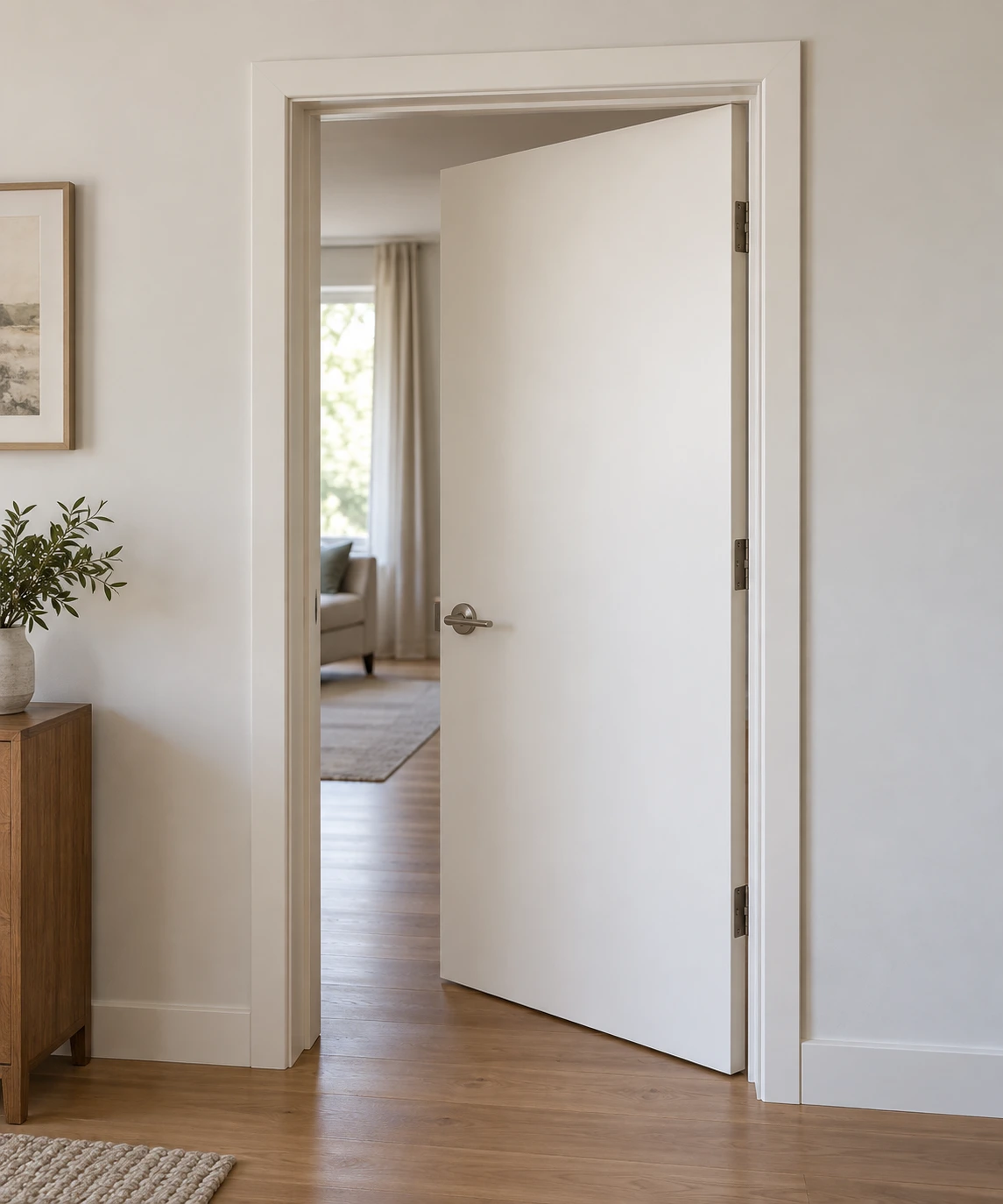
The leaf, frame, casing and hardware form a coordinated door set.

Follow the quote revision from leaf to operating doorway

Route A initially offers L-D12 as an unmachined primed leaf for USD 180. Its primer is included; it is not the final warm-white finish required by the schedule. The quote has no new frame, trim or hardware. It is a legitimate leaf-only offer, but it cannot be compared directly with a finished set for this new opening.
The buyer returns schedule D-12 and asks A’s workshop to take responsibility for a revised task. Assume the workshop reviews the actual product, frame, hardware and opening records and accepts them in writing. Its revised component-supply and preparation price is:
- Primed leaf: USD 180.
- Frame with stops: USD 85.
- Casing for both faces: USD 45.
- H-D12 hardware, including the specified fixings: USD 80.
- Final coating to the required leaf/frame/casing surfaces and installation touch-up: USD 55.
- Coordinated hinge and passage-latch machining: USD 45.
These six amounts total USD 490 for the defined finished, prepared set. Machining is charged once; it is not hidden in the unmachined leaf or charged again during fitting. The coating line completes the specified finish, rather than adding another primer charge.
A also confirms USD 40 for delivery to the named room and USD 120 for fitting. Fitting includes frame positioning and fixing with the specified installation consumables, hanging the leaf, fitting both faces of casing, installing hinges and passage hardware, and final adjustment and operation checks. Hardware mounting is included: a box of loose levers is not treated as an installed door. The machining charge covers workshop preparation; the fitting charge covers assembly and installation.
Route B offers the same scheduled finished, prepared set for USD 610, initially excluding delivery and fitting. Assume B confirms the same leaf construction, frame detail, trim coverage, hardware references, coating and machining. Its accepted delivery and fitting charges are the same USD 40 and USD 120 for the same room and services.
| Quote record | Documented task | Comparable amount |
|---|---|---|
| A0: initial | Unmachined primed leaf only. No frame, casing, hardware, final coating, delivery or fitting. | 180; not a completed-task total and not compared with B as equivalent. |
| A1: accepted revision | Scheduled finished/prepared set 490 + room delivery 40 + fitting 120. | 650 for the defined operating doorway. |
| B1: accepted confirmation | Same scheduled finished/prepared set 610 + same room delivery 40 + same fitting 120. | 770 for the same task. |
| Buyer decision | Select A1, with D-12 schedule, sample and accepted responsibilities attached. | A1 is 120 lower than B1. |
The completed comparison is USD 650 versus USD 770. The buyer accepts A1 because the assumed compatibility and finish responses close the technical scope, the workshop accepts the defined responsibility, and A1 is USD 120 lower. The decision is not simply “buy the cheapest leaf.” Without the accepted revision, A0 would remain an incomplete comparison.
Make the workshop-to-site handoff part of the acceptance
Assume A1 names one coordinating workshop for the leaf, frame, casing, hardware preparation and finish, plus its identified delivery and fitting team. It accepts that its own preparation or fitting errors will be corrected under the agreed service arrangement. The buyer must report delivery damage using the agreed receiving record; responsibility for transport damage and supplied-product defects is recorded separately. This does not imply unlimited cover for an inaccurate buyer-provided opening record or later site changes.
The buyer keeps the accepted finish sample and final schedule revision. The installer checks the delivered door code, handing, frame depth, hardware and opening reference before cutting or fixing. Any mismatch goes back to the coordinator for a documented decision, rather than being resolved by arbitrary trimming or substituting hardware.
Taxes, permits or statutory charges where applicable, old-door removal, opening reconstruction, wall decoration outside the agreed trim line, special access equipment and later changes are excluded from both model totals. They are outside this defined task, not assumed to cost zero. Determine their actual treatment before setting the total project budget.
When a price addition cannot make the doors equivalent
A price comparison stops when a required technical property is unresolved. If the project needs fire/smoke performance, an acoustic rating, a particular security function or another assessed requirement, obtain evidence for the relevant assembly and configuration. Do not add a nominal allowance for a seal, closer or heavier leaf and declare the result an equivalent system.
JELD-WEN’s molded-door guidance specifically pairs its rated options with appropriate certified frames and hardware. The procurement implication is to check the actual assessed configuration, not to transfer its ratings or component combinations to D-12. This example claims no special performance.
If A cannot document the required assembly while B can, A is not a cheaper equivalent offer. Record it as technically unconfirmed or outside the requirement until a valid revised offer is available. Keep that status separate from a cash allowance so the buyer can see whether a real alternative exists.

Which schedule changes move the cost?
Door size, construction, frame depth, casing coverage, hardware preparation, final finish and site conditions can all change the task. Ask for a revision against the same door code. A deeper finished wall may change the frame and trim solution; a changed lever or latch can alter machining; a changed coating requires an accepted finish scope. None has a universal price uplift.
Send NOVARMIA a numbered door schedule, opening records, hardware references and finish sample to discuss a complete offer. Ask the supplier to separate supplied set, room delivery and fitting, and to identify every unresolved technical requirement before presenting a normalized total.
FAQ
Can retaining an existing frame make a leaf-only route appropriate?
Yes, after the responsible provider checks the existing frame, hinge positions, latch/strike relationship, clearances and required performance. That is a different scope from D-12’s new frame. Do not carry this example’s frame and fitting charges into a replacement calculation unchanged.
Should an unused hardware allowance be deducted automatically?
Only after the supplier confirms what is removed and whether the remaining offer still works. Hardware may affect preparation, finish and fitting. Obtain the actual revised scope and price rather than deducting a catalog figure from a bundled total.
Does an order for several identical leaves mean every door set is identical?
No. Door codes may have different handing, wall depths, functions or site conditions. Group genuinely identical schedules for pricing, while retaining each opening’s identity through delivery and installation.
How should a late finished-floor change be handled?
Notify the coordinator before release and review the opening reference, operating clearance and permitted adjustment. Obtain an accepted drawing and commercial revision where needed. Do not assume the installer can trim every leaf enough to absorb the change.