On this page
If a toilet is clogged and you have no plunger, stop flushing first. For a likely toilet-paper or waste blockage, one cautious attempt with ordinary liquid dish soap and warm tap water may help—but only if the bowl has plenty of room and the water is already receding. Do not add water to a full bowl. A dropped object, a drain opener or unknown cleaner in the water, or sewage backing up elsewhere changes what you should do next.
This guide starts with the no-plunger option, then explains when to get a toilet plunger, use a closet auger, or call for help. There is no household mixture that reliably clears every toilet blockage.
Stop the toilet from overflowing
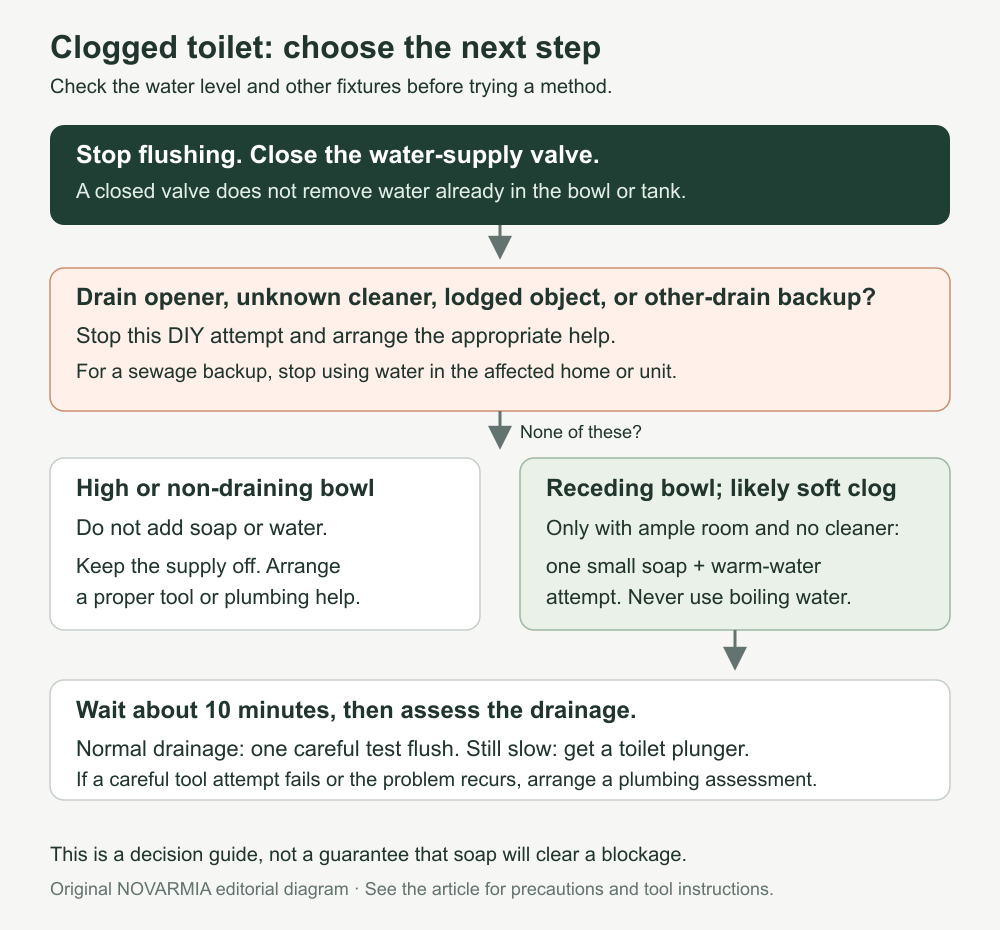
Do not flush again to see whether the extra water will push the clog through. Close the toilet’s water-supply valve, usually near the wall or floor behind it. Closing this valve limits incoming water; it does not remove water already in the bowl or stop an existing tankful from emptying. Do not force a stuck valve. In a rental or shared building, contact maintenance if you cannot shut the supply off.
Put on rubber gloves and protect the nearby floor from splashes. Keep children and pets away. American Standard’s first instructions for a clogged toilet are to shut off the water and avoid repeated flushing. American Standard’s toilet-unclogging instructions
Look at the situation before adding anything:
| What you notice | What to do next |
|---|---|
| The bowl is high, rising, or not making room for more liquid | Add nothing. Keep the supply off and arrange a proper tool or plumbing help. |
| Only this toilet is affected, the problem followed excess toilet paper or waste, and the water is receding | Consider the limited dish-soap method below. |
| A toy, cap, wipe bundle, or other object went in | Skip the soap method. A visible, easily reached object may be retrieved with a gloved hand; do not push it farther into the outlet. Otherwise, get help. |
| Drain opener, bleach, or another cleaner is already in the bowl | Do not add another product or start plunging. Read the chemical precautions below. |
| Wastewater is coming up in a shower, tub, or another drain | Stop using water in the affected home or unit and contact a plumber, building maintenance, or the sewer utility. |
The last situation needs attention beyond the toilet bowl. A public water authority advises stopping household water use during a sewage backup, because additional water can worsen it. Prince William Water’s sewage-backup guidance
Try dish soap and warm water only for a likely soft clog
Dish soap may help lubricate a soft blockage. It will not remove a lodged toy or make a large solid object disappear. Kohler’s guidance distinguishes these limits and warns against boiling water, which can damage the ceramic. Kohler’s dish-soap guidance
Use this method only when all of these conditions apply:
- You suspect toilet paper or human waste, rather than an object or nonflushable material.
- The water is receding and there is ample empty space below the rim.
- No drain opener, bleach, toilet cleaner, or other chemical is already in the water.
- No other fixture is backing up.
You need rubber gloves, ordinary liquid hand-dishwashing soap, and a small container of warm tap water. Leave the kettle off. Do not substitute dishwasher detergent, bleach, or a mixture of cleaning products.
- Add a small squirt of dish soap. There is no need to fill the bowl with suds. Avoid vigorous stirring or splashing.
- Add warm tap water slowly, in small amounts. Keep the container close to the bowl. Stop immediately if the level rises instead of draining. Do not pour a predetermined bucket or gallon into a partly full toilet.
- Wait about 10 minutes without flushing. Watch whether the level continues to fall. Do not keep topping it up during the wait.
- Assess the result. If the bowl remains slow or high, end the attempt and get a toilet plunger or plumbing help. If it drains freely and returns to its usual level, use the testing steps below.
American Standard’s soap-and-nonboiling-water advice includes a roughly 10-minute wait before plunging. It does not establish a standalone cure or a measured recipe. Here, water additions are deliberately limited by actual drainage. American Standard’s method
Do not repeat this cycle indefinitely. If the first attempt produces no useful drainage, adding more soap and water does not identify or remove the obstruction.
Test drainage before returning the toilet to use
A falling water level is encouraging, but a toilet that slowly empties can still be partly blocked. Wait until the bowl has returned to its usual level. If it remains unusually high or drains sluggishly, do not test-flush it.
Only after normal drainage has been restored, reopen the supply and make one test flush. The supply valve cannot stop a tankful already emptying into the bowl. If you are unsure whether the toilet has cleared, get the appropriate tool or help instead of using a full flush to find out. If water climbs abnormally, stop further flushing and close the supply again to prevent refilling. Do not treat a brief improvement followed by another slow flush as a repair. Korky similarly places a test flush after normal drainage has been restored. Korky's plunging and testing instructions
A repeat blockage deserves investigation, especially when normal amounts of toilet paper cause it. It is not, by itself, proof that you need a new toilet.
If soap does not work, use a toilet plunger with a good seal
When a toilet will not unclog, getting the right tool is usually a better next step than improvising another household mixture. Choose a toilet plunger with a flange that fits into the bowl outlet. A flat sink-plunger cup may not seal well against a toilet’s curved surface.
Provided no drain opener, bleach, toilet cleaner, or unknown product is in the bowl, and there is enough space to work without overflowing:
- Lower the plunger at an angle so its rubber head fills with water rather than trapping air.
- Position the flange in the outlet and keep the cup seated against the bowl.
- Start with slow, controlled pushes and pulls. Maintain the seal rather than lifting the cup clear on each stroke.
- Pause after several strokes and check for drainage. Stop if the water threatens to overflow.
These steps follow Korky’s guidance on filling the plunger head, maintaining a seal, and controlling splashes. Korky’s toilet-plunger instructions
If your plunger is not working, first check its fit and seal. More force is not a useful substitute for a seal, and it is a poor response to a known solid object. If a careful attempt does not restore drainage, move to an appropriate toilet auger or a plumber.
How to snake a toilet with a closet auger
A toilet auger, also called a closet auger, is designed to pass a cable through the toilet’s trapway. Choose one with a protective guide intended for a porcelain bowl. Do not substitute a wire coat hanger or assume an exposed metal drain snake is suitable.
Read the instructions for the specific tool. The basic sequence is to retract the cable into its guide, seat the protective guide in the bowl outlet, and advance the cable using the tool’s hand crank. Keep the guide in position while working; retract the cable before removing the guide from the bowl. RIDGID’s instructions show this sequence and the importance of supporting the cable with the guide. RIDGID’s toilet-auger operating guide
Do not force the cable against hard resistance or use a drill merely because a tool has a powered option. If you suspect an object is lodged in the trapway, the toilet may need professional removal and access from below rather than an attempt to drive the object farther down.
Stop if the cable will not advance or retract normally, you cannot protect the bowl, or the toilet still does not drain afterward. Kohler notes that persistent failure after the trapway has been checked can also involve a restricted vent; that calls for a different diagnosis. Kohler’s bowl-drainage troubleshooting
Treat bubbling and gurgling as diagnostic clues
A bubbling toilet does not identify the blockage’s location by itself. Air movement during sewer maintenance can also cause temporary bubbling or gurgling, as Loudoun Water explains. Loudoun Water’s sewer-cleaning guidance
The surrounding symptoms matter more than the sound alone:
- One clogged toilet, with other fixtures working normally: a toilet-trapway problem remains possible. Follow the limited steps above.
- Gurgling that keeps returning, even after a local clog is cleared: arrange a plumbing assessment of drainage and venting rather than repeating household treatments.
- Bubbling with wastewater rising in another fixture, or several fixtures draining poorly: stop using water and report the backup. Do not keep running taps or flushing toilets to test the system.
In an apartment, notify building maintenance promptly; the affected piping may serve more than one unit. Do not climb onto the roof to inspect a vent as part of this toilet-unclogging attempt.
Do not add drain cleaner or mix cleaning products
Drain-opening chemicals can leave corrosive liquid in a blocked fixture. Poison Control describes the burn hazards associated with drain cleaners, while Florida’s Poison Control Centers warn against mixing household cleaners. Poison Control’s drain-cleaner safety information, Florida Poison Control’s household-cleaner precautions
Do not pour sink drain opener into a clogged toilet. Drano’s own FAQ distinguishes toilet maintenance products from products that open a complete blockage; its clog removers are not intended for toilets. Its liquid drain-opener precautions also say not to plunge during or after use because product may remain in the drain. Drano’s FAQ, Drano’s liquid drain-cleaner precautions
If someone has already added a drain opener or an unknown cleaner:
- Add no soap, vinegar, baking soda, bleach, or other cleaner.
- Do not plunge, snake, or manually scoop out the liquid.
- Keep the container or product name available and tell the plumber exactly what was used.
- Follow the product label. For a chemical exposure, seek advice from your local poison center or emergency service.
A vinegar-and-baking-soda reaction, a pressure-sealed bottle, plastic wrap, and a bent hanger are not necessary steps in this process. Avoid making more liquid, splashing, or surface damage the next problem to solve.
Questions about stubborn toilet clogs
How do you unclog a toilet fast without a plunger?
First prevent an overflow. If the clog appears to be soft waste or paper and the bowl has room, try the single soap-and-warm-water attempt above. There is no reliable instant household fix. If it fails, obtaining a toilet plunger or calling maintenance can resolve the next step sooner than cycling through mixtures.
Will a clogged toilet eventually clear itself?
Some soft blockages may loosen while the water drains, but waiting does not establish what caused the clog. Do not flush a still-high bowl. A suspected object, recurring blockage, chemical-filled bowl, or backup in another fixture needs a different response.
Can you flush hair down the toilet?
No. Put collected hair in the trash. NSW Government’s sewerage guidance notes that hair can tangle and trap other waste. Human waste and toilet paper belong in the toilet; hair, wipes, tissues, paper towels, and sanitary products do not. NSW Government’s blockage-prevention guidance, Portland’s flushing guidance
When should you stop trying to unclog the toilet yourself?
Stop when water is close to overflowing, a drain opener or unknown cleaner has been added, an object is lodged beyond easy reach, a tool meets hard resistance, or normal drainage does not return after a careful tool attempt. Wastewater rising elsewhere, several affected fixtures, and repeated unexplained clogs are also reasons to get plumbing help. Describe those symptoms when you call; they are more useful than simply reporting that the toilet is blocked.