On this page
Triple glazing is worth paying for when the complete window achieves a thermal or comfort requirement that the comparable double-glazed option cannot meet, and its extra cost, sash mass, daylight and installation implications are acceptable. Double glazing remains a reasonable choice when the specified window already meets the project brief. In a sunny cooling-dominated room, solar control can be the more urgent issue; an extra pane alone does not establish the right result.
Compare the same frame family, opening type, size and rating method. Then examine the actual glass build-up and the complete window evidence. The filled example below uses ratings and prices to show how the decision changes with the room. It is not a product recommendation, an energy-code determination or a market-price survey.
An extra pane changes a system, not just a description
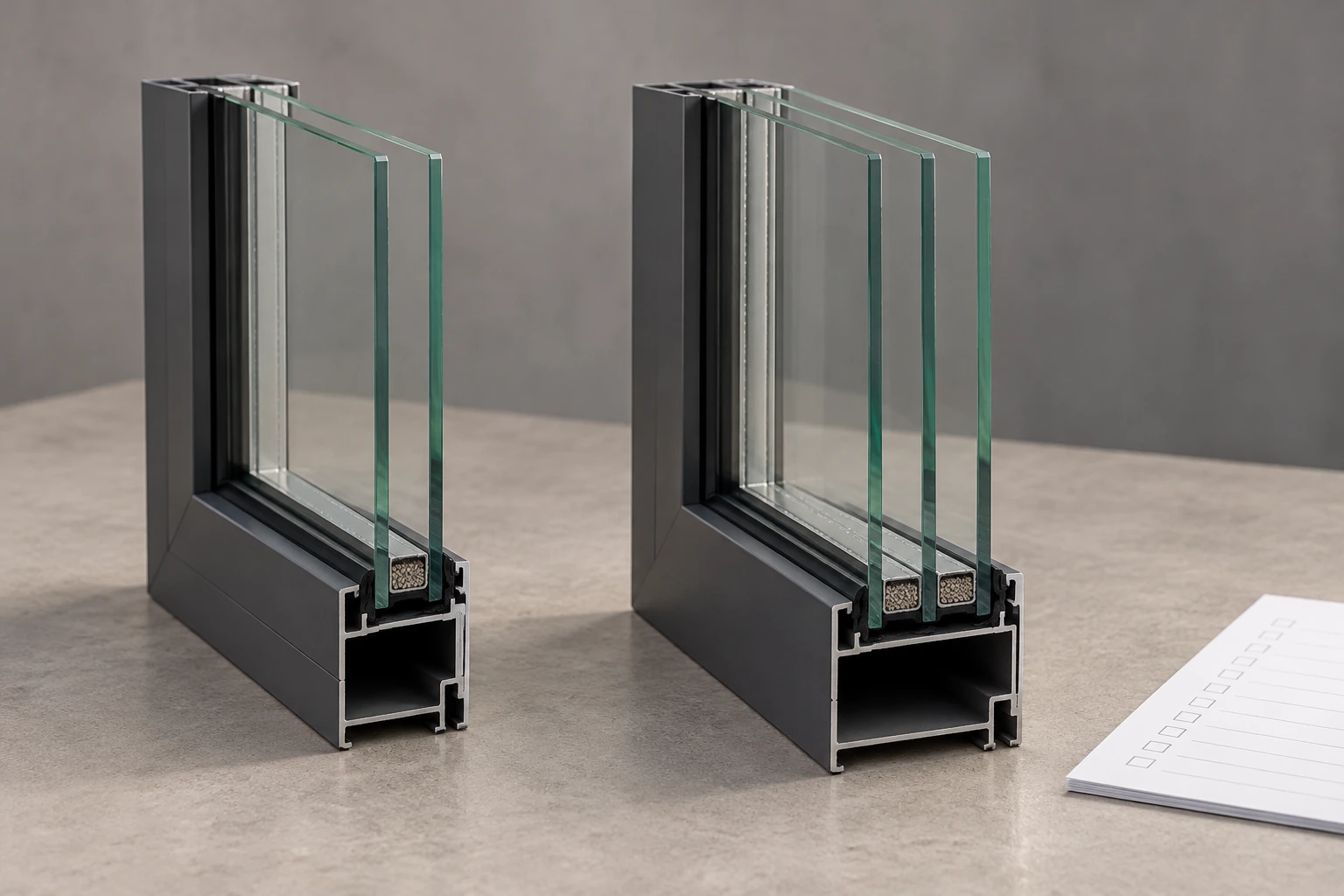
A double-glazed insulating unit has two glass panes separated by a sealed cavity. A triple-glazed unit has three panes and two cavities. Its actual performance also depends on coatings, glass thicknesses, gas specification, spacers, edge seals and the frame around it. Write those variables into the proposed configuration instead of accepting only “double” or “triple.”
The window system must accommodate the proposed unit. Check glazing thickness, sash construction, hardware, seals and the approved size range. A frame that accepts one insulated-glass thickness is not automatically approved for a thicker replacement. Changing the whole frame or operating type to accommodate the glass also changes the comparison scope.
Cutaway samples make the additional pane and cavity visible.
Use whole-window ratings on a common basis
The NFRC consumer guide to window ratings explains whole-product performance and the separate roles of U-factor, solar heat gain coefficient and visible transmittance. These answer different questions:
- U-factor: the rate of non-solar heat transfer per unit area and temperature difference; a lower value means less heat flow for the same area and temperature difference.
- Solar heat gain coefficient, SHGC: the fraction of incident solar energy admitted as heat; select it for the room’s solar conditions and building design.
- Visible transmittance, VT: visible light transmission; compare the proposed glazing rather than assuming an extra pane has a fixed daylight penalty.
Require the whole-window value for the applicable size/configuration and method. Center-of-glass performance excludes effects that matter in the complete assembly. Keep units explicit: a U-factor reported in Btu/(h·ft²·°F) is not numerically comparable to one in W/(m²·K). Use a documented conversion or request both reports in one unit system. The example below uses SI units throughout.
Energy ratings do not replace every other check. Air leakage, structural/water performance, safety glazing, installation interfaces and any destination-specific requirements still need appropriate evidence. Do not treat a thermal rating as approval for those separate tasks.
G-08: compare twenty windows without changing the base product
The package has twenty identical operable windows, each 1.20 × 1.50 m overall: 1.80 m² per window and 36 m² in total. Both options use the same frame family, operating type, finish and opening layout. The comparison assumes ratings on the same whole-window reference-size and calculation/testing basis. Actual evidence for that exact configuration is a production hold.
The sash masses are complete moving-sash assumptions, not calculated glass weights or hardware capacities. Prices cover complete window supply, the stated compatible glazing/hardware package and standard packing. They exclude freight, taxes, installation, opening alterations and any extra site lifting arrangements.
| Field | Double-glazed option D | Triple-glazed option T |
|---|---|---|
| Whole-window U-factor | 1.40 W/(m²·K) | 0.90 W/(m²·K) |
| Whole-window SHGC | 0.40 | 0.40 |
| Whole-window VT | 0.58 | 0.51 |
| Complete moving sash | 40 kg assumed; verify actual mass and hardware application. | 55 kg assumed; verify actual mass and hardware application. |
| Supply price per window | USD 900 | USD 1,120 |
| Twenty-window supply total | USD 18,000 | USD 22,400 |
| Unresolved evidence | Actual configuration/rating traceability, glass build-up, hardware and destination/site requirements. | The same evidence, including compatibility with the proposed heavier sash. |
The supply difference is USD 220 per window, or USD 4,400 for twenty. The assumed moving sash is 15 kg heavier per window. That mass comparison does not set an allowable hinge load, lifting method or total packed shipment weight. Ask for those separately, including the effect of actual sash dimensions and the selected hardware application.


Three room briefs give three different buying decisions
The following are client criteria chosen for this exercise. They are not climate-zone code limits, ENERGY STAR criteria or regional recommendations. A building designer must set the actual project targets, including orientation, shading and heating/cooling use.
- Cold, heating-dominated bedroom: the brief requires whole-window U-factor no higher than 1.00 W/(m²·K), SHGC no higher than 0.45 and VT at least 0.50. Option D fails the U target; option T meets all three assumed numerical criteria. Develop option T, subject to evidence and system-compatibility approval. The additional USD 4,400 buys a candidate that can meet this stated brief, rather than an assumed universal quality upgrade.
- Mild room with effective external shading: the brief accepts U-factor up to 1.60 W/(m²·K), SHGC up to 0.45 and VT at least 0.50. Both candidates meet the assumed numerical criteria. Retain option D as the lower supply-cost basis unless a further documented comfort or operational objective justifies option T. Both still need technical release.
- Sunny, cooling-dominated room: the brief accepts U-factor up to 1.60 W/(m²·K) but requires SHGC no higher than 0.25. Both candidates fail the solar-gain target at 0.40. Hold both and request revised solar-control configurations. Do not pay for option T on the assumption that the third pane closes this particular gap.
The equal SHGC values are intentional. They show why pane count cannot replace the actual solar rating. Real alternatives may have different coatings, light transmission and solar gain. If the supplier changes these to meet the third brief, update the complete rating and price record before making the choice.
A heat-flow calculation is not an annual saving or payback
The U-factor difference in G-08 is 1.40 − 0.90 = 0.50 W/(m²·K). At an assumed inside-to-outside temperature difference of 25 K across the 36 m² whole-window area, the simple steady-state heat-transfer difference is:
0.50 W/(m²·K) × 36 m² × 25 K = 450 W.
The DOE-sponsored window performance guide explains U-factor and whole-window versus center-of-glass scope. This calculation is a snapshot using fixed inputs. It excludes solar gains, air leakage, changing weather, room temperatures, shading, HVAC efficiency, occupancy and energy tariffs. It is not 450 kWh, an annual reduction or money saved.
To evaluate payback, obtain an appropriate annual building-energy comparison and the complete installed incremental cost. Include any changed frame, hardware, handling, opening work and installation scope. Then use the applicable energy prices and stated assumptions. Do not divide the USD 4,400 supply premium by the 450 W snapshot: the units and time basis do not describe a payback period.

Review sash mass, comfort and noise as separate evidence tasks
For an operable window, confirm that the complete sash mass, size, opening arrangement and fixing details are within the manufacturer’s approved system. A generic hardware load number detached from its application is insufficient. Review operating effort, adjustment access and safe replacement handling for the actual assembly. Fixed windows have a different hardware task, but still need suitable glazing support and installation details.
For cold-window comfort or condensation concerns, ask for the relevant complete-product evidence and assess the actual indoor humidity, temperatures and installation. A lower whole-window U-factor alone is not a promise that condensation can never occur at an edge, frame junction or installation defect.
For noise, request the required acoustic report for the specific window/glass configuration and test method. Pane count does not specify an acoustic result. Manufacturer sound-transmission tables can distinguish ordinary insulating glass, laminated configurations and triple glazing within the same opening family; their results should not be transferred to another product. If noise is the main reason for the upgrade, the thermal comparison in G-08 does not settle that decision.
The record to approve before placing the order
For the cold-bedroom case, record: select T for technical development; USD 22,400 supply basis; USD 4,400 above D; production held. Close the following fields before release:
- Exact frame/system, operating type, overall sizes and glass build-up, including coatings, cavities and specified gas.
- Whole-window U-factor, SHGC and VT evidence in the agreed units, with the relevant configuration and rating basis identified.
- Complete sash mass and approved hardware/application; any resulting operating, handling or installation change.
- Destination and project requirements, plus separate acoustic or condensation-related evidence where required by the brief.
- Same-scope final quotation and drawing/sample revision references; revised cost if any of the accepted components changes.
If a report belongs to a different opening type or only to the glass unit, retain the hold rather than copying its best number into the schedule. If the window family must change to support T, request a new complete comparison instead of assuming the original D-to-T premium still applies.
Send NOVARMIA the window schedule, destination, orientation/shading information, performance brief and the two proposed system submittals. Include the supplier’s whole-window ratings and complete supply boundaries so the discussion can address whether the extra pane solves your project’s actual requirement.
FAQ
Can double and triple glazing be mixed on one project?
Yes, if the schedule identifies each accepted configuration by opening and the design review considers appearance, daylight, solar gain and the relevant room targets. Keep glass and frame references traceable so a permitted mixed schedule does not become an uncontrolled substitution.
Can a broken triple-glazed unit be replaced with double glazing?
Do not assume the existing beads, gaskets, support and sash are compatible with the thinner unit. Obtain the window-system supplier’s approved replacement arrangement and recheck the project’s required performance. A unit that fits loosely into the opening is not an accepted replacement detail.
Is a low U-factor enough to confirm a gas fill?
No. Confirm the ordered glass build-up, gas specification and applicable production documentation. A reported thermal value describes a defined configuration under its rating method; it is not a direct field measurement of the gas in each delivered unit.
Should the lowest U-factor be selected if two prices are equal?
Check the other requirements first. Solar gain, daylight, opening effort, evidence scope, replacement support and the complete installation arrangement can change the choice. Equal supply prices do not make different window packages equivalent.