On this page
In this quotation comparison, the revised CIF route costs USD 13,320 and the completed FOB route USD 13,380 at the same defined destination-terminal stage. CIF is USD 60 lower for these two offers after insurance and destination-fee questions are resolved. Import clearance, duties, taxes and onward delivery remain outside both totals.
The comparison holds the goods, route, sailing, receiving point and agreed insurance schedule constant. It separates four things that an invoice total can blur: the sales price, purchased transport services, cargo cover and the event at which cargo risk transfers.
Define “at destination” before comparing the numbers
F-40 is a case comparison dated October 30, 2026: twelve packed crates of interior-door components move as conventional non-containerized sea cargo from Qingdao to Singapore on the same accepted sailing. Assume the carrier accepts direct-onboard loading. The two sale quotations state FOB Qingdao Port, China, Incoterms® 2020 and CIF Singapore Port, Singapore, Incoterms® 2020. The agreed origin loading point and vessel are identified in booking F40-BK.
The comparison endpoint is physical placement in collection bay P-40 at destination Terminal T-40, after vessel discharge and a defined internal terminal move, with the listed arrival-document administration paid. It is before import clearance and collection by an inland vehicle.
The carriage quotes end at T-40’s landside receiving pad after discharge. A separate terminal service moves the crates from that pad to bay P-40. Distinguishing those two points prevents an included discharge operation from being priced again under a vague “destination handling” heading. Physical placement in the bay does not establish customs release.
The cost endpoint is an agreed unloaded pickup stack at the destination terminal.
The two starting prices leave different work to purchase
The FOB seller offers the identified goods, packed and delivered onto the nominated vessel, for USD 12,000. The buyer needs a carriage contract and its chosen insurance, plus the separately identified terminal services. Under the CIF offer, the seller quotes USD 13,000, including its carriage to the receiving pad and the initially specified minimum insurance. Comparing 12,000 with 13,000 alone answers a different question from the terminal-stage budget.
These two rules apply to the direct-onboard sea arrangement in this model. If the actual receiving event is a container-terminal handover before vessel loading, review the appropriate rule and point rather than copying this example mechanically. The model does not prescribe a transport mode for every door order.
Close the service questions with accepted responses
The following are stipulated responses from providers.
Carriage response: the buyer’s nominated carrier accepts USD 1,000 for the FOB route on the stated sailing, including discharge onto the receiving pad. Its schedule identifies USD 220 of that amount as discharge; that 220 is a component of 1,000, not an additional charge. The CIF seller supplies its carriage-scope confirmation showing the same route, sailing and receiving pad, with discharge already included in the 13,000 sale price.
Terminal response: the destination service provider accepts USD 140 to move the crates from the receiving pad to bay P-40 and USD 60 for the specified arrival-document administration. The provider confirms those activities are outside both carriage scopes and are charged once for either route. The 60 excludes customs brokerage, government charges and inland-trucking documents. No other routine charge is required to reach the stated comparison stage under the accepted model conditions.
Insurance response: the buyer requires schedule INS-40 for both routes: USD 15,000 agreed insured amount in USD; the same Institute Cargo Clauses (A)-based wording; the same USD 250 per-claim deductible, exclusions and conditions; and the same covered transit from origin onboard delivery through the terminal move to bay P-40. The buyer has the agreed direct-claim entitlement and document access. These are common coverage inputs, not a recommendation of an insured value or deductible for a real order.
The FOB insurer accepts that exact schedule for USD 180. For CIF, the seller and its insurer accept a USD 120 net addition to replace the initial minimum-cover arrangement with the same INS-40 schedule and return the revised evidence. The original CIF price already contains its initial insurance; the buyer neither subtracts an unknown embedded premium nor adds another full 180 on top. Matching cover is established by the stipulated schedule and acceptance, not by similar premium amounts.
Normalize to the same physical stage and cover
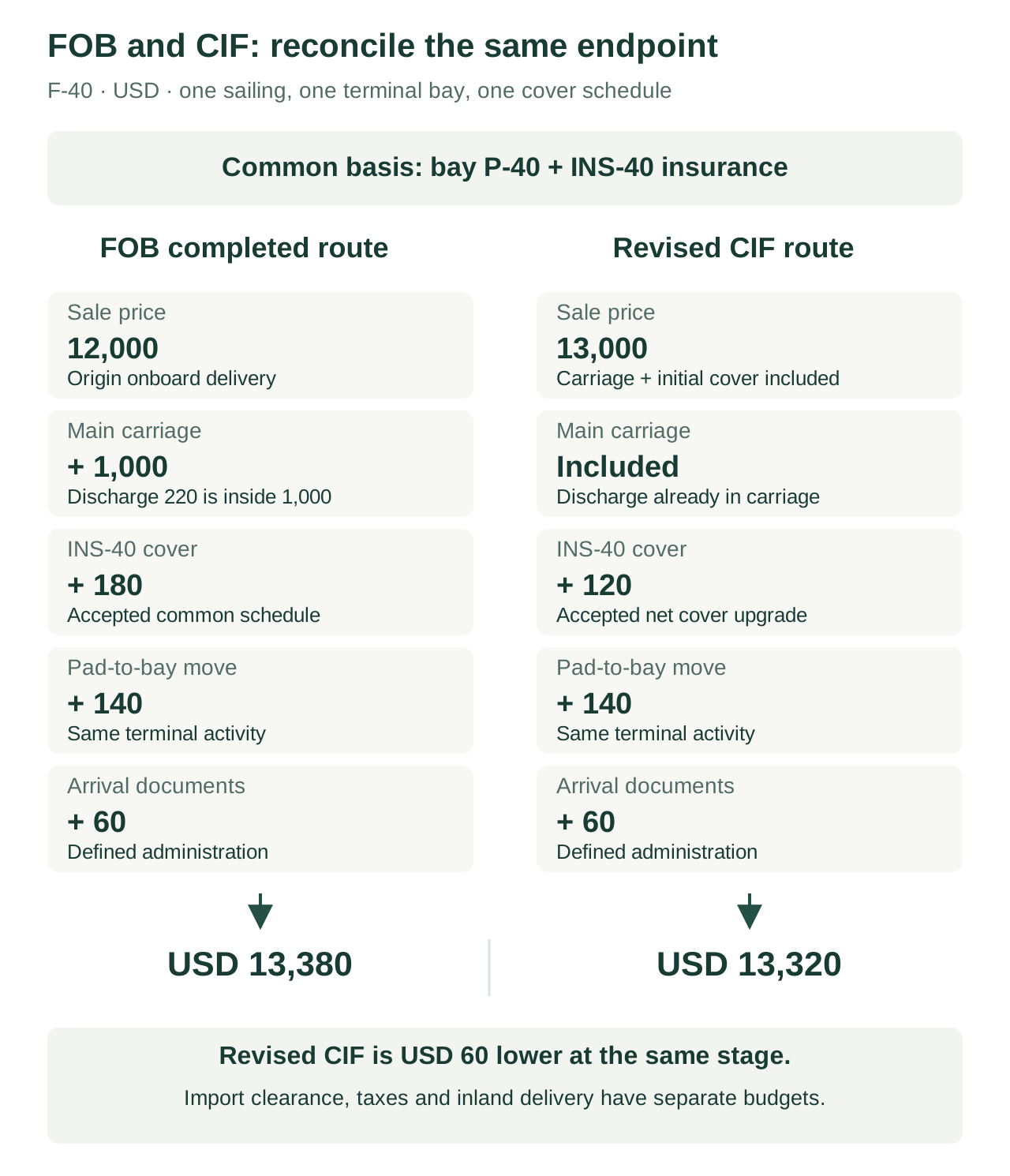
| Cost / scope | FOB route completed by buyer | CIF route after accepted revision |
|---|---|---|
| Supplier sale price | 12,000: goods through origin onboard delivery. | 13,000: goods, seller’s carriage and initial minimum insurance. |
| Main carriage | Add 1,000, including discharge onto receiving pad. | Included in sale price through the same receiving pad. |
| Discharge 220 | Already inside the 1,000 carriage amount. Add nothing again. | Already inside the seller’s carriage scope. Add nothing again. |
| INS-40 cover | Add 180 for the accepted common schedule. | Add 120 net to obtain that same schedule; revised sale amount 13,120. |
| Pad-to-bay move | Add 140; separate terminal activity confirmed outside carriage. | Add the same 140 for the same activity. |
| Arrival documents | Add 60; defined administration, excluding customs services. | Add the same 60 for the same administration. |
| Comparable total | 13,380 to the defined terminal stage. | 13,320 to the same stage. |
FOB: 12,000 + 1,000 + 180 + 140 + 60 = 13,380. Revised CIF: 13,000 + 120 + 140 + 60 = 13,320. The difference is 13,380 − 13,320 = USD 60 in CIF’s favor. The discharge component is visible for scope checking but is counted only within its existing carriage amount.
Completed selection: after receiving those confirmations, the buyer accepts the revised CIF offer and its INS-40 evidence for the stated sailing and endpoint. It records 13,120 as the revised sale amount and 200 as the separate terminal services, producing the 13,320 comparison total. It rejects the claim that the 12,000 FOB headline alone is the cheaper destination outcome.
The selection is limited to these accepted offers. It does not prove a usual CIF saving, compare every possible carrier, or value the buyer’s coordination time. If the CIF seller had not obtained the requested cover, or if either terminal scope remained unresolved, this completed comparison would not yet be available.
Keep insurance and cargo risk separate from the paid destination
ICC’s current Incoterms® 2020 explanation identifies Institute Cargo Clauses (C) as CIF’s default insurance level and allows agreement on higher cover. Minimum cover is not comprehensive protection against every cause of loss. That is why F-40 obtains a common coverage schedule rather than merely comparing the included premium with the FOB insurer’s invoice.
The formal ICC FOB/CIF rules distinguish delivery, carriage, insurance and costs. CIF’s normal cargo-risk transfer remains origin onboard delivery, even though the seller pays the contracted carriage and insurance to the named destination. The model assumes normal performance; applicable notice/default exceptions still matter. A destination price does not mean the seller bears every transit risk until the cargo arrives.
Read the insurance evidence, deductible, conditions, exclusions, transit period and claim procedure together. An agreed policy limit or a Clause (A)-based description is not a promise that every loss is covered or that a claim will succeed. The schedule does not replace the insurer’s actual acceptance for a consignment.
Discharge also follows the actual carriage scope. Where it is already paid for within the CIF seller’s carriage contract, it is not automatically an extra buyer charge. F-40 resolves that question with the carrier schedules and the distinct terminal move. It does not declare that every CIF quotation includes every destination-terminal service.

What is still outside the chosen 13,320?
All routine cost questions inside the declared comparison stage are closed in the model. The following remain outside both offers, with separate owners and budgets. They are not zero-cost assumptions:
- Import clearance and brokerage: buyer/import representative to confirm the actual procedure and service scope.
- Duties, taxes and government charges: assess for the destination, goods and transaction; no rate is assumed here.
- Inland collection, delivery and unloading at the project: obtain a separate route/access quotation after the terminal stage.
- Exceptional delay, examination or storage costs: resolve if the event occurs and check the relevant contracts and tariffs; no contingency is added in advance.
- Destination inspections, permits or product-compliance work: confirm what the actual goods and project require.
Consequently, 13,320 is a normalized terminal-stage amount, not a complete landed-cost or project-delivery budget. Keep this scope label next to the total when passing it to another buyer or accountant.
Send NOVARMIA both quotations, the cargo list, named ports/points, sailing, freight inclusions, insurance evidence and destination service responses to discuss a comparison against one endpoint. Mark each unresolved item explicitly before choosing the lower total.
FAQ
Should I add discharge if a destination agent sends a separate invoice?
Reconcile the actual service with the carriage contract and paid schedule first. A new invoice does not establish a new activity. Ask whether it duplicates paid discharge, covers a distinct move or reflects an agreed charge outside the original scope.
Can I compare offers in different currencies without changing the method?
Use an identified conversion date and rate source and keep currency exposure visible. A converted figure can support a dated comparison; it is not a guarantee of the rate available when payment falls due.
What if the shipment arrives after the quoted free-storage period?
Ask for the applicable time basis, trigger and charging party and update the affected route. F-40 excludes exceptional storage. Do not carry its 60-dollar difference forward as if an unpriced delay could not change the decision.
Does matching insurance remove the need to check packing?
No. Review the actual packing against the goods, handling and policy conditions. Comparable coverage does not establish that packing is suitable or that a packing-related claim will be accepted.


