On this page
Choose FCL when a dedicated container and a controlled packing plan justify the complete cost and the receiving site can handle that container. Choose LCL when a shared-container service accepts the actual packages, handling restrictions and delivery requirement at a suitable complete price. Neither mode is automatically cheaper, faster or damage-free. For building materials, package geometry, mass, fragility and the route to the final unloading point can outweigh the headline ocean rate.
FCL means full-container-load service: the container can be dedicated without being physically full. LCL means less-than-container-load service, where the shipment is consolidated with other cargo and separated for onward delivery. Compare the same goods and the same delivery endpoint. A port-only LCL price is not comparable with an FCL service that includes the destination truck journey.
The BM-06 case below starts with an LCL inquiry, then selects FCL after the LCL service declines a mandatory packing condition and the FCL response passes the accepted scope and budget.
Start with packed cargo, not the supplier’s product volume
Our shipment, BM-06, contains cabinet-panel crates and palletized tile cartons. Its proposed comparison route is a Foshan factory collection point F1 to an appointed warehouse W1 in Auckland. Use actual addresses, route, cargo-ready date and delivery window in the live request.
| Package group | Dimensions and volume | Gross mass and handling brief |
|---|---|---|
| C01–C04 Panel crates |
Four at 1.20 × 0.80 × 1.00 m. Each 0.960 m³; group 3.840 m³. | 180 kg each; group 720 kg. No top loading; lifting entry and support arrangement to be approved. |
| T01–T02 Tile pallets |
Two at 1.20 × 0.80 × 0.90 m. Each 0.864 m³; group 1.728 m³. | 650 kg each; group 1,300 kg. Remain upright and unitized; no top loading in this brief. |
| Same shipment | Six handling units, total external cube 5.568 m³. | 2,020 kg gross in total. Not a verified container packing or equipment-capacity assessment. |
The cube is 3.840 + 1.728 = 5.568 m³; gross mass is 720 + 1,300 = 2,020 kg. The two dense tile pallets need individual handling checks even though the shipment’s total cube looks modest. Space above non-stackable units is also not freely usable just because the arithmetic leaves room.
These dimensions do not prove that the cargo fits a particular container or vehicle. Check door opening, internal dimensions, floor loading, payload, access for loading equipment and the proposed arrangement. Do not select a container solely by dividing its nominal capacity by 5.568.
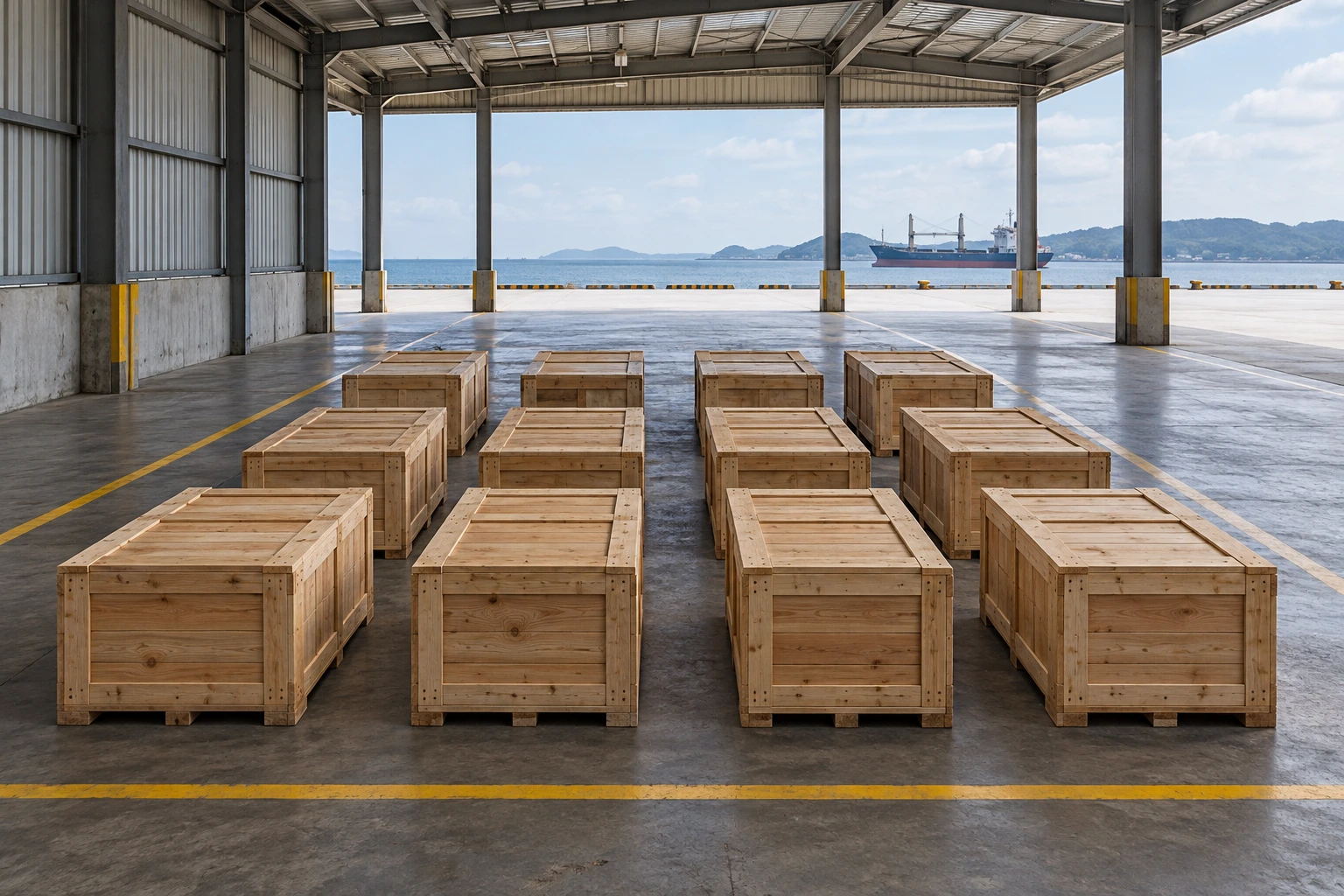
Pallet bases, protected edges and separate handling units during a packing review.

Compare the handling path and package protection
Under a proposed FCL path, a packer can load and secure BM-06 as one dedicated consignment. Under a proposed LCL path, the six units pass through the consolidator’s acceptance, storage and container-packing process, then destination separation and delivery. Confirm the actual transfers and parties. Do not assign an invented fixed number of handling events to either service.
FCL can reduce reliance on shared-container placement, but it does not remove factory loading, inland transport, terminal movements, possible inspection or destination unloading. A seal is a traceability item, not a promise that no authority or service provider will ever open or transload the cargo.
The IMO overview of the 2014 CTU Code describes a non-mandatory packing and handling code covering the intermodal chain, including receiving and unpacking. Use applicable guidance with the actual cargo and route; it is not a substitute for mandatory requirements or a qualified securing plan.
The CTU Code’s packing and securing guidance also addresses heavy-cargo distribution and avoiding heavy goods over light goods. The practical procurement task is to give the packer the mass, support, orientation and stacking constraints it needs. A heavy tile pallet should not be treated as self-securing, and a crate should not be assumed suitable for another pallet above it.
For BM-06, retain the no-top-loading instruction for both options until a competent package review authorizes a change. Obtain the required crate/pallet construction, lift points, fork-entry clearances, restraints and protection method. If LCL acceptance requires a different outer package, revise the packed dimensions and gross weights before requesting the final rate. FCL still requires its own approved securing arrangement.
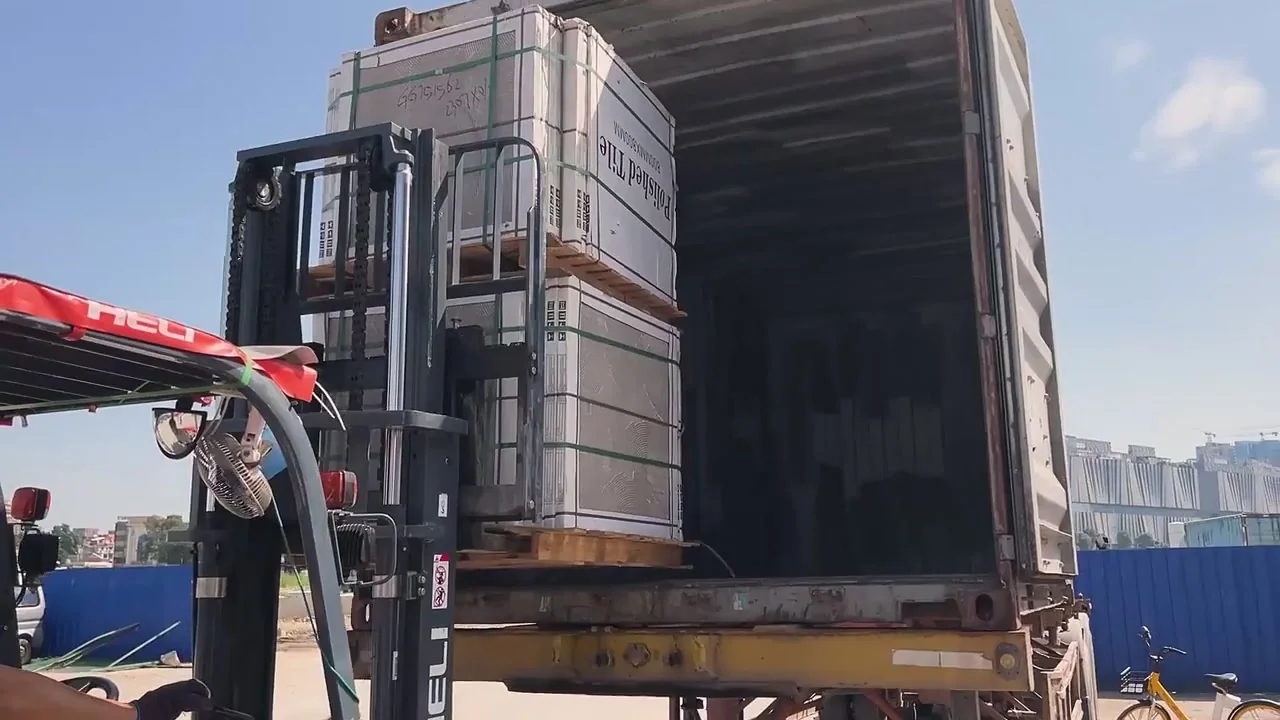
One shipment, one endpoint, two service scopes
The comparison boundary ends when the delivery vehicle reaches W1’s agreed unloading bay, with the consignee providing the approved unloading team and equipment. It does not include placement inside the building. The same boundary applies to both modes. For FCL, identify the empty-container return arrangement and associated charges even though the cargo has already arrived.
| Decision field | FCL proposal | LCL proposal |
|---|---|---|
| Container use | Dedicated space for BM-06; confirm equipment and packing plan even if partially filled. | Shared container; require written acceptance of all six packages and their no-top-loading restriction. |
| Origin service | State empty positioning, factory loading, securing responsibility and movement from F1. | State collection from F1, consolidation-warehouse receipt, handling and any required repacking. |
| Main carriage | Identify service, route, estimated milestones and all included/specified surcharges. | Identify consolidation service, route, estimated milestones and all included/specified surcharges. |
| Destination | State terminal/release tasks, transport to W1, empty return, free-time terms and exceptional charges. | State separation/release tasks, warehouse handling/storage terms and delivery to W1. |
| Unloading | W1 confirms container-vehicle access and a safe method for extracting the packed units. | W1 confirms delivery-vehicle access and a safe method for unloading all six intact units. |
| Charge basis | Record equipment-based charges, service fees, validity and exclusions; container rate alone is incomplete. | Record volume/weight-measure basis, conversion, minimums, rounding, non-stackable treatment and other fees. |
| Release hold | No booking until stowage, access, receiving arrangements and accepted total scope are confirmed. | No booking until package acceptance, handling path, receiving arrangements and accepted total scope are confirmed. |
Identify customs/brokerage service charges, duties and taxes, cargo insurance, inspections and exceptional storage separately. Mark each as included, excluded, separately estimated or conditional. An excluded government charge is not zero. This article does not estimate those amounts or establish import clearance for this lane.
Why the volume alone cannot produce a price winner
LCL pricing is not universally “cube multiplied by a rate.” Current logistics-provider terms can use volume or weight-and-measure units, with service-specific rules. The quotation must identify its conversion basis, minimums and chargeable quantity. Ask how restrictions such as no stacking affect that quantity or add charges. Do not copy one provider’s weight conversion into every tariff.
FCL also has costs beyond the sea leg. The factory-loading arrangement, inland legs, terminals, release services, equipment return and exceptions can change the comparison. Obtain both offers in the same currency, with quote dates, validity, shipment particulars and delivery boundary stated. No current rate has been obtained for BM-06. The completed case below therefore uses service responses, a service-only budget and a quote amount. These inputs demonstrate a selection method; they are not market rates, actual provider offers or a cubic-meter break-even threshold.
When correcting an incomplete offer, add a missing service once and keep its source visible. Remove an overlapping allowance if the revised package already includes it. If the provider cannot price or bound a material exclusion, retain it as an unresolved item instead of inventing an adjustment to declare the offers equivalent.
Close the BM-06 decision with service responses
The initial inquiry prioritizes LCL because the buyer does not require dedicated equipment by default. That inquiry priority is not the final choice. To finish the case, use the following continuation
The fixed comparison is still the same six packages, unchanged dimensions and gross masses, F1 collection and delivery to W1’s unloading bay. The no-top-loading requirement remains mandatory. The buyer’s approved budget for the defined routine transport services is USD 3,000. Import duties and taxes, cargo insurance, government inspections and exceptional storage are outside that service budget; the buyer has accepted their separately documented provision and exception terms.
- LCL response — reject for this unchanged packing brief. The consolidator will accept the shipment only in stackable outer packages and declines the existing no-top-loading condition. No revised package has been approved. Record “ineligible under the current package requirements”; do not remove the restriction merely to obtain a rate. A cheaper number would not repair this failed acceptance condition.
- FCL response — eligible within the case assumptions. The dedicated-container proposal accepts all six unchanged units without top loading. For this continuation, assume the competent packer has approved the equipment-specific packing/securing arrangement and W1 has confirmed vehicle access and its unloading method. These are stipulated case inputs: this article supplies no securing design or real-world approval.
- FCL scope and commercial review — accepted. The scoped quote is USD 2,800, including agreed origin positioning/collection, loading and securing services, main carriage and specified surcharges, routine export/import brokerage and terminal/release services, delivery to W1 and empty return. The quote identifies the responsible parties, validity, free-time and exception terms. The buyer accepts those terms and the separately listed exclusions. The service quote is USD 200 below the USD 3,000 service budget; that difference is not a saving against an equivalent LCL offer.
Recorded outcome: select FCL for BM-06 and decline the current LCL response. The decisive difference is compliance with the unchanged package requirements. FCL then passes the matched-service review and the buyer’s service budget. The decision record states the reason: “LCL package restriction refused; FCL accepted within the matched scope and service budget.” Cargo volume alone did not determine the result.
The buyer updates the transport request to “FCL selected,” attaches the accepted scope and package register, and instructs the coordinator to complete the formal booking documentation against those accepted terms. For a live shipment, attach the provider’s actual acceptance, approved packing and receiving records, and signed service terms to the booking file.
A different accepted LCL service could change the result in a new comparison. For example, if it accepts the restrictions and meets the same endpoint, receiver and budget requirements, it can remain an eligible choice. Reassess when the cargo, package design or service changes; retain the reason for the original decision.

Make the receiving plan part of the selection
Before booking, W1 should confirm the vehicle approach, unloading location, appointment, available equipment and package movement route. Name the person who receives the six units and reconciles C01–C04 and T01–T02 against the packing list. Retain the provider’s agreed documentation and exception-reporting procedures for visible package damage or missing units.
For FCL, plan safe door opening and unpacking with the competent receiving team; do not improvise around cargo that has shifted. For LCL, confirm the condition and identity of each released unit rather than assuming a container seal accompanies the individual delivery. Keep package-condition records and report exceptions under the relevant transport and insurance procedures without assuming the shipping mode determines coverage.
The RFQ scope format can hold the packed-cargo register and common delivery boundary. Send NOVARMIA the package dimensions and gross masses, material mix, handling restrictions, origin/destination points and receiving-site information to discuss packaging and supply coordination before asking a logistics provider for matched transport options.
FAQ
Can goods from several suppliers share one FCL container?
They can form one coordinated consignment if the agreed collection, packing and documentation arrangement allows it. Confirm who checks quantities and compatibility at the consolidation point. Several suppliers do not automatically make the final ocean booking LCL.
Should paint, adhesive or cleaning chemicals travel with the materials?
Declare the exact products and provide the documents requested by the logistics provider for classification and acceptance. Do not assume that a small quantity or inclusion in a building-material order removes special requirements. Keep any resulting packing or service change in the comparison.
What if the final package size differs from the estimate?
Issue a revised packing list before the provider confirms its booking and charges. Recheck acceptance, chargeable quantity, vehicle/container fit and receiving equipment. Keep the old estimate in the revision history so a change in price is not mistaken for an unexplained surcharge.
Does selecting FCL include cargo insurance?
No automatic insurance inclusion should be inferred from the mode. Check the actual quotation and proposed policy or cover separately, including the insured goods, route, packing conditions and relevant exclusions. Transport liability and a purchased insurance arrangement should not be treated as the same promise.