On this page
In the case, a USD 700 raw slab becomes a USD 1,970 supplied-and-installed route after an identified service provider accepts the fabrication, transport and installation scope. A comparable fabricator package is USD 2,050. The meaningful difference is USD 80, not the USD 1,350 gap between the slab-only price and the complete package.
A slab quote buys material on its stated basis. A fabricated quote may include measuring, layout, cutting, finished edges, openings, delivery and installation—but its inclusions must be checked. Compare completed routes for the same product and drawing, rather than treating a low material invoice as the cost of an installed countertop.
Q-38: fix the product, drawing and delivery point
Assume one quartz product, Q20, in the same color, finish and 20 mm thickness for both routes.The kitchen has two separate straight countertops: 2,800 × 600 mm and 2,000 × 600 mm. There is no L-shaped overlap to deduct.
The finished-edge schedule is the two front edges plus one exposed 600 mm end on each run. Thus 2.8 + 2.0 + 0.6 + 0.6 = 6.0 linear meters of the same simple eased edge. The remaining ends and rear edges meet walls under this example’s drawing. The opening schedule is one sink opening, one cooktop opening and one faucet drilling, using the same approved appliance references.
Both routes end with the tops installed on the prepared cabinets, including the agreed support detail, installation consumables and final fit check. Cabinets are assumed ready and suitable for that detail. The scope excludes backsplash, waterfall ends, old-top removal, plumbing/electrical disconnection and reconnection, appliance supply, cabinet alterations and taxes.
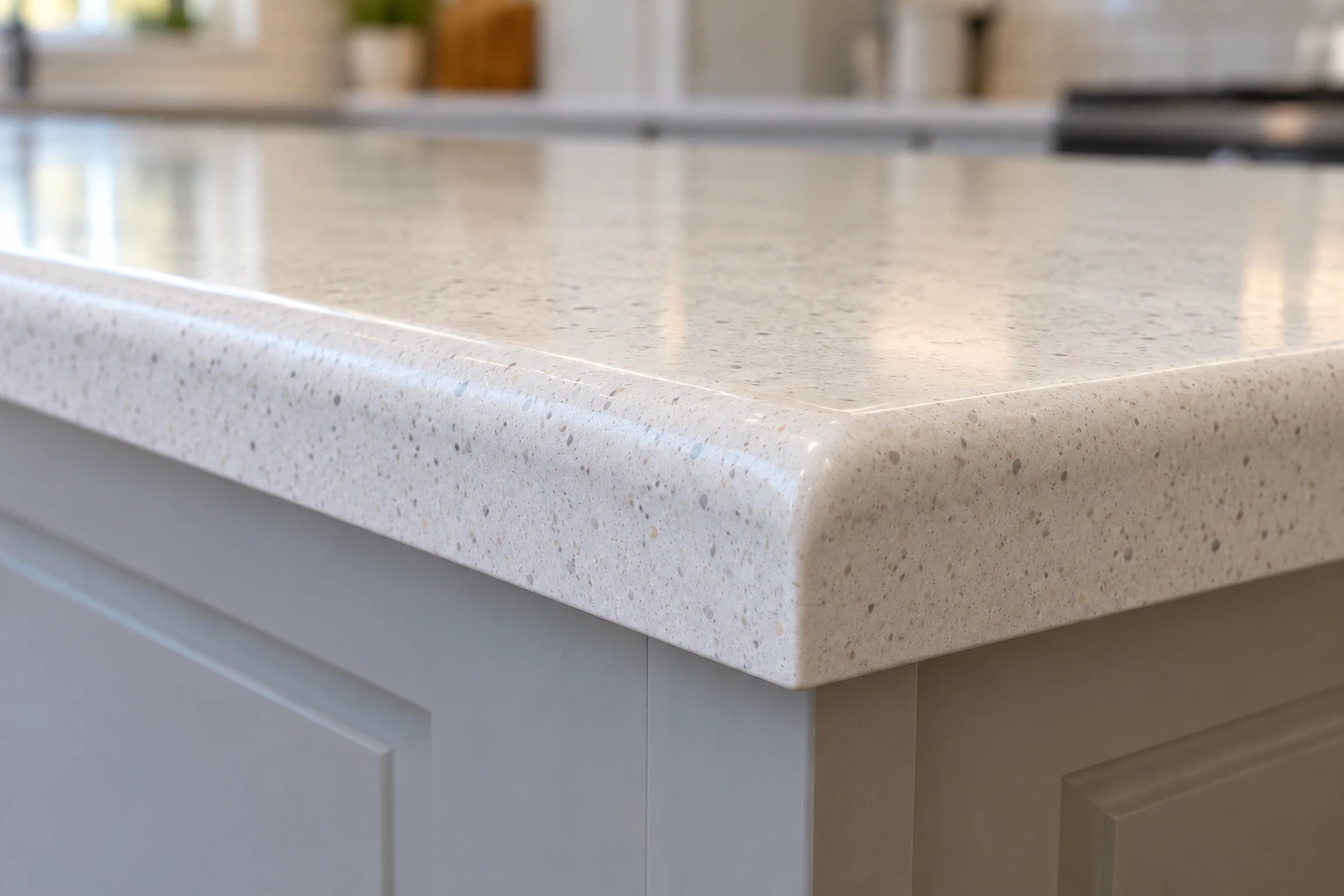
A finished countertop scope includes shaped edges and fixture openings as well as the surface material.
Keep countertop area separate from the slab purchase
The first top’s outline area is 2.8 × 0.6 = 1.68 m²; the second is 2.0 × 0.6 = 1.20 m². Their combined finished top-outline footprint before openings is 2.88 m². This is not the stone area remaining after the sink and cooktop voids, and it is not the purchased slab area.
For this example, the offered slab is 3,200 × 1,600 mm, or 5.12 m², and it must be purchased as one whole slab. The fabricator confirms that the two pieces can be nested on that slab, allowing for the required trimming, saw cuts, pattern orientation and production details. That response is a stipulated inputs. Area arithmetic alone would not establish that a real slab yields the required pieces.
On the stated footprint basis, utilization is 2.88 ÷ 5.12 × 100 = 56.25%. The geometric difference, 5.12 − 2.88 = 2.24 m², is the slab area not assigned to the two top outlines. It includes space taken by layout, trimming and saw cuts. It is not a promise of one usable 2.24 m² remnant, nor a saleable remnant valuation. Opening cutouts and actual recoverable pieces require their own identification.
In both accepted routes, the buyer owns recoverable remnants. The provider labels and returns the agreed recoverable pieces with the tops; unusable waste is disposed of. No assumed resale credit reduces either quote. If a real provider retains remnants or charges for their handling, resolve that difference before comparing totals.

Build the complete slab-purchase route with a real scope owner
Route A begins with a slab supplier’s USD 700 quotation. That supplier sells the identified whole slab; it does not fabricate or install countertops. Adding a guessed processing percentage would not make this a complete alternative.
For the example to proceed, assume service provider A-F responds in writing that it accepts this buyer-supplied Q20 slab, confirms the one-slab layout and undertakes the listed work for USD 1,270. It arranges the raw-slab collection and finished-top delivery, checks the slab on receipt and records any pre-existing defect before cutting. It accepts responsibility under this arrangement for replacement material and corrective work arising from its own handling or fabrication damage. Pre-existing material defects remain for resolution with the slab supplier before work proceeds.
A-F also confirms the same approved sink/cooktop references, six-meter edge schedule and job-specific support detail are included. The buyer remains responsible for the listed exclusions and for coordinating the slab sale with A-F’s service order.
| Scope line | A: slab plus accepted service | B: fabricator package |
|---|---|---|
| Whole slab | 700; one identified 5.12 m² slab, not 2.88 m² billed pro rata. | Included in package; same Q20 product and confirmed one-slab layout. |
| Measure / template | 100; site measurement and approved production template. | Included for the same drawing and prepared site. |
| Cut / edge | 360; straight piece cutting and 6.0 m of the specified eased edge. | Included; same piece shapes and edge schedule. |
| Openings | 220; sink and cooktop openings plus the faucet drilling. | Included for the same approved references. |
| Raw transfer | 90; slab supplier to A-F’s workshop. | Included within package logistics; no buyer-added raw-transfer line. |
| Finished delivery | 120; workshop to the agreed site/access conditions. | Included to the same site/access conditions. |
| Install / support | 380; installation, agreed support detail, consumables and fit check. | Included for the same detail and endpoint. |
| Comparable total | 1,970: 700 material + 1,270 accepted services. | 2,050 complete package; do not add another 700 for its slab. |
The two transport lines in A describe different journeys. They are not two allowances for the same delivery. The cut/edge line excludes the separately priced openings, so the USD 220 is added once. The installation line already includes the agreed support detail; no second generic support allowance is added.
Obtain the package response and complete the choice

Assume fabricator B confirms USD 2,050 for all included lines above, with the same product, one-slab yield, openings, edge, site access and remnant return. B is the buyer’s lead commercial contact for material procurement, fabrication, transport, installation and correction of its own work, including coordination with any subcontractors. This is one agreed scope owner, not a promise that every task is performed by B’s employees or a guarantee against every possible defect.
The buyer now has two complete routes: A at 1,970 and B at 2,050. B’s difference is 2,050 − 1,970 = USD 80. Neither route is declared technically superior from these prices.
Recorded selection: the buyer chooses B at USD 2,050 because it accepts the USD 80 difference for one lead scope owner and fewer interfaces between the slab sale and service order. It rejects the claim that Route A costs only USD 700. Route A remains a valid lower-priced alternative in this example because A-F has actually been stipulated to accept the complete service and damage/correction boundaries. A buyer comfortable managing those interfaces could choose A instead.
This closes the decision. In a real comparison, a missing acceptance of buyer-supplied material, an unresolved yield or an undefined installation scope would prevent treating the slab route as an equivalent offer.
Understand what changes the conversion
The useful cost drivers are the decisions that change material consumption or work. A wider/deeper piece, pattern direction or a different seam arrangement may alter the slab requirement. Another opening or a different edge changes processing scope. Access restrictions and the agreed support/installation arrangement can change delivery and site work. Confirm the revised scope before carrying forward the old total.
Cambria’s current planning guidance illustrates why an estimate needs the cabinet layout, edge, backsplash and sink/cooktop information, and why the fabricator confirms the maximum producible piece. Its installation explanation distinguishes measuring, cutting/edges/openings and installation. These are useful scope distinctions; Cambria’s slab sizes, product claims and warranty are not the inputs to Q20.
Specify what “fabrication” includes rather than instructing an improvised site adjustment to protect a budget. The 2026 OSHA/NIOSH countertop hazard alert addresses respirable crystalline silica exposure during manufacturing, finishing and installation of natural and engineered stone countertops. The provider must resolve the appropriate work methods and applicable requirements. The USD example is not a method or compliance approval.

Return one revision and one scope schedule
Use the same drawing revision for both offers. Identify the product, finish, thickness, piece dimensions, openings, edge lengths, seam/pattern requirements, support detail, delivery access and installed endpoint. State the slab purchasing basis and remnant treatment. List exclusions next to the total so the buyer can see which other trades and budgets remain involved.
- Mark each line included, separately priced, excluded or unresolved; do not turn an unresolved item into zero.
- Add a missing service only after a provider accepts that work and its interfaces.
- Remove duplicate allowances where a package already contains the item.
- Recheck the total and record the chosen route and reason against that scope revision.
Send NOVARMIA the countertop drawing, product/finish reference, opening and edge schedule, site access and competing quote inclusions to discuss a comparable material-and-fabrication package. Identify who will own templating, support, delivery, installation and any buyer-supplied slab interfaces.
FAQ
Can an existing remnant replace the whole slab purchase?
Only after the provider checks its usable dimensions, condition, product match and layout for the required pieces. Obtain a revised material and service quotation; a remnant’s nominal area alone does not establish that it supplies both tops.
Why might two quotes use different square-meter quantities?
They may measure purchased slab area, finished top outlines, minimum billable pieces or another declared basis. Ask for the takeoff definition and the piece schedule. Converting units does not resolve a difference in what is being billed.
Does the sink opening price include buying and connecting the sink?
Do not assume it does. Identify the fixture supply, opening fabrication, sink support/fixing and plumbing connection separately. In Q-38 the opening and agreed support are included; fixture supply and plumbing work are excluded.
What if I change the cooktop after templating?
Request a change review against the actual model and opening before work continues. Establish whether the existing layout can be revised and obtain the cost/responsibility response. A matching nominal appliance width is not permission to reuse the old opening.