On this page
Evaluate acrylic kitchen cabinets by the actual door construction, the appearance of the finished face and edge, and the maker’s repair limits for that precise finish. Some specified gloss acrylic products have approved scratch-repair methods; that does not make every acrylic, hard-coated or matte surface polishable. Surface marks, damaged edging and a damaged core require different decisions.
This guide concerns acrylic-faced cabinet fronts, not an assumption that the entire cabinet is solid acrylic. Its case selects a finished sample and then completes three distinct service decisions: clean a surface residue, return an edge-damaged leaf for approved workshop work, and replace a leaf with a split core.
Identify the acrylic product beneath the gloss description
“Acrylic” can appear in different product descriptions. Get the maker, family, finish variant and complete panel build-up, including core, reverse and edging. A decorative acrylic laminate is not interchangeable with a liquid-applied coating that happens to contain acrylic resin.
For a real construction example, REHAU’s RAUVISIO brilliant technical information describes a coextruded laminate with a styrene-copolymer base and acrylate top layer. It separately identifies hard-coated brilliant SR variants and a pressed-board assembly with MDF and a balancing sheet. Those distinctions matter when finding the right care or repair instructions; one family name is not enough.
Record whether the offer is a loose laminate, a pressed board for fabrication or a finished edged door. An attractive face sample says little about an unspecified backer, an unapproved core or an edge made by a different process. Ask which party takes responsibility for the finished component.
Compare finished samples against the ordered appearance
Use the intended door size and edge detail, not only a small face chip. Observe the reflected line of a window or light fitting across the face and toward the edge, with the samples in the same orientation. Describe any reflection distortion, face/edge sheen difference or visible joint that affects the buyer’s choice. This is a project appearance review, not a measured gloss or optical-flatness test.
In review A-43, the buyer requests two nominally equivalent warm-white high-gloss acrylic/MDF door samples at the same finished size. The maker identifies each construction and removes the review-piece protection according to its instructions. Production handling/protection remains governed by the actual product guidance.
| Check | Sample G1 | Sample G2 |
|---|---|---|
| Declared build-up | Named high-gloss acrylic laminate, MDF, reverse and matching edge, with care record C-43. | Same requested core/size and gloss brief, but a different offered edge/profile configuration. |
| Face reflection | The buyer accepts the reflected-line appearance under the stated project viewing conditions. | The face alone is also visually acceptable; no inferred scratch or heat superiority. |
| Face-to-edge transition | Selected edge/profile gives the appearance the buyer wants with the face. | Visible edge sheen/profile differs from the buyer’s preferred reference. |
| Service record | Maker identifies the exact finish and the applicable cleaning/repair limits. | A generic “all acrylic can be polished” statement is not accepted as finish-specific guidance. |
| Completed choice | Select G1 as the construction and appearance master for the order. | Do not adopt G2 as an equivalent substitution for this brief. |
These sample observations are dated October 30, 2026.
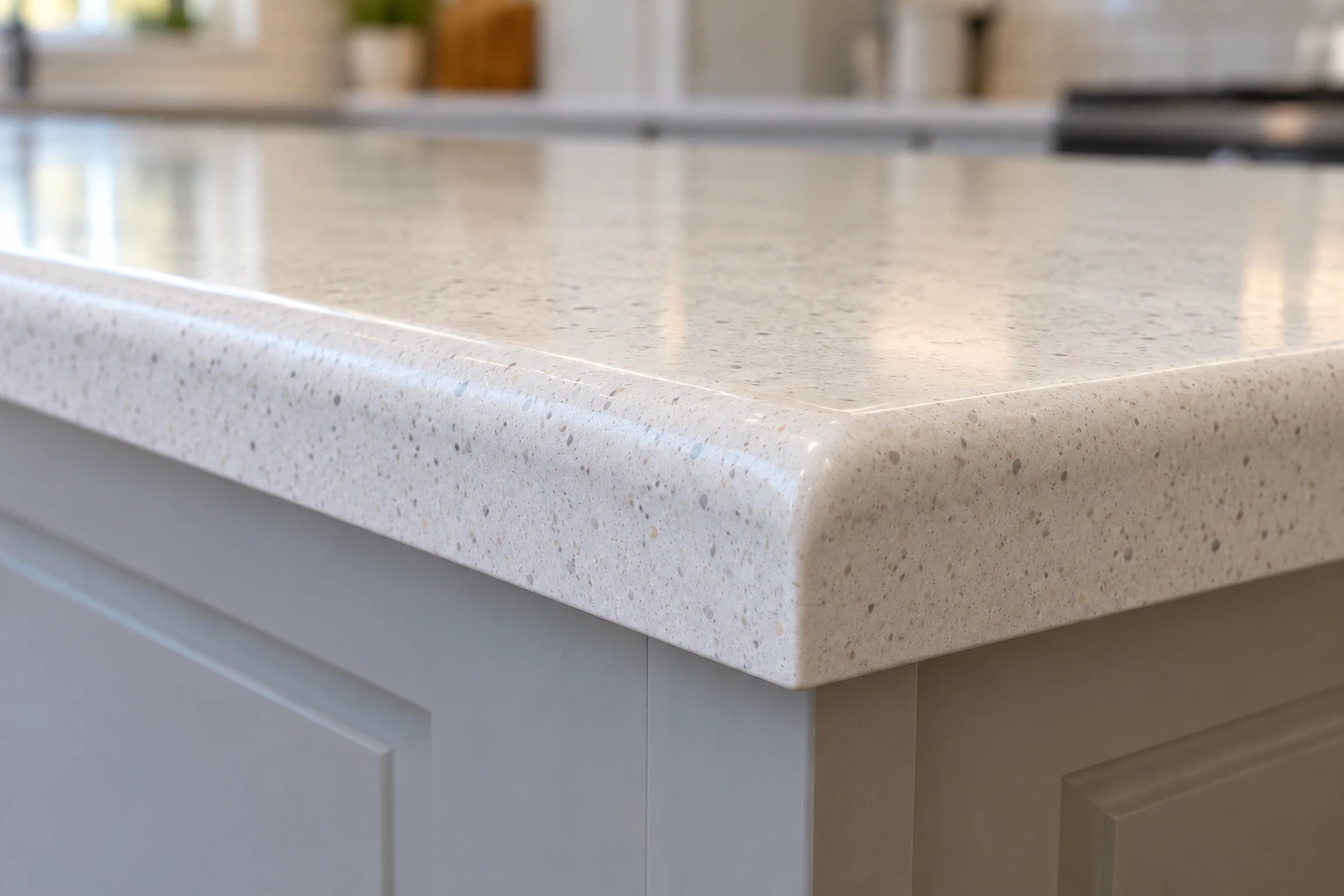
An oblique view helps inspect reflections and finished edges.

Diagnose the affected part before authorizing a repair

Keep the door reference, finish, damage location and photographs with the service request. Ask the maker to distinguish removable residue, a damaged decorative layer, a damaged edge and damage that extends into the core or fixing zone. Do not begin with a polishing instruction before knowing what the mark actually is.
A real example of a bounded repair method appears in EGR’s current care guidance: its TruGloss section describes scratch-repair treatment for that finish, while the same guidance does not extend that repair to TruMatte. This is a product-specific distinction, not authorization to use that method on REHAU SR, an unidentified acrylic coating or another maker’s matte surface.
The following A-43 service events occur after the sample choice. They do not establish a general manufacturer warranty or prove that every similar-looking defect can be repaired.
| Event | Maker response and accepted action | Recorded result / boundary |
|---|---|---|
| Face mark | A hazy handling mark is diagnosed as residue on intact G1 material. Maker approves cleaning under care record C-43; no abrasion or refinishing is authorized. | In the review, cleaning removes the mark and the buyer accepts the appearance. Close this event as cleaning, not scratch repair. |
| Edge chip | A local edge chip leaves the core firm and the face intact. Maker confirms it can replace that edge in the workshop while maintaining the agreed final size and profile. | Buyer chooses the accepted workshop work. The returned leaf is compared with G1 and accepted. Do not treat the response as permission for arbitrary on-site trimming or filler. |
| Core split at hinge fixing | The maker identifies split core in the fixing area and rejects a face-only cosmetic treatment. It offers a new leaf and a corrected assembly/fixing record. | Buyer chooses replacement, withdraws the damaged leaf from use and updates the part/service record. A surface polish cannot restore the stipulated damaged fixing substrate. |
Completed outcome: retain the selected G1 construction, close the residue event after cleaning, accept the confirmed workshop edge repair and replace the core-damaged leaf. The buyer rejects a universal polishing remedy and the proposed cosmetic cover-up of the split core. No real field repair, repair yield or performance test is being reported.
For actual work, the maker must confirm that the proposed repair is suitable for the exact leaf, construction and finish. If re-edging would change the dimensions, expose another defect or fail to reproduce the accepted appearance, obtain a replacement response instead of assuming the A-43 outcome applies.
A repairable surface is not a promise of an invisible repair
Define what the buyer will accept after work: face reflection, visible haze, edge profile, color relationship and operation of the door. Compare the repaired or replacement leaf with the retained master and neighboring fronts. A surface can be technically treated yet still leave an appearance the buyer does not accept.
Keep the exact finish variant visible in the record. REHAU’s technical information distinguishes its standard acrylic laminate from hard-coated SR variants; the current instructions for the supplied variant must govern. Do not carry an older or different product’s polishing advice across that distinction.
For replacements, record the decor, batch information, construction, size, edge and hardware pattern. Ask what matching stock or future replacement route is available rather than assume the same decor will always be produced. If no acceptable local repair or match is offered, the commercial choice may be a replacement leaf or an agreed wider replacement scope.
Keep a UV-lacquer alternative clearly defined
Here, UV lacquer means a coating system cured using ultraviolet energy, rather than the acrylic laminate facing described above. For a real alternative construction, EGGER identifies PerfectSense Feelwood as UV-coated melamine-faced chipboard with its own surface build-up and reverse. That is not an acrylic laminate on the same MDF core, and it is not a controlled performance comparison with G1.
If a supplier offers UV-lacquer cabinets as an alternative, request the actual substrate, coating build-up, edge treatment, appearance sample and repair/replacement instructions. A coating chemistry containing acrylic components does not turn that system into the same product as an acrylic-faced door. Compare the offered finished components against the project brief without inventing a heat, scratch, repair-cost or durability ranking.
Keep the acrylic and named UV-lacquered proposals separate in the sample and service record. Approval of one does not authorize substitution of the other or imply that both can be touched up in the same way.

Put the accepted master and service limits into the order
- Construction: identify the face variant, core, reverse, edge/profile and finished-door maker.
- Appearance master: retain the approved full-size sample or its agreed reference, viewing record and face-to-edge decision.
- Care: provide the current finish-specific instructions to the installer and user, separate from workshop processing directions.
- Service response: state who diagnoses a defect, who may perform approved work, what post-work appearance is accepted and when replacement is required.
- Traceability: keep part, batch, drawing, hardware and any replacement changes together.
Send NOVARMIA the acrylic finish reference, complete door build-up, approved face/edge sample and required repair/replacement response to discuss a cabinet package. For a service issue, identify whether the concern is on the face, edge or core and include the relevant part record and photographs.
FAQ
Can I repaint acrylic fronts instead of replacing them?
That would create a different finished system. Obtain a specific assessment of adhesion, preparation, appearance and warranty implications from the responsible parties. Do not assume repainting preserves the original acrylic specification or its care and repair claims.
Who pays packing and return freight for an approved repair?
Record collection, protective packing, freight, removal/refitting and any replacement handling in the commercial service scope. Approval of a repair method does not mean every associated cost is included. Obtain the provider’s cost and responsibility response before sending the leaf; do not assume a universal refund or freight entitlement.
Does an oven-side location change the approval?
Check the exact panel and appliance installation requirements for that location, including any specified clearances or protective details. A gloss sample and a generic acrylic label do not establish suitability beside a particular heat source.
What if a replacement face matches but the edge does not?
Treat the face/edge relationship as part of the replacement review. Request the specified matching edge/profile or record an explicit alternative acceptance. A decor code on the face alone does not close the service issue.