How is this board different from a wood grille panel?
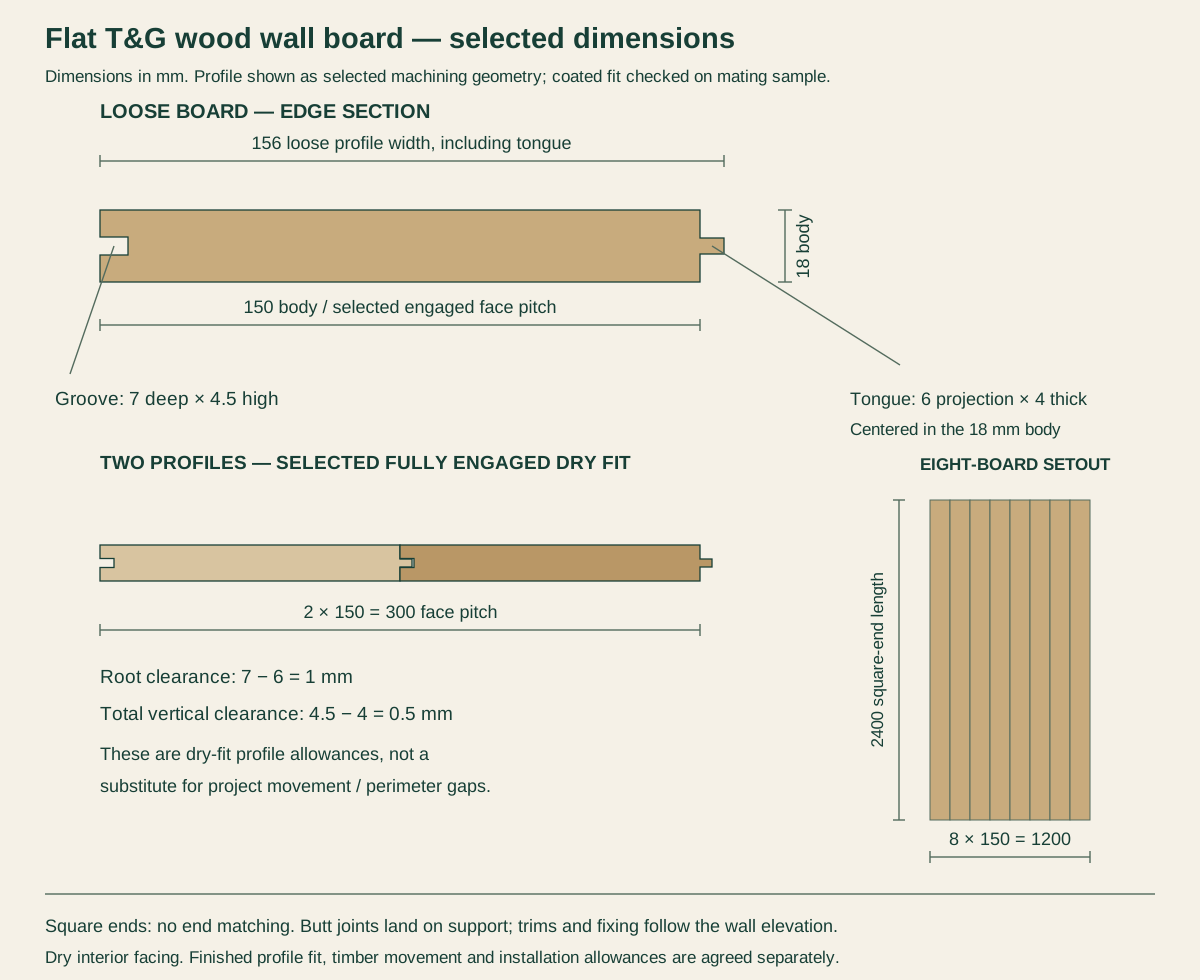
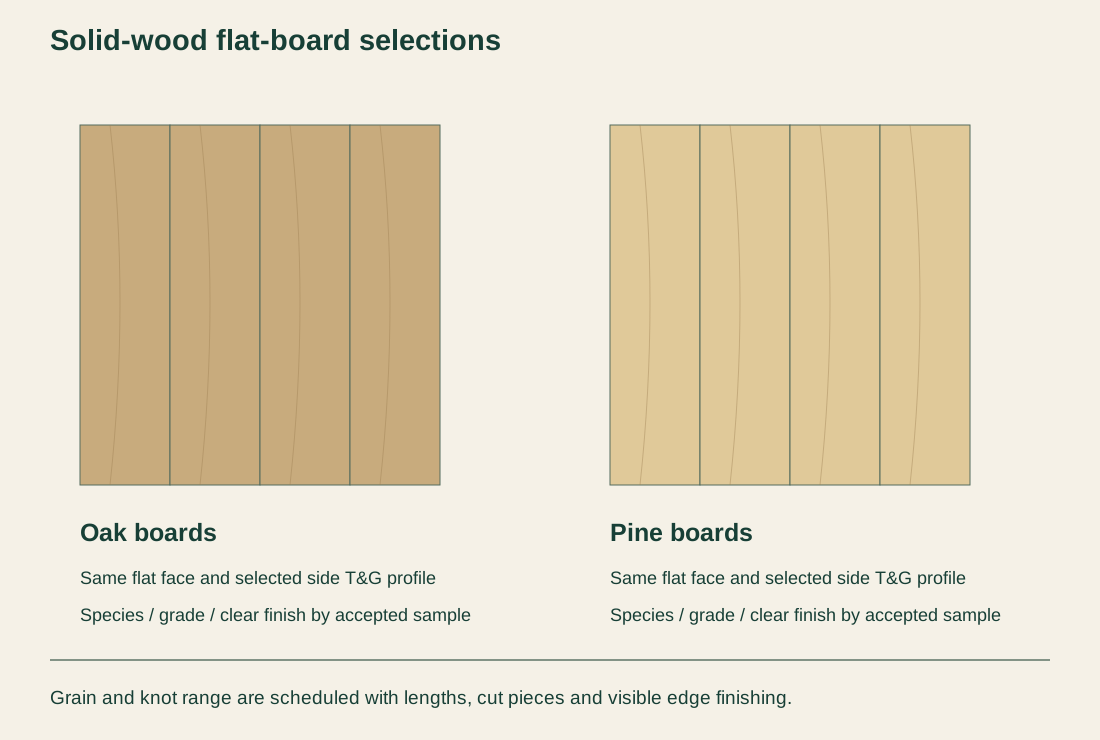
It has a broad flat solid wood face and interlocking side edges. It does not use multiple projecting ribs or open grille slots. The profile drawing shows the interlocking side edges and flat face.
Which width is used for installed coverage?
The selected starting face pitch is 150 mm when the profiles are fully engaged in a dry mating sample. The 156 mm loose width includes the 6 mm projecting tongue, so installed coverage is the 150 mm pitch. Any specified movement or installation gap is allowed for on top.
What tongue-and-groove dimensions are selected?
The selected 18 mm body has a centered 4 mm-thick tongue projecting 6 mm. Its matching groove is 7 mm deep and 4.5 mm high. That leaves 1 mm at the root and 0.5 mm total vertical clearance at the selected dry fit; final coated fit is checked on a mating sample.
Are the board ends also tongue and groove?
No. The selected 2400 mm board has square ends. Length-to-length butt joints require their own support and layout. End matching can be a separate profile request, with its own dimensions and quotation.
Can the boards run horizontally as well as vertically?
Yes, with a support and joint layout for the chosen direction. Board ends, fixings, corners and service openings change with the orientation. The wall elevation identifies the direction and the actual cut pieces before the order is finalized.
Can these boards be used as flooring or exterior siding?
This selection is for dry interior wall facing. Flooring, exterior siding and wet-area lining have different wear, moisture, fixing and performance requirements. Those uses call for a complete product specified for them.