On this page
Begin dining table decor with the meal, not the centerpiece. Put out the plates, glasses and serving dishes you actually use. Then choose an arrangement that fits around them, leaves people able to see one another and can be cleared without a complicated reset.
A low flower arrangement, a bowl or a small group of vessels can give the table a finished appearance between meals. The same display does not have to stay in place during dinner. Plan a simple everyday arrangement and decide what changes when food comes to the table.
Decide what stays out between meals
An everyday dining table does not need a complete place setting at every seat. If the surface is also used for homework, a laptop or food preparation, permanent plates and glasses may make it harder to use and keep clean.
Choose one main role for the display. A fruit bowl can hold something the household eats. A vase can bring a color from the room onto the table. A sculptural bowl can be left empty so its shape is visible. Each of those can be the whole arrangement rather than the start of a larger collection.
Think about the table when nobody is sitting at it. Does the room already contain patterned chairs, a busy rug or a strong pendant? A simple vessel may connect those elements without adding another competing pattern. If the room is quiet, a patterned runner or a more expressive bowl can provide the interest.
Then decide where the arrangement goes during a shared meal. It might stay, move to a sideboard or be reduced to one object. Giving it a destination makes the change quick and keeps a vase from ending up on the floor because every counter is occupied.
Set the usable places before choosing centerpiece size
Use your ordinary dinnerware for this check. Set one place fully, including the largest plate you regularly use, the glass and the utensils. If you serve meals in the center, put the actual serving bowl or its empty equivalent on the table too.
Now look at the space that remains. A long narrow opening may suit a line of small vessels. A compact central opening may suit one low bowl. If the only way to pass a serving dish is around a tall arrangement, the arrangement is using space the meal needs.
Pottery Barn's table-setting guide builds a setting in layers of linens, dinnerware, glassware and finishing pieces. For an everyday meal, stop at the layers you use. Extra glasses and decorative plates should have a purpose rather than fill every gap.
Check the setting from every chair, including the ends of a rectangular table. A centerpiece that looks narrow from the side can sit directly in the end diners' view. Have someone sit opposite you and test conversation before adding more height.
Rectangular tables work with an interrupted center line
A long table often looks balanced with a central arrangement that follows its length. It does not need an unbroken row of objects from one end to the other. Breaks in the display can become useful places for food and allow people to pass things across.
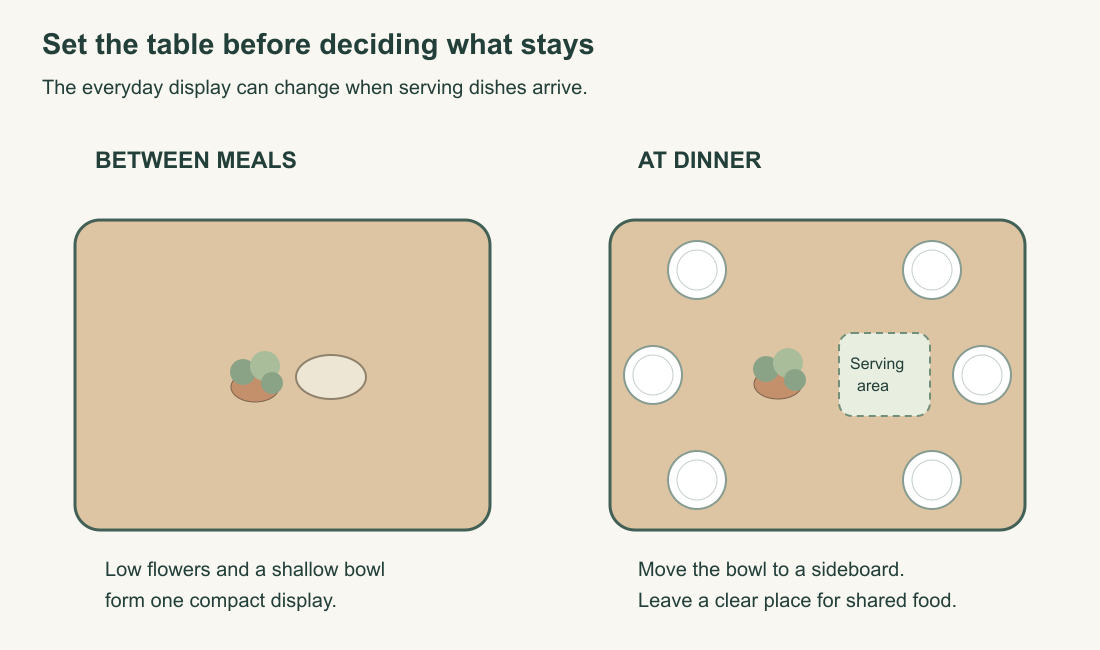
Try this arrangement:
- Place a low vase near the center, with a shallow bowl beside it rather than directly in front of an end seat.
- Keep the grouping short enough that the outer places remain distinct from the display.
- Set the table and put a serving dish where it would normally land.
- Move the bowl or the whole decorative group to the sideboard if it occupies that serving area.
The empty spaces are part of the composition. They show the wood, stone or finish of the tabletop and keep a runner from becoming a shelf for small ornaments. A long table can also work with two separated low groups, but check that neither blocks the path of a shared dish.
For an extendable table, arrange it in its everyday length first. When you add a leaf, reset the display after placing the additional settings. Simply stretching the same arrangement along the new seam can leave awkward gaps or put an object where a serving bowl belongs.
Round tables suit a compact center with clear reach
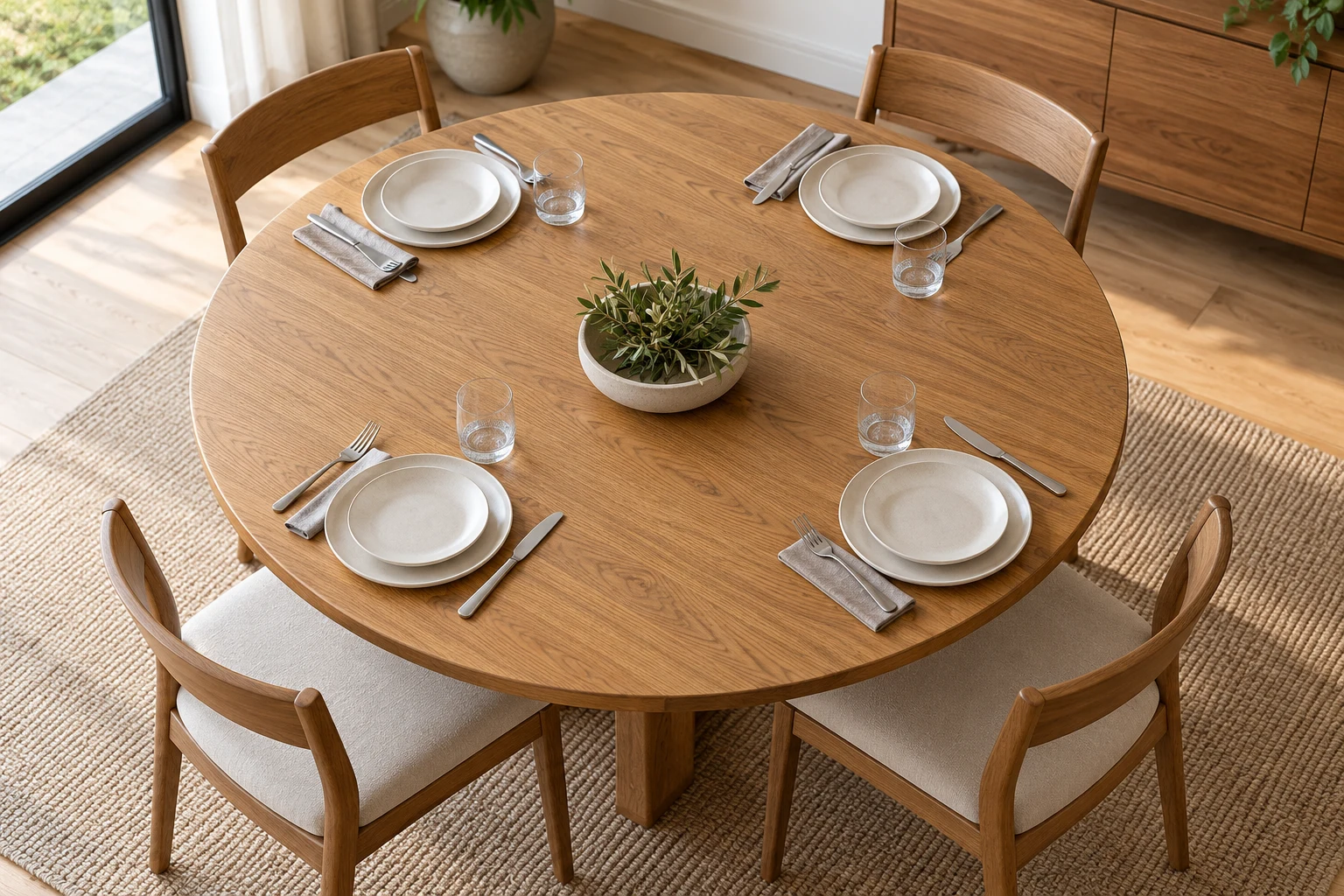
A round table often needs fewer objects because everyone shares the same central area. Try one low floral vessel or a shallow bowl. Turn it and look from all the seats; there should not be a finished front facing one person and an exposed back facing another.

If a serving platter normally sits in the center, move the decorative piece before the meal. Avoid making each person reach around flowers to find food. On a table with a rotating center, check that the objects remain stable through a full rotation and do not interfere with the place settings. Use that feature as intended for the particular table.
For a small dining table, a single stem in a suitable low vessel or one small bowl may be enough. Do not compensate for a limited footprint with a tall, narrow centerpiece that interrupts faces at close range. An empty center during meals can be the most comfortable arrangement.
Choose a centerpiece that has a clear shape
There are several ways to make dining table centerpiece ideas feel specific without filling the table. Choose the object type for how you want to use the room, then adjust its shape and contents.
| Centerpiece | Everyday version | What changes for dinner |
|---|---|---|
| Flowers | One low arrangement with a contained outline | Shorten or move stems that interrupt the view |
| Fruit | A shallow food-suitable bowl with room to take a piece | Move it if the same space is needed for shared dishes |
| Sculptural vessel | One bowl or vase with its outline visible | Leave it only if it does not obstruct service |
| Small vessels | A restrained group with space between pieces | Remove extra pieces instead of squeezing settings around them |
| Candlelight | Suitable flameless candles in a compact grouping | Keep the table's food and conversation paths available |
Flowers should work from seated eye level
Start with the vessel before choosing the flowers. A broad, low container lets you build an arrangement with an identifiable shape without relying on tall stems. Put water in the vessel before the final table test so you assess it with its normal weight and condition.
Keep foliage inside the display area. Stems that trail across a placemat or into a serving bowl are no longer just a visual choice. Look at the arrangement from the shortest and tallest seated positions, and trim or remove what blocks the view.
Fresh flowers need regular attention. Remove fallen material, check the water and lift the vessel to inspect the surface beneath. If that routine does not suit the household, choose an empty vessel or another object you can keep clean instead of letting an elaborate display deteriorate on the eating surface.
A bowl can be useful without becoming a storage pile
If fruit will be eaten from it, use a bowl intended for food contact and manage the contents as food. Keep decorative, non-food objects out of the same bowl. A display of fruit is useful only while it is easy to inspect, pick up and replenish.
An empty bowl can also work. Its rim, texture and interior may provide all the detail the table needs. Avoid filling a distinctive vessel merely because an empty container seems unfinished.
Grouped vessels need restraint
Choose a relationship among the pieces: similar color with different shapes, or one material with contrasting finishes. Start with a small group and leave enough space that you can read each outline. If several small items look like a collection waiting to be put away, remove the weakest one rather than adding something taller.
The Architectural Digest collection of everyday centerpiece ideas shows how many different objects can serve as the focal point. Use that variety to find a direction, then test your version with the meal in place. A photographed arrangement is not automatically a practical layout for your table.
Use linens as a background rather than another obstacle
A tablecloth changes the whole surface; a runner draws attention along one line; placemats define individual settings. Pick the one that makes the table easier to use and clean. Using all three is an option, not a requirement.
Lay the actual textiles out before deciding where the centerpiece sits. Check for wrinkles under a vase, overlapping placemats and fabric hanging where it catches a chair or a person's knees. A runner that looks even when the table is empty may disappear almost entirely once plates and serving dishes are in place.
Choose the care routine as carefully as the pattern. If a cloth needs a wash after every ordinary meal and that becomes a nuisance, use a washable arrangement that suits the household better. Avoid leaving wet fabric trapped under a vessel.
Protect the finish according to the table maker's care instructions. For example, Ethan Allen's care guide warns against prolonged contact between plastic coverings and its furniture finishes. That is a reason to check the actual finish and textile backing, rather than assume every decorative mat is suitable for every table.
A thin runner or placemat is also not automatically protection for a hot serving dish. Use the support and surface protection appropriate to the dish and table. Keep the arrangement's practical parts—the trivet, serving spoon and space to lift a lid—in the plan.
Three everyday dining table arrangements to try
Use these combinations as starting points, then adjust the objects to the table and the dishes you own. Each gives the room a different look while keeping a clear place for the meal.
Warm wood with cream linen and low flowers
On a rectangular wood table, try a cream runner, a low terracotta vase of white flowers and a shallow ceramic bowl. Keep the vase and bowl in one short group so the wood remains visible at both ends. Olive napkins can repeat greenery in the flowers without adding another pattern.
Between meals, leave the vessels in place without setting every seat. For dinner, bring out plain plates and clear glasses, then move the shallow bowl to a sideboard if a serving platter needs its space. The runner gives the setting a continuous line even after one object moves.
A dark round table with one pale bowl
Try one low ivory bowl against a dark tabletop, with fruit if the bowl is food-suitable. Use plain plates and napkins in the same light color family so the bowl connects with the setting. A few pieces of fruit can supply the color; the bowl does not need a second decorative object beside it.
Set out the placemats before committing to them. If their corners overlap around the curve, try a different shape or use the bare surface with the protection its care guide requires. Move the bowl before a meal served from the center.
A patterned cloth with simple dishes
For a traditional setting, begin with a blue-and-cream cloth and plain cream dinnerware. Add a low clear vase of white flowers and repeat the blue in the napkins. Keeping the dishes and flowers simple lets the cloth supply the pattern.
Check the vase from the end seats as well as the sides. If flowers obscure a face, shorten the arrangement or move it for dinner. Avoid adding a patterned runner over the cloth merely to create another layer; the setting already has its focal surface.
Keep candlelight separate from combustible decoration
Flameless candles are a practical way to add light when the centerpiece includes flowers, foliage or fabric. They also avoid a flame near a moving sleeve or a dish being passed across the table.
If you use lit candles, follow the candle and holder instructions. The US Fire Administration advises stable holders, at least 12 inches of separation from things that burn and extinguishing candles when leaving the room. If a crowded centerpiece cannot provide that separation, change the display or use flameless light. Do not build a flame into a tight nest of dried greenery simply because the arrangement looks attractive.
Test the arrangement through one complete meal
Set the places, bring the food, pour the drinks and pass a serving dish. Watch what has to move. If people repeatedly lift a vase, lean around stems or balance a hot dish near an edge, adjust that exact part of the layout.
Then clear the table and wipe it as you normally would. A good everyday arrangement can return to its place without rebuilding the display. West Elm's dinner-party guidance likewise treats conversation across the table as part of the centerpiece decision. For daily use, the final test is whether the room looks cared for while the table remains easy to eat at.