On this page
A plywood vanity does not automatically handle bathroom moisture better than an MDF vanity. Compare a specified plywood grade and finished assembly with a specified moisture-resistant MDF assembly, including their faces, edges, pipe cutouts and basin connections. Properly finished MR MDF can suit a protected bathroom vanity; a documented plywood system is another candidate. Neither material name makes the completed cabinet waterproof or excuses a leaking joint.
The useful choice is the package that matches the actual exposure and preserves protection after installation. This guide uses a single-basin vanity, V-09, to show a filled material-and-interface specification and a cutout defect closed before acceptance. It does not rank tested products, predict service life or compare market prices.
Identify where the water will come from
Separate humid room air, occasional surface splashes and persistent liquid water. They impose different tasks. A ventilated bathroom where splashes are removed is not the same application as furniture beside an unenclosed shower, a leaking trap or a cabinet regularly washed with a hose. A moisture-resistant board designation does not make those conditions interchangeable.
- Room humidity: record ventilation and the cabinet supplier’s permitted service conditions. Do not assume the door face and concealed back experience identical conditions.
- Occasional splash: inspect the exposed front, top edges and basin-to-top or top-to-cabinet junctions that could admit water.
- Concealed leak: identify the supply connections, waste assembly and pipe penetrations, with a route for inspection and repair.
- Floor water: examine the cabinet bottom, plinth and any wood-based edge that could contact a wet floor.
For repeated direct wetting or standing water, hold both ordinary wood-based proposals and reconsider the exposure, furniture location and system. Selecting a different core is not a substitute for resolving that condition. Any alternative still needs its own documented suitability.
Compare actual grades, not waterproof labels
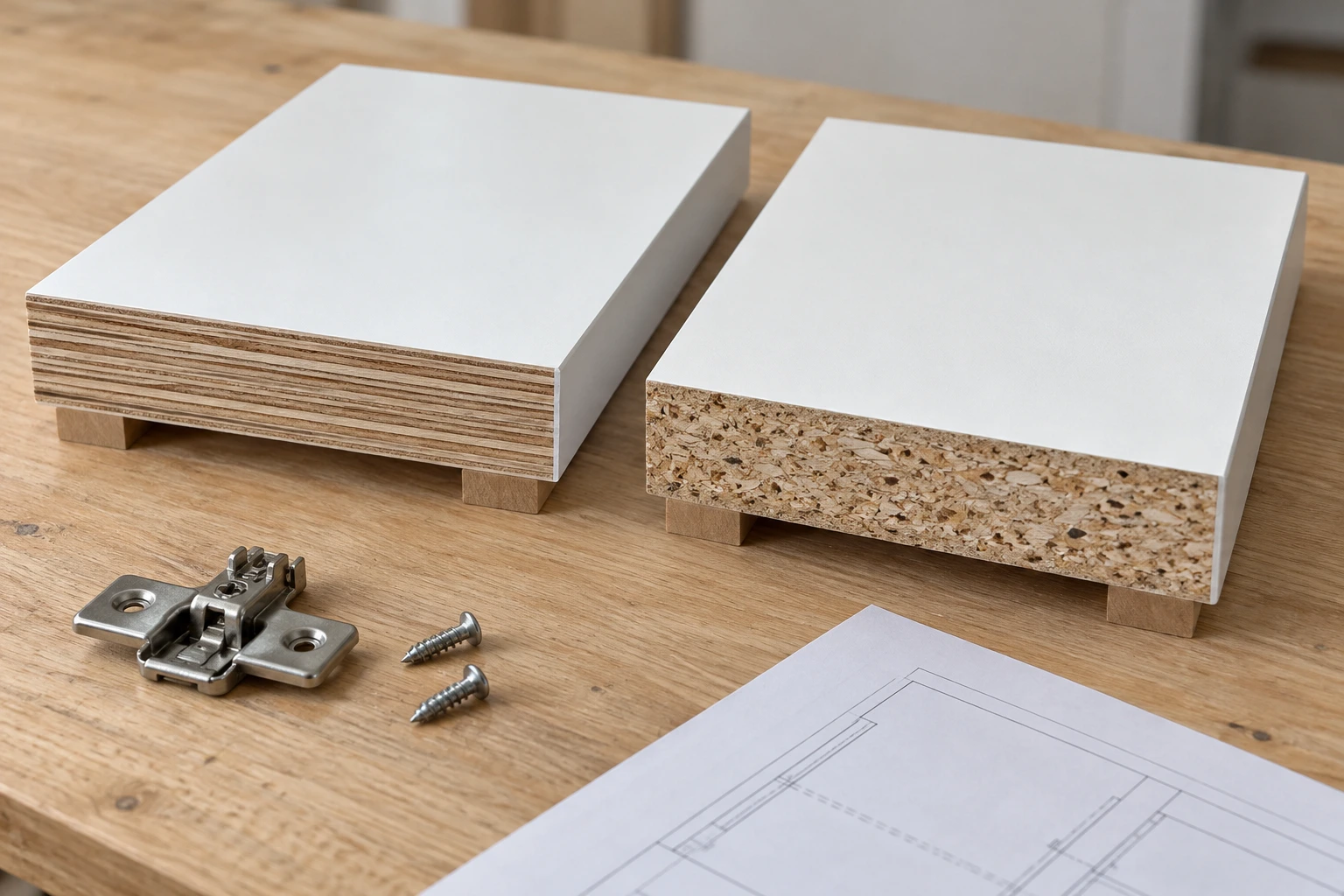
MDF is a fiber-based panel; veneer-core plywood consists of bonded wood veneers. Both need a defined product, thickness, facing and use declaration. “MDF” can mean a standard dry-use board or a product intended for humid interiors. “Plywood” can conceal different veneer constructions and bond classifications.
The European Panel Federation’s bathroom-fitment guidance makes sealing of water-exposed surfaces and edges central to MDF use. The board grade and finish must be considered together. That guidance does not certify an assembled vanity or establish that every MDF panel is suitable for the same exposure.
A current manufacturer example is MEDITE MR, whose datasheet identifies an MDF-H grade for interior humid conditions and requires sealing, priming and painting of all surfaces before installation. Its instructions also distinguish the more absorbent edges from the faces. This is an example of a documented product system, not evidence that the panel in an unnamed vanity is the same product.
For plywood, obtain both the bond classification and the producer’s intended-use statement. APA’s explanation of structural-panel bond classifications distinguishes glue-bond durability from other grade characteristics. Its structural-panel context should not be converted into a bathroom-furniture approval. A durable glue line does not establish the finished cabinet’s edge protection, coating compatibility or resistance to an unnoticed plumbing leak.
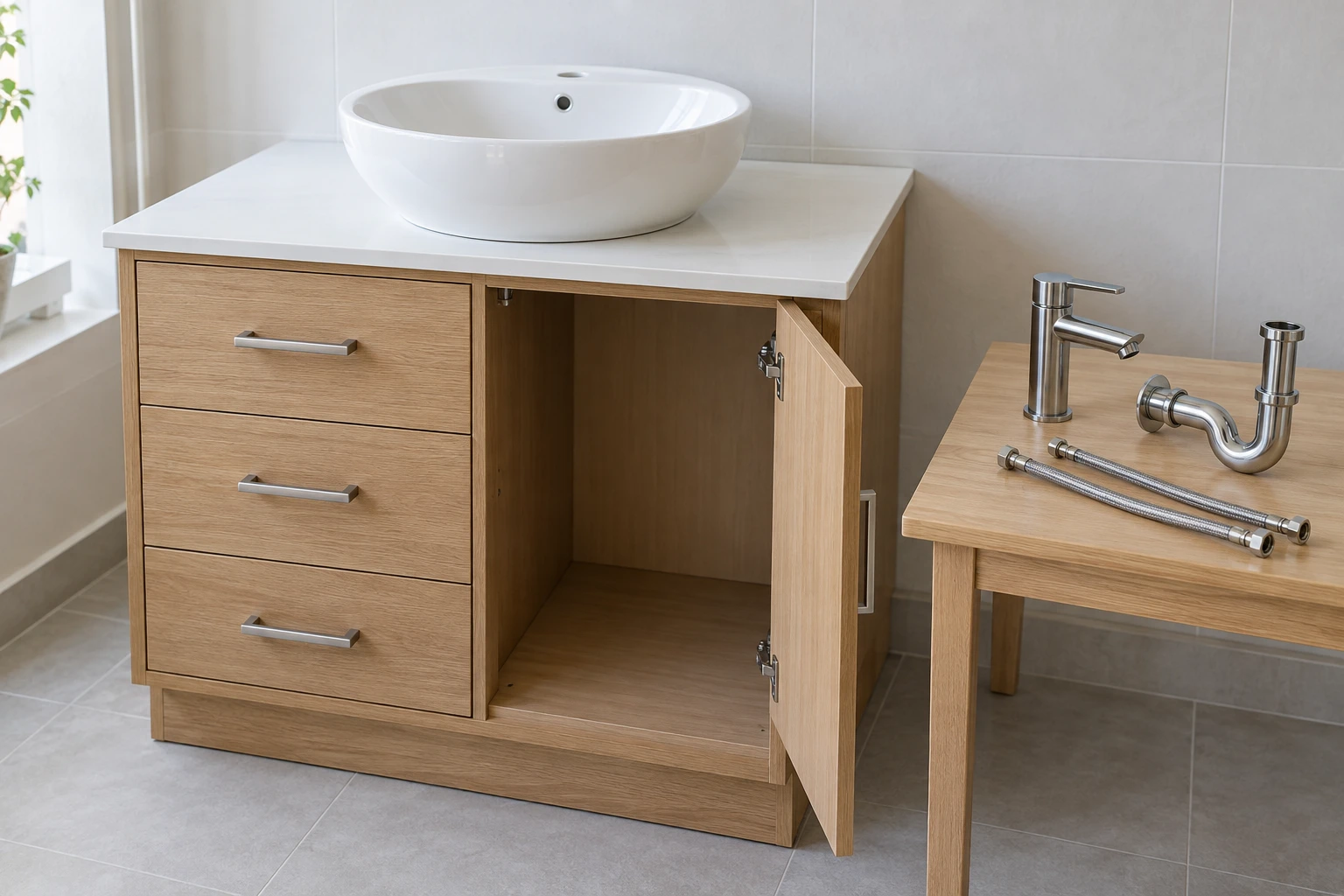
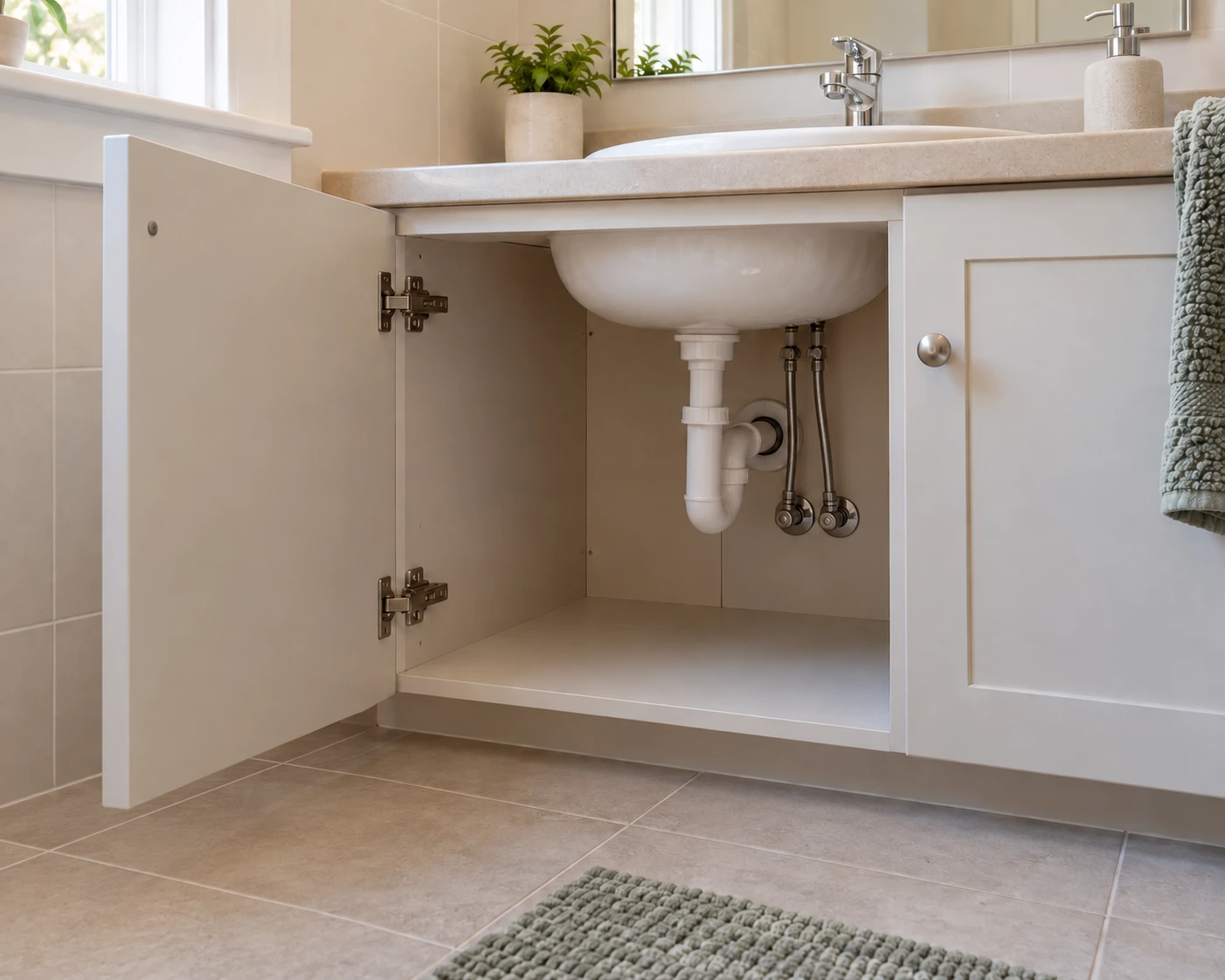
The open cabinet exposes the basin underside, pipe-opening area and maintenance access.

What changes in the moisture strategy?
Hold the basin, top, cabinet envelope, plumbing layout, cleaning practice and access requirement constant. Then compare the completed surfaces and joints. The following are review questions and conditional failure paths, rather than measured rankings of all plywood and MDF products.
| Moisture task | Specified veneer-core plywood | Specified MR MDF |
|---|---|---|
| Humid air | Verify the panel’s declared use and bond conditions; veneer construction alone does not establish suitability. | Verify the exact humid-use grade and required finish; a standard dry-use substitute is a new material proposal. |
| Exposed cut edge | A cut can expose veneer end grain and glue lines. Retain the approved edge treatment after machining. | A cut exposes the fibrous core. Follow the approved edge-sealing and coating system rather than relying on the finished face. |
| Damaged protection | Water can reach the wood through a damaged face, edge or joint; a bond declaration does not protect the whole surface. | Water can reach the core through damaged coating or an untreated cutout; the MR designation does not restore the missing barrier. |
| Basin and top | Need a compatible, accessible joint and the top supplier’s support/sealing detail. | Need the same interface control; a painted top rail must not become the unrecorded substitute for that joint. |
| Leak recovery | Inspect actual damage and construction before deciding repair or replacement; drying does not prove the original condition returned. | Inspect actual damage and construction before deciding repair or replacement; covering a changed edge with paint is not evidence of recovery. |
| Reason to reject | Unidentified board, inappropriate bond/use declaration or missing cut-edge and service details. | Unidentified board, unsuitable use grade or missing all-surface/edge protection and service details. |
The practical advantage of a plywood proposal must come from its documented panel-and-assembly response to the brief. MR MDF can remain a sensible painted-furniture option when its particular product and protective system are accepted. Without comparable finished-assembly evidence, there is no defensible universal percentage advantage or life expectancy to attach to either name.
V-09: a filled specification that includes the hidden edges
Assume a 900 mm-wide, single-basin vanity with a separate solid-surface top and an inset basin. The cabinet is outside the shower spray zone. The client’s operating brief includes ventilation, prompt removal of splashes and no hose cleaning.Support, plumbing compliance and top installation remain separate professional responsibilities.
The buyer wants an opaque painted finish. Two proposed cabinet-body options use 18 mm nominal panels and the same approved support concept. Doors, hardware and the top are held as separately specified components so the comparison does not quietly change a complete bathroom package.
| Field | Option P: plywood body | Option M: MR MDF body |
|---|---|---|
| Board declaration | 18 mm veneer-core plywood; producer/product and veneer build identified in submittal. Target EN 314-2 class 3 bond declaration; furniture-use suitability remains a separate confirmation. | 18 mm MDF-H (Option 1) to EN 622-5 proposed; producer/product identified in submittal. Require the actual panel instructions, not a green-core photograph. |
| Faces and perimeter | Opaque compatible primer/topcoat system on both faces and all perimeter edges; edge preparation and cure instructions approved with coating supplier. | Compatible sealer, primer and opaque topcoat system on all surfaces and edges; preparation and cure instructions approved with panel/coating suppliers. |
| Factory penetrations | Pipe and fixing cuts listed on drawing V-09-C; exposed core treated before assembly with the approved repair/edge system. | Same cut register; all machined core edges treated before assembly with the approved repair/edge system. |
| Top and basin | Top supplier’s joint/support detail J-02 referenced; cabinet top edges finished before the top is fitted. | Same J-02 detail and finished top edges. Joint sealant is a separate compatible interface material. |
| Bottom zone | Finished underside and bottom edges; no raw panel edge contacting the floor in the approved detail. | Same finished underside and bottom-edge requirement; no raw panel edge contacting the floor. |
| Service access | Front access to valves/trap; removable rear service panel with a recorded removal method and finished edges. | Same valve/trap access and removable finished service panel; do not glue shut after plumbing. |
| Field changes | No new cut accepted without recording location, approved treatment and completed reinspection. | Same rule. A new hole through a coated face creates a new exposed-core task. |
This is a completed proposed scheme with explicit approval fields, not proof of product equivalence. EN 314-2 bond class and MDF-H classify different properties under different standards. One label cannot be scored against the other as though they were the same test. The 18 mm thickness is also a design input, not a demonstrated support capacity.

Close a pipe-cutout defect before it disappears behind the plumbing
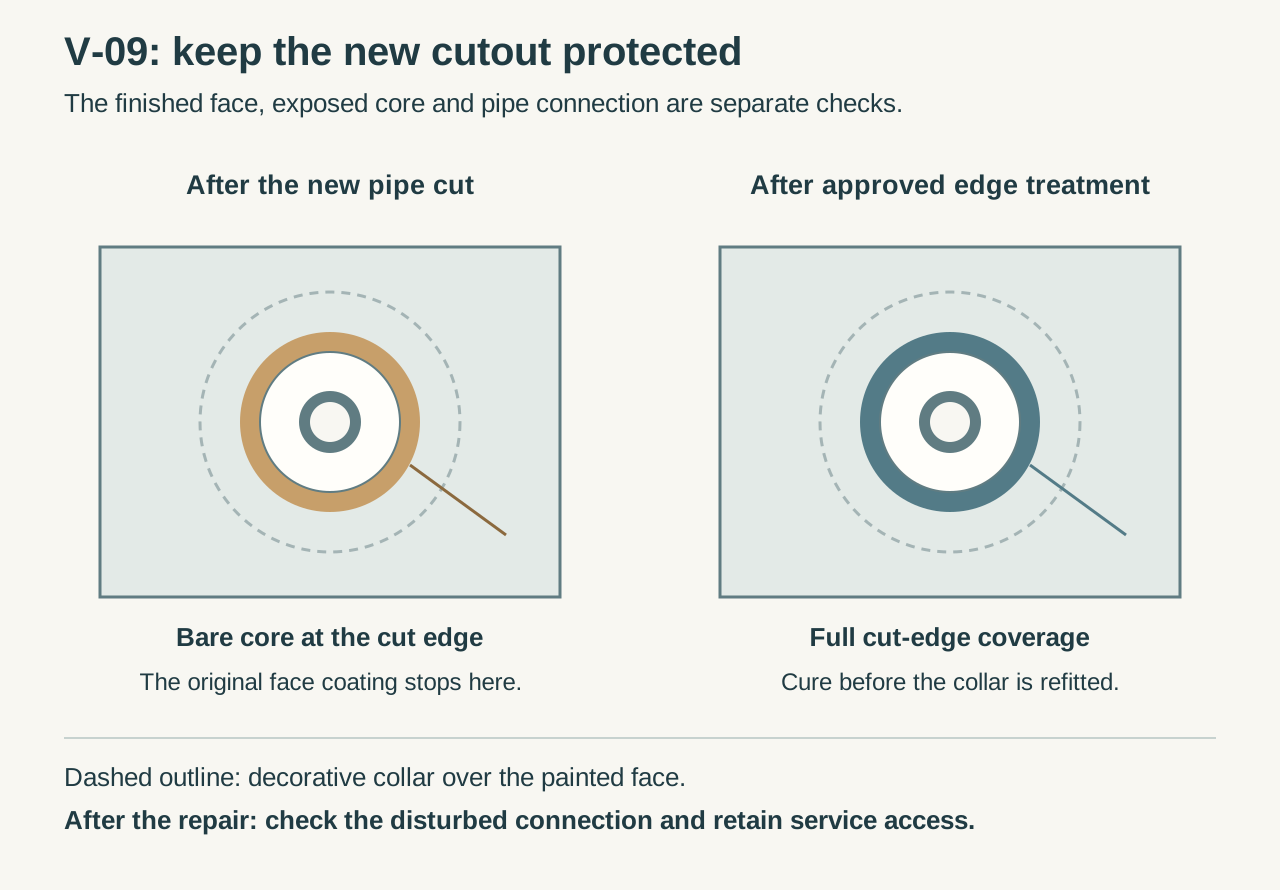
In the review, option M initially matches the finished sample. A site revision then requires a new pipe hole in its removable back panel. The installer cuts it after painting and fits a decorative collar. The visible face still looks complete, but the newly exposed core is untreated. Water reaching the hole from a connection or cleaning can bypass the original coating there.
- Record the defect: query V-09-Q1 identifies the new penetration and its bare edge. Hold closure of that service area; a collar alone is not the approved core treatment.
- Resolve the method: the cabinet and coating suppliers confirm preparation, compatible edge treatment, application sequence and cure conditions for the actual finished panel. Do not substitute a generic silicone bead as an unreviewed coating repair.
- Complete the repair: remove access obstructions, treat the full exposed cut edge and allow the specified cure before refitting the collar or service panel.
- Reinspect: record completed edge coverage and the revised drawing/photo reference; the plumber checks the disturbed connection under the applicable procedure, and the installer confirms service access remains available.
Assume those actions are completed in the review: Q1 closes with a treated cutout, checked connection and accessible panel. The buyer retains option M for the protected painted-vanity brief, subject to the remaining product and production approvals. Replacing it with plywood while leaving the new cut untreated would not resolve the recorded interface defect.
If inspection finds swollen material, lifted facing, separated veneer layers or distortion, do not classify it as merely a missing coat. Stop the water source and have the supplier assess repair or component replacement. A cosmetic patch should not conceal evidence needed to understand the failure.

Choose the assembly and the maintenance obligation together
For a protected, ventilated bathroom, either fully documented proposal can remain in consideration. Choose MR MDF where the specified painted construction, finish and interfaces meet the brief; choose plywood where its particular construction and finished system provide an accepted benefit. Reject either package when the buyer cannot identify the board or the installer cannot preserve its protection.
For the V-09 example, the material choice survives only because the cutout defect is closed and access remains practical. The same result cannot be transferred to a cabinet beside regular shower spray or a site that expects standing water. Review those exposures before asking which core is “better.”
Ask for one complete price for each accepted scheme, including factory finishing, cut-edge repair materials/instructions, service panels and installation responsibilities. Keep any additional work itemized. There is no reliable plywood-versus-MDF price premium from the material name alone, and this article supplies no market range.
Use the building-materials RFQ format to attach the V-09-style component and interface record. Send NOVARMIA the vanity section, basin/top references, board declarations, pipe locations, expected exposure and intended cleaning routine to discuss a coordinated proposal with its unresolved approval fields identified.
FAQ
Does a green MDF core prove moisture resistance?
No. Some manufacturers use color for identification, but verify the producer, product and declared grade against the supplied panels. Color does not identify a coating system, confirm a shipment’s traceability or establish that a finished vanity meets the exposure brief.
Can a liner tray replace sealing the cabinet bottom?
Treat a tray as a separate accessory. Check its fit, removal, drainage or retained-water behavior and whether it hides a leak. It does not finish a raw edge or make nearby pipe penetrations protected. Keep the underlying cabinet detail and inspection route intact.
Should replacement hinges be installed in the original holes?
Inspect the actual fixing location and panel condition first. Record the original hardware and any damage, then use the cabinet supplier’s approved fastening or repair detail. A change of hinge must not introduce an untreated cut or be used to conceal deteriorated material.
Does moisture resistance establish emissions compliance?
No. Moisture suitability and destination emissions requirements are separate checks. Obtain the documents applicable to the actual panel and finished order for the destination; an MR label, exterior-bond declaration or paint finish does not itself complete that evidence.