12 × 12 Field Sheet:144 Chips
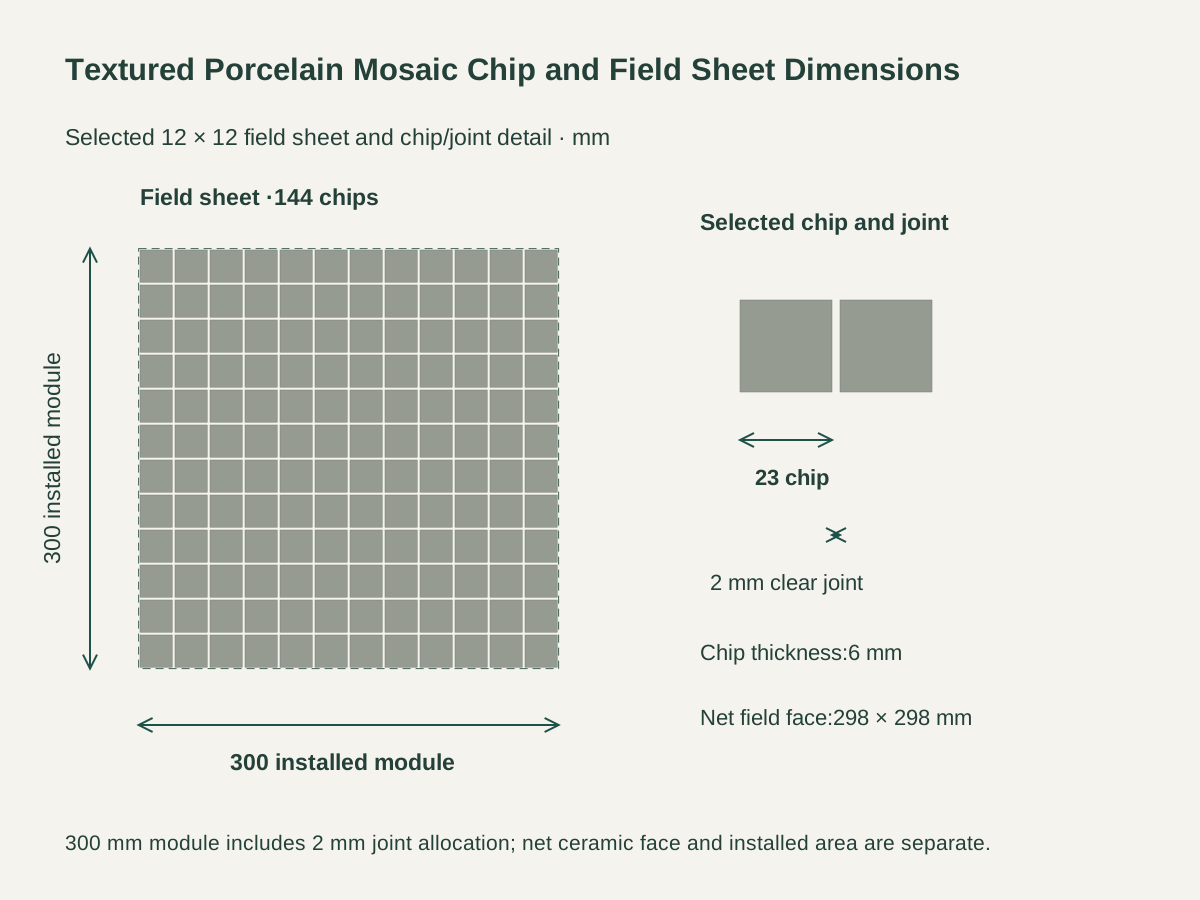
The default field has twelve rows of twelve chips. Its ceramic-and-internal-joint face is 298 × 298 mm, while a 300 × 300 mm repeating installed module includes the outer joint allocation.
Textured Through-Body Gray Porcelain Pool-Floor Mosaic
The selected face is fine-textured, matte gray, unglazed through-body porcelain. Its material and surface direction differ from a glossy blue glazed waterline tile.
Each chip is 23 mm square and 6 mm thick, with 2 mm joints, laid in a straight square grid.
Mesh holds the chips in field sheets or narrower strips for handling and layout. The actual backing and adhesive-contact arrangement must suit the complete pool lining, without assuming that all mesh or glue systems are immersion-compatible.


The default field has twelve rows of twelve chips. Its ceramic-and-internal-joint face is 298 × 298 mm, while a 300 × 300 mm repeating installed module includes the outer joint allocation.
The border strip uses four columns and twelve rows. Its 98 × 298 mm face fits a 100 × 300 mm repeating module with the same 23 mm chips and 2 mm joints, keeping the fine square grid aligned with the field.
The narrow edge format has two columns and twelve rows: a 48 × 298 mm face on a 50 × 300 mm repeating module, as a flat mesh strip for pool edges.
| Selected material | Gray textured matte unglazed through-body porcelain on mesh |
|---|---|
| Selected mesh format | 144 gray unglazed chips ·300 × 300 mm installed module |
| Selected chip | 23 × 23 × 6 mm square |
| Selected joint | 2 mm clear gap; 25 mm chip-and-joint pitch |
| Field sheet | 12× 12 =144 chips; 298× 298 mm face; 300× 300 mm installed module |
| Border and edge strips | 4× 12 =48 chips:98× 298 face/100× 300 module; 2× 12 =24 chips:48× 298 face/50× 300 module |
| Installed module areas | Field 0.09 m²; border 0.03 m²; edge 0.015 m², including joint allocation |
| Pool assembly boundary | Slip and immersion evidence, mesh contact, waterproofing, adhesive, grout and movement joints specified for the pool |
| Standards & certificates | Matched to the ordered model: tell us the standards or certificates your market or project requires, and we confirm in writing which documents are available for this configuration before you order. |
 Open product drawing ↗
Use the selected 2 mm gap at sheet edges as well as between chips. The 300 mm field module is separate from the 298 mm face, so adjacent sheets need the correct spacing to retain a consistent square grid.
Coordinate the substrate, waterproofing, bedding adhesive, mesh backing and grout for the actual immersion assembly.
Show floor falls, drains, perimeter cuts and movement joints on the lining plan. The narrow formats remain flat mesh pieces; changes in plane, coves and any shaped edge details need their own selected components.
List 144-chip fields, 48-chip borders and 24-chip edges as three counts, with installed module areas of 0.09, 0.03 and 0.015 m² including their joint allocation.
Retain the unglazed matte-gray texture and through-body material requirement with the accepted chip sample.
Record the backing, mesh and glue arrangement and the adhesive contact required. Waterproofing, bedding, grout, movement joints and installation are their own lines unless explicitly included.
Keep the shade and texture range, format counts and pool-zone references together, count spare sheets and strips on their own, and record chip-edge protection, destination and delivery stages on the order.
The selected material is matte-gray, unglazed, textured through-body porcelain in a fine 23 mm square grid. It is not the glossy blue glazed 48 mm mosaic or a shaped waterline-corner system.
Twelve 23 mm chips plus eleven 2 mm internal joints total 298 mm. A 2 mm outer joint allocation brings the repeating installed pitch to 300 mm. Net ceramic face and installed coverage therefore remain separate quantities.
The field sheet has 12 × 12 =144 chips; the border has 4 × 12 =48; the edge has 2 × 12 =24. Their repeating modules are 300 × 300, 100 × 300 and 50 × 300 mm respectively.
The textured face is designed for pool floors and steps. Tell us the barefoot slip rating your pool designer needs, such as DIN 51097, and we confirm whether a matching test report is available for the production batch.
No. They are narrower flat mesh formats using the same square chips. A pool cove, bullnose, step edge or other change in profile needs its own shaped component and lining detail.
The mosaic is the finish layer; watertightness comes from the pool's waterproofing membrane underneath. We supply the mosaic with a pool-rated adhesive and epoxy grout recommendation and can include those products in the same order.
 Slotted Porcelain Pool Overflow Grating Tiles
 Blue & White Square Glass Pool Mosaic Tiles
 Blue Porcelain Waterline Tiles with Matching Corner Pieces
 Rounded-Nose Porcelain Pool Coping Tiles