R 300 Main Outer Face
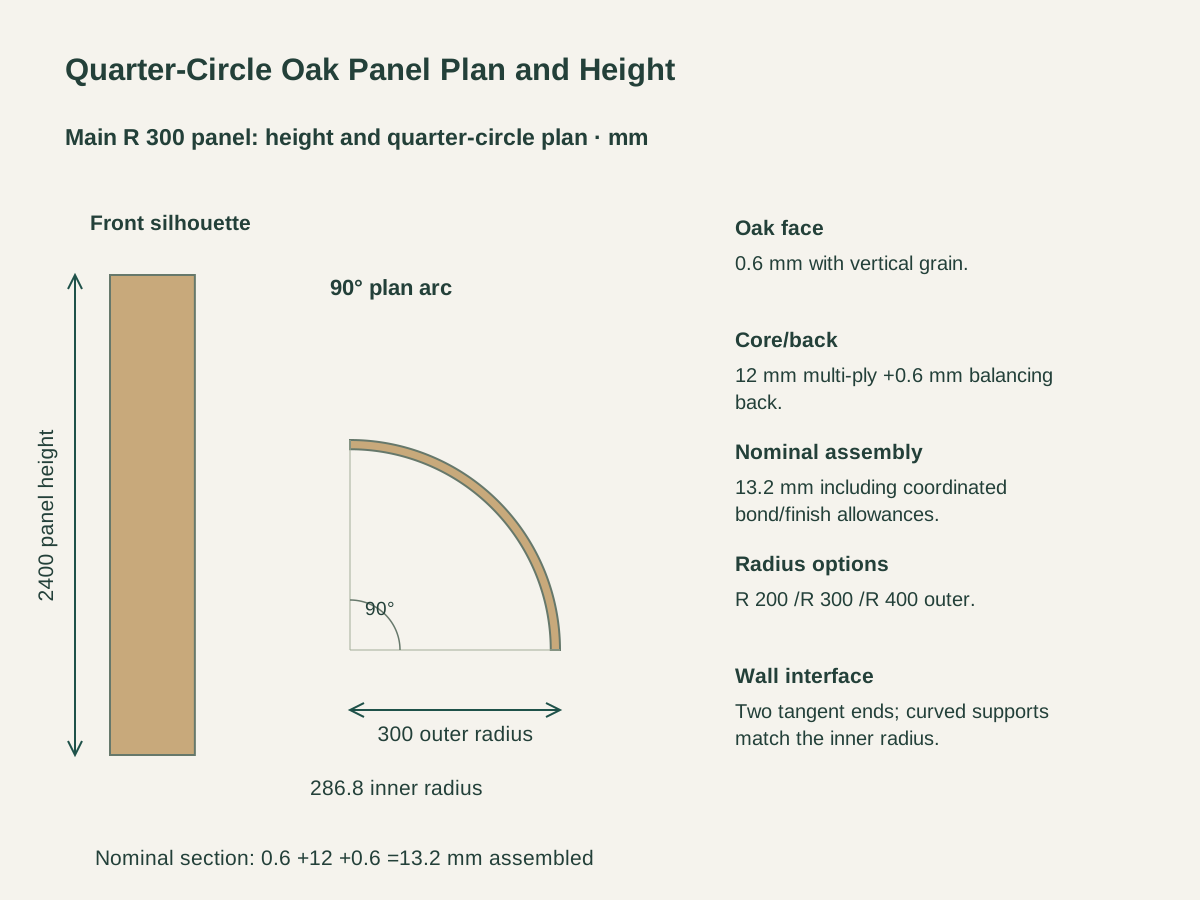
The main panel has a 300 mm outer face radius and 286.8 mm inner radius. Both follow the same center through the 90-degree plan arc.
Curved Oak-Veneer Wall Corner Panels
The formed panel wraps a 90-degree convex wall corner as one continuous quarter-circle. Its 2400 mm height and two tangent vertical ends establish the transition to the adjoining wall-panel runs.
A 0.6 mm oak face layer, 12 mm laminated multi-ply core and 0.6 mm balancing back form the nominal 13.2 mm bonded section. Bond and finish allowances are coordinated within that nominal component specification.
The oak face runs vertically over the curved form. The material reference carries the grain, finish, edge treatment and tangent-end junctions, with curved supports and attachment points assigned to the wall detail.
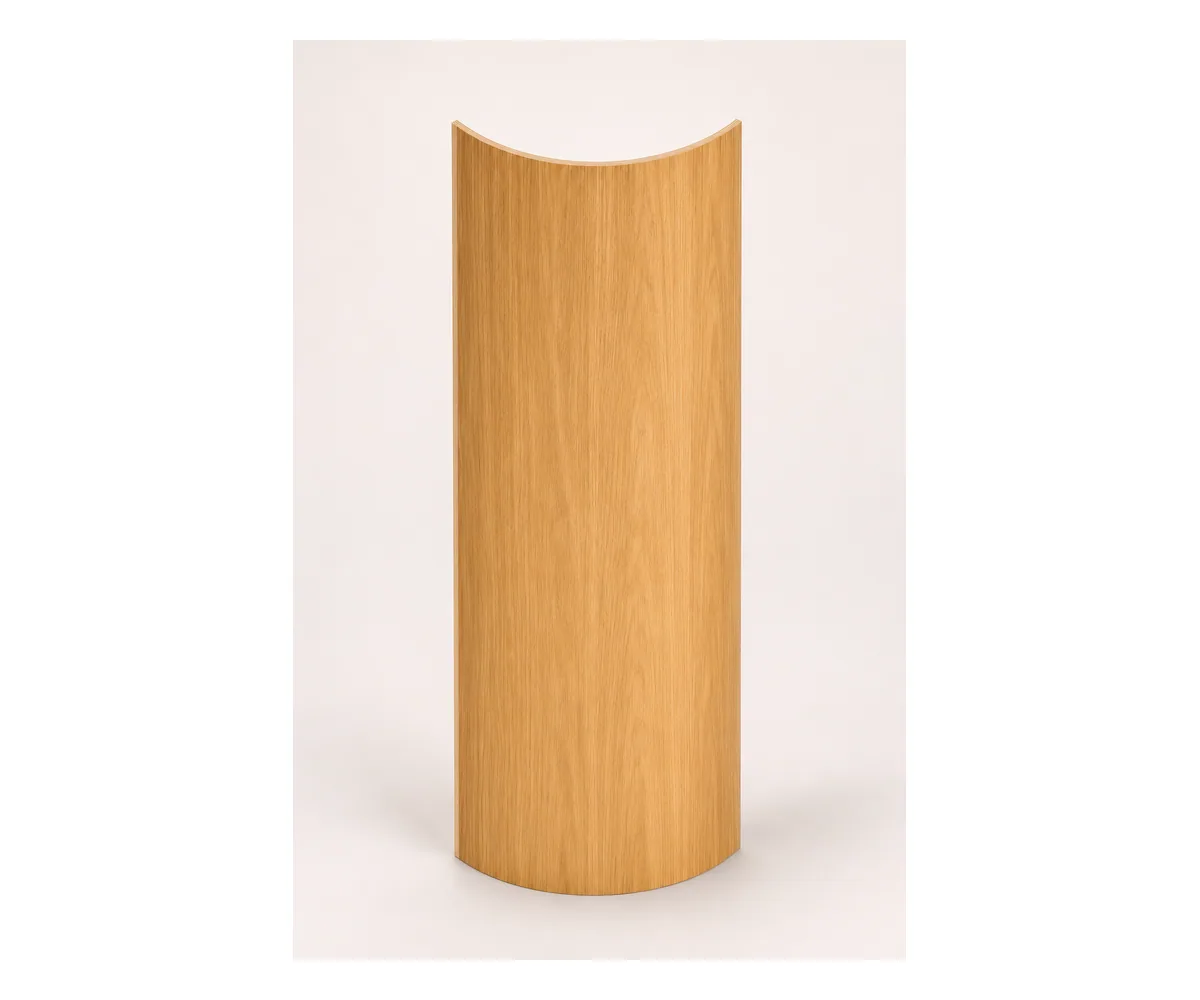
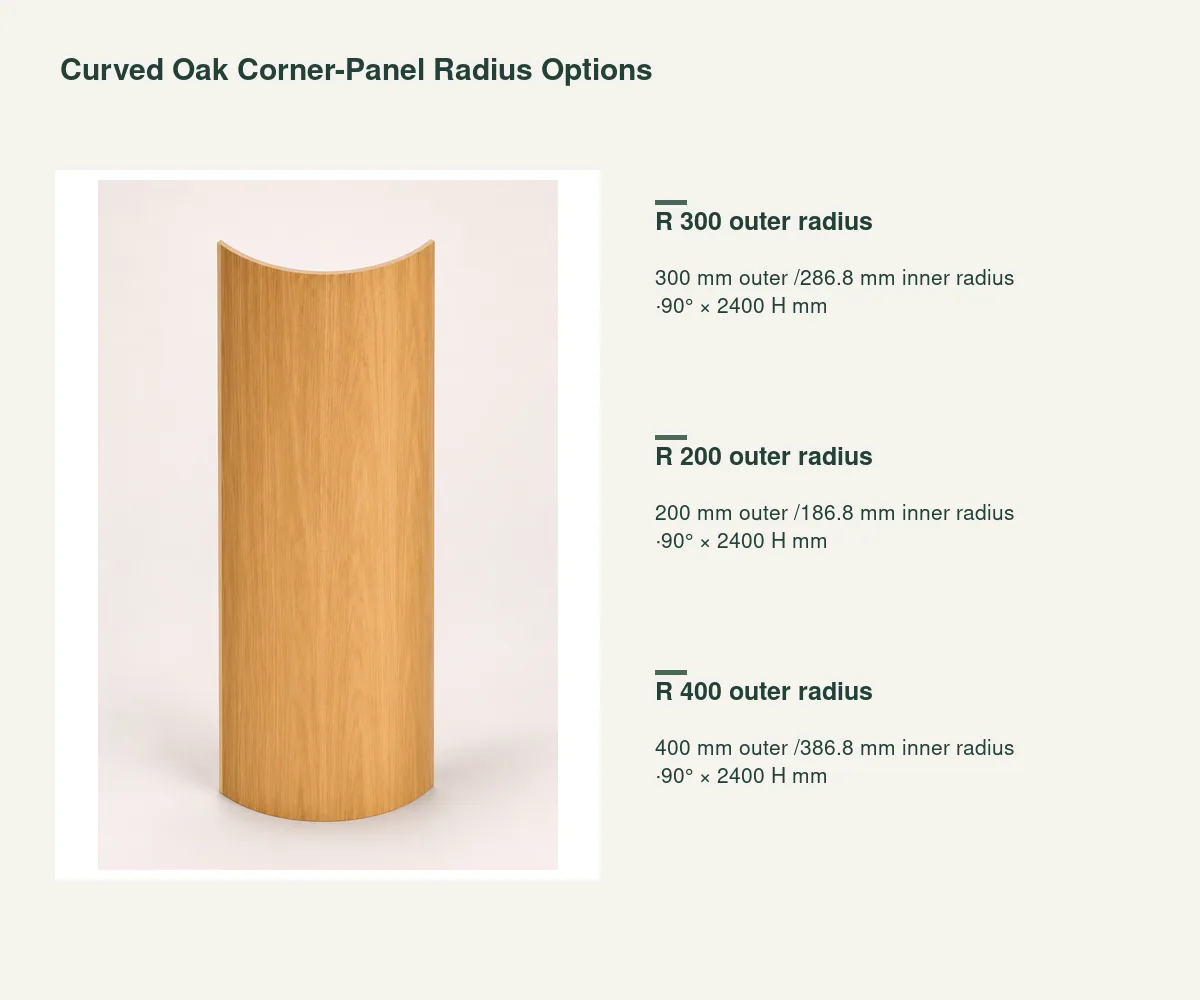
The main panel has a 300 mm outer face radius and 286.8 mm inner radius. Both follow the same center through the 90-degree plan arc.
The tighter option has a 200 mm outer radius and 186.8 mm inner radius. It retains the 2400 mm height and nominal 13.2 mm bonded assembly.
The broader option has a 400 mm outer radius and 386.8 mm inner radius. The wall junctions and curved supporting geometry follow this larger arc.
| Panel form | One convex 90-degree quarter-circle wall corner panel |
|---|---|
| Outer and inner radius | 300 mm outer /286.8 mm inner radius ·90° × 2400 H mm |
| Panel height | 2400 mm with vertical oak grain |
| Nominal bonded section | 0.6 mm oak face +12 mm multi-ply core +0.6 mm balancing back =13.2 mm assembled |
| Radius relationship | Inner radius =outer radius -13.2 mm; common arc center |
| Bond and finish allowance | Coordinated within the nominal 13.2 mm component specification |
| Wall interface | Two tangent vertical ends; radius-matched curved supports and attachment detail |
| Supply unit | One formed panel by radius, height, grain, finish and wall/corner reference |
 Open product drawing ↗
The wall plan establishes the corner, arc center and two tangent vertical ends. Adjacent flat panels, joint gaps and corner alignment use those same references.
The curved backing/support detail follows the inner face: 286.8, 186.8 or 386.8 mm for the three radius options. Fixing locations, support spacing and wall interfaces are coordinated with the formed panel assembly.
The elevation identifies vertical grain, panel height, ceiling/base junctions and connections to adjoining finishes. The retained sample records oak appearance, edge treatment, finish and the curved-to-flat junction.
Count formed panels by wall/corner reference. List the outer and inner radius, 90-degree arc, 2400 mm height and adjoining wall-panel runs.
Quote the 0.6/12/0.6 mm nominal layer build and 13.2 mm assembled section. Carry oak grain, finish, balancing back and edge references together.
Schedule radius-matched supports, attachment points, tangent joints and base/ceiling interfaces. The wall condition and adjoining flat panels use the same corner detail.
Support the curved form during packing and protect the oak face and tangent ends. Mark radius, height, corner reference, panel count and destination on the package.
One panel forms a continuous convex 90-degree quarter-circle wall corner. It is 2400 mm high with two tangent vertical ends for the adjoining wall runs.
The nominal bonded build combines 0.6 mm oak face, 12 mm laminated multi-ply core and 0.6 mm balancing back. Bond and finish allowances are coordinated within that nominal component specification.
Subtract the nominal 13.2 mm assembled section from the outer radius. The R 300 panel therefore has a 286.8 mm inner radius; R 200 and R 400 correspond to 186.8 and 386.8 mm respectively.
The supporting curve follows the inner face radius. The wall detail coordinates that support with the formed panel, attachment points, tangent joints and adjoining finishes.
The oak grain runs vertically over the 2400 mm height. The retained material reference records grain, finish, edge treatment and the curved-to-flat junction.
List panel count, height, outer/inner radius, wall/corner reference and adjoining finishes. Include the curved support and attachment detail, grain/finish reference, protected packing and destination.
 Custom Flat Wood Veneer Wall Panels
 GP-JT147SGS Solid Wood Wall Panels
 Custom Flat Tongue-and-Groove Wood Wall Boards
 Custom 3D Solid-Wood Mosaic Wall Panels